


Step-By-Step Guide To Calculating Overtime Pay

When an employee works more than their regularly scheduled hours, overtime pay ensures they are properly compensated.
This provides employees with protection against overwork and communicates that the employer values their additional effort and the time they spend working after hours.
In addition, receiving overtime pay helps maintain the employee’s financial stability and encourages healthy work-life balance practices.
Federal laws in the United States also outline the process for calculating overtime pay to help protect employees.
The Fair Labor Standards Act defines the minimum wage an employer must pay an employee, whether an employee is entitled to overtime wages, and the maximum number of hours an employee may work.
The United States Department of Labor strictly enforces these provisions to provide employees with the legal protections they need, hold employers accountable, and ensure compliance with the law.
Understanding Overtime Pay

Overtime pay is money you earn when you work more hours than usual in a day or week.
Overtime rules apply to both time and part-time workers who are not exempt from overtime pay. Some salaried employees and professionals might not get overtime pay.
It’s essential to know your job type to ensure you get paid fairly. Most employers pay 1½ times your hourly rate for overtime.
So if you work hours, your pay will show that you worked more than a typical employee.
Keep in mind that overtime rules vary depending on where you live and the labor laws that apply.
For instance, the Fair Labor Standards Act sets overtime standards for US employers. Some states offer protections, like higher base pay and daily overtime compensation.
Calculating Overtime Pay For Hourly Employees
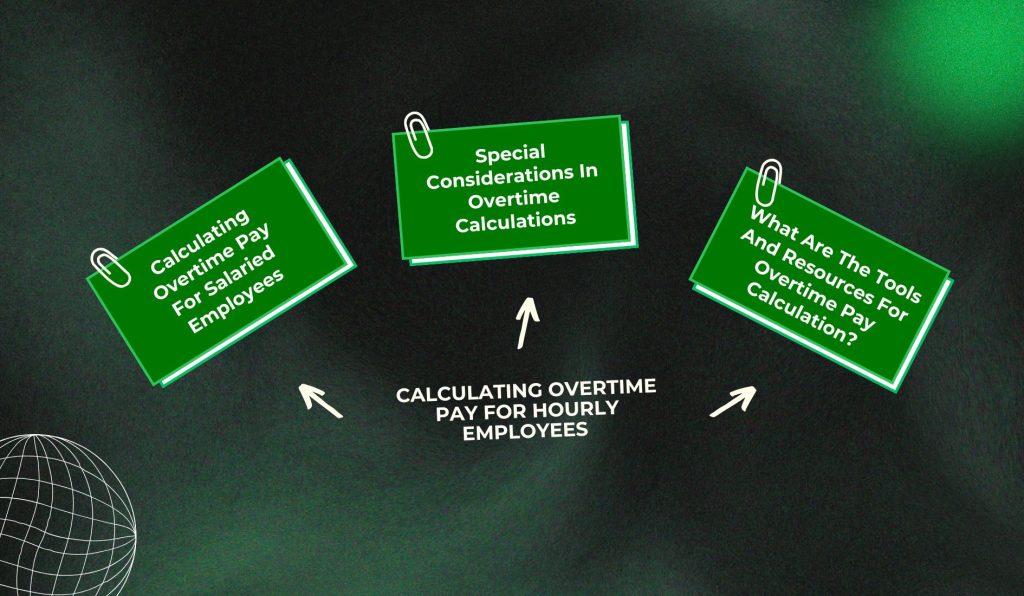
To determine the value of an employee’s regular rate, it must then be multiplied by 1.5 to get the employee’s overtime rate.
Overtime rate having been established, the next step will be to determine your employee’s total hours worked by subtracting the total hours worked from the scheduled work week.
The employer computes the overtime rate by multiplying the total work hours.
Then the employer calculates the total pay per pay period by adding the employee’s overtime pay to their regular earnings.
For example, if an employee has a base wage of 200 rupees and generates an account of 300 Rupees/hour overtime (200 x 1.5) and works 5 hours of overtime during that same week (300 x 5 = 1500), the employee receives an extra 1500 Rupees after accounting is completed.
This practice allows the employer to ensure they’re paying their employees appropriately for any work performed outside of regular hours.
Additionally, the method helps employers provide employees with accurate figures to verify their payments.
And to have documented evidence if there is a need to resolve differences between an employer and an employee.
1. Calculating Overtime Pay For Salaried Employees
To ascertain the employee’s weekly fixed salary under the employment contract, calculate the regular hourly wage by dividing the weekly salary by 40 hours.
An employee must multiply their regular hourly wage by 1.5 to receive overtime pay. Multiplying the total number of overtime hours worked by the overtime compensation yields the overtime rate.
The employee’s regular hourly wage of ₹500 can be calculated by dividing his weekly payment of ₹20,000 by forty.
Next, multiply your regular hourly wage by 1.5 to determine the overtime compensation.
That’s ₹750 per hour. The fourth step is to multiply the overtime pay per hour by five if the employee works five overtime hours.
Consequently, the total amount of overtime compensation would be ₹3,750.
2. Special Considerations In Overtime Calculations
In computing overtime, bonuses, and commissions, special care is required. In particular, employers must take into account non-discretionary bonuses and commissions in computing the regular rate of pay.
Hence, this will increase the base rate, directly affecting overtime. As EddySoftware noted, failure to account for these earnings often results in overtime compliance issues.
Moreover, the employees must always verify things. Their earnings should reflect properly in overtime pay.
Shift differentials, too, play a critical role in computing overtime. When employees receive additional compensation for night or weekend shifts, it boosts their regular earnings.
Employers must therefore account for shift differentials in computing overtime pay. Otherwise, the resulting overtime pay will come up short of legal requirements.
Overtime pay for piece-rate workers, on the other hand, requires a slightly different computation.
Employers must first compute the average hourly rate based on total weekly earnings. They must then apply the overtime premium based on the computed rate.
Moreover, piece-rate workers will still receive fair overtime pay in this process.
3. What Are The Tools And Resources For Overtime Pay Calculation?
First, online overtime calculators provide a fast and accurate way to estimate additional income.
They eliminate confusion and save time, and employees can easily understand their income without having to perform calculations.
In addition, reputable online platforms automatically update calculators to reflect current labor laws.
Second, downloadable overtime templates enable employees to calculate their income manually and clearly.
The templates provide a structured format for hours, rates, and totals, minimizing the risk of errors.
They are also useful for record-keeping and future references. Finally, professional help can be very valuable in complex situations.
HR personnel provide clear information about company policies and efficiently address payroll questions.
Similarly, experts provide guidance to employees in case of disputes or labor law issues.
Things To Remember About Calculating Overtime Pay
In summary, knowledge of overtime regulations enables employees to safeguard their income and prevent payroll discrepancies.
Furthermore, awareness of computation procedures enables employees to check their income with confidence.
Throughout this tutorial, we have discussed eligibility, rates, exceptions, and step-by-step computation procedures.
Thus, take control of your situation by utilizing trustworthy calculators, forms, and expert advice. These resources make computation easier and minimize expensive errors.
Fair payment encourages the employees to put in their best efforts. Thus, the employees do stretch their hours without hesitation.
Finally, precise overtime computation enhances financial planning and workplace fairness.
An employee often works more than their regularly scheduled hours. Thus, overtime pay ensures they are properly compensated.
Share this article:





![AMEX GyFTR Latest Update In 2026 [EXPLAINED]](https://www.financeteam.net/wp-content/uploads/2026/06/Fetures-4-160x160.jpg)