- Quick Decision Checklist About Debt Consolidation Loan
- What Types Of Debt Consolidation Loan Options
- 1. Personal Loans (Unsecured):
- 2. Balance Transfer Credit Cards:
- 3. Home Equity Loans / Helocs:
- 4. Debt Management Plans & Credit Counseling:
- The 7-Point Lender Evaluation Checklist (Parameters & Weights)
- Real Examples & Mini-Calculator (3 Borrower Scenarios)
- Safety & Scams: Red Flags And What To Do If You’re Targeted
- Choosing By Borrower Profile: Debt Consolidation Loan
- 1. Excellent Credit
- 2. Good Credit:
- 3. Fair/Bad Credit:
- Post-Consolidation Plan (90-Day Behavioral Playbook)
- Cost Comparison Table
- Expert Tips & Final Checklist
- Frequently Asked Questions About Debt Consolidation Loans
- 1. What Is A Debt Consolidation Loan And How Does It Work?
- 2. Will A Debt Consolidation Loan Hurt My Credit Score?
- 3. How Do I Calculate If A Debt Consolidation Loan Will Save Me Money?
What A Debt Consolidation Loan Is And Who It Helps
Debt consolidation allows borrowers to combine multiple debts into a single loan or payment plan.
This is because you will replace several bills with a single monthly payment. For clarity, the Consumer Financial Protection Bureau provides a clear explanation of this process.
This is because you will only be making one payment as opposed to having to keep track of several due dates. In addition, you will be able to enjoy a lower APR.
This is why debt consolidation can be an effective way to simplify your budget and reduce financial stress.
This article seeks to inform you about Debt Consolidation Loans and the procedural nuances involved in detail.
Quick Decision Checklist About Debt Consolidation Loan
First, use this quick checklist before you choose debt consolidation.
Answer yes or no to each question honestly.
- Do you pay high interest on your current debts?
- Can you qualify for a lower APR right now?
- Do you have a stable income every month?
- Are you ready to close paid credit cards?
- Can you resist taking new credit after consolidation?
Now, give yourself one point for each yes answer. Hence, add your total score carefully.
If you score 4 to 5, consolidation can strongly help you. On the other hand, when you score 2 to 3, think carefully and compare options. Furthermore, if you score 0 to 1, improve habits before consolidating.
Finally, choose the option that supports long-term financial control.
What Types Of Debt Consolidation Loan Options
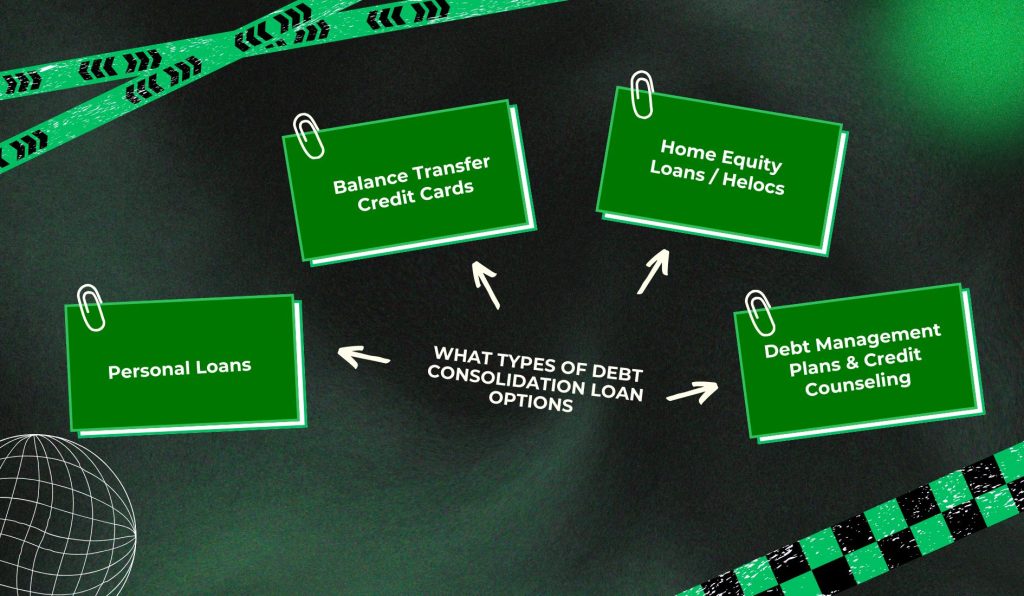
There are several options for debt consolidation. Here are the major debt consolidation loan options.
1. Personal Loans (Unsecured):
On the basis of lender choice and the credit score, unsecured loans charge APR ranges up to 36%, and it starts at 6%. A three-year loan plan with 12% is the most average rate.
With the term of repaying, one can take two years to upto seven years until the term of the loan ends, but with fixed monthly payments.
To get money for emergency purposes, or some big expenses, or to consolidate high-interest debt, these types of loans can be meaningful.
2. Balance Transfer Credit Cards:
Balance transfer credit cards offer you a 0% intro APR for a fixed period of time, such as 12 to 21 months.
During the promotional period, you don’t need to pay interest on the balance you transfer.
But there is a transfer fee, which varies by card, typically between 3% and 5% of the amount.
To determine whether it’s a good idea, you can compare the fee to the amount of interest you pay on your debt. If you save more money in interest than you pay in fees, it’s a good idea.
3. Home Equity Loans / Helocs:
Home equity loans and HELOCs are secured loans because they use your home as collateral, as explained by the Consumer Financial Protection Bureau.
This means that if you do not pay back the money, you will lose your home. But the interest rates on these loans are lower compared to credit cards.
This means that you will save money if you are careful with the payments.
4. Debt Management Plans & Credit Counseling:
You may prefer a home equity loan or HELOC if you qualify for a significantly lower rate, as explained by the Consumer Financial Protection Bureau.
Also, select this option if you require a substantial amount of money and have good repayment capacity.
Moreover, these loans are ideal if you require fixed payments or flexible access to money. However, do not select this option if your income appears unstable or risky.
The 7-Point Lender Evaluation Checklist (Parameters & Weights)
Use a simple scorecard to easily compare loan offers. First, assign a score of 1 to 5 to each factor.
Then, calculate the weighted score of each factor by multiplying the score by its weight and adding the scores.
Assign the highest weight to APR (25%), as cost is the most important factor. Next, assign a weight of 15% to fees and the loan term to manage the total interest.
Also, assign a 20% weight to monthly affordability, as consistent income will always protect you.
Next, assign a 10% weight to both collateral risk and approval chances. Finally, assign a 5% weight to lender reputation, since it still counts.
Real Examples & Mini-Calculator (3 Borrower Scenarios)

Let’s look at three examples to better understand consolidation. Also, check your numbers with calculators from Bankrate and NerdWallet.
First, you owe $10,000 at 24% APR. You pay $300 per month and about $3,600 in interest.
If you consolidate at 12%, you may pay $332 monthly. But you can reduce the interest to about $1,980.
Next, you owe $4,000 at 20% APR. You pay $200 per month and about $1,600 in interest.
If you consolidate at 15%, you may pay $111 monthly. So, you lower payments and reduce total interest.
Finally, you owe $15,000 at 22% APR. You pay $450 per month and about $6,000 in interest.
If you use home equity at 8%, you may pay $304 monthly. But you risk your home because the loan uses collateral.
Safety & Scams: Red Flags And What To Do If You’re Targeted
Be aware of red flags such as upfront fees, high-pressure sales, or “guaranteed” settlements.
Also, be cautious of any company that tells you to stop paying your creditors. As Investopedia says, these red flags indicate a scam.
If you believe you have been scammed, document the evidence and act quickly.
Second, report the scam to the Federal Trade Commission and the Consumer Financial Protection Bureau.
Finally, seek safe help through the National Foundation for Credit Counseling referral service.
Choosing By Borrower Profile: Debt Consolidation Loan
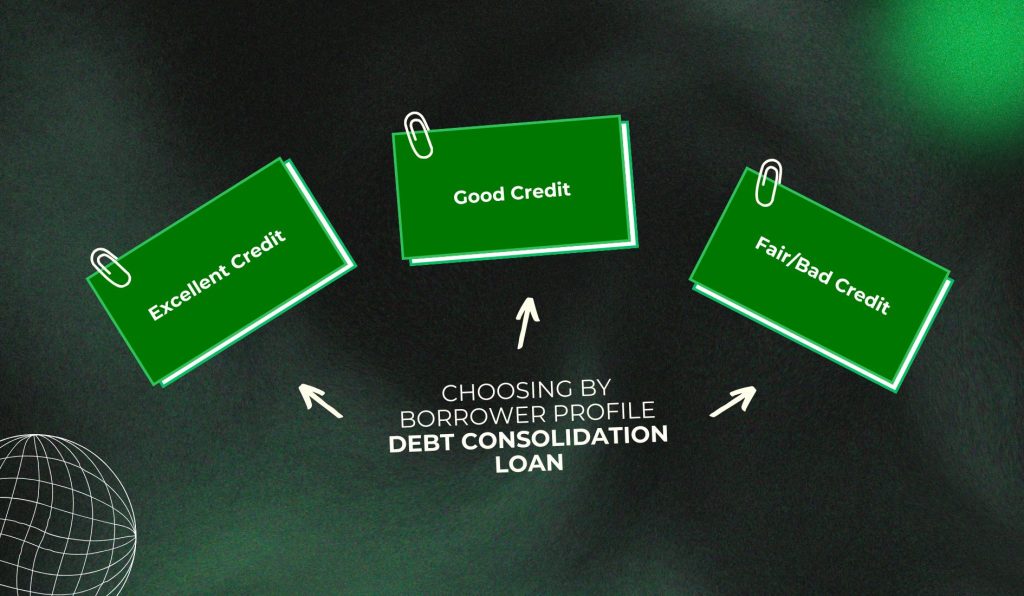
Lenders consider several criteria when offering loans to borrowers. Below are the mentioned points that play a crucial role in the process of debt consolidation loans.
1. Excellent Credit
When you consolidate, try to get the shortest term with the lowest APR that you can qualify for.
You can compare online lenders and other options, such as LightStream and Discover to get the best APR.
A shorter term will always save you more money in interest, even if your monthly payments are still manageable.
2. Good Credit:
Also, shop credit unions and fintech lenders for competitive rates and lower fees. Credit unions may provide excellent personal loan terms to their members.
Fintech lenders can provide fast online approvals and excellent APRs, too. Compare all of them before you pick your consolidation loan.
3. Fair/Bad Credit:
You might want to try a credit union or a secured loan if the terms seem reasonable. You can also consult a credit counsellor for help.
But you should steer clear of predatory lenders who charge high rates and use strong-arm tactics.
Post-Consolidation Plan (90-Day Behavioral Playbook)
Just follow this easy 6-step plan to prevent yourself from sliding back into debt. First, freeze or lock your credit cards to prevent impulse buying.
Then, set up automatic payments for all your loans to prevent late charges. Next, create an emergency fund of $1,000 to meet unexpected expenses.
After that, monitor your budget every month and make changes accordingly. Also, make extra payments using the snowball or avalanche system.
Finally, check your credit report regularly to monitor your progress and spot any mistakes.
Cost Comparison Table
Make a simple table for comparing costs that readers can duplicate and use. Use columns for product type, APR range, fees, target borrower, and example total cost.
Compare personal loans, balance transfer credit cards, and home equity loans in the same table.
Add sample numbers to make it easier for readers to understand the total repayment cost.
Finally, make this table available as a downloadable PDF or picture. Use this table as a lead magnet to build your email list. Keep the table design simple so readers can easily compare their options.
Expert Tips & Final Checklist
Use these quick expert tips before you sign any loan. First, ask clearly about any prepayment penalty.
Then, get the full APR in writing, not just verbally. Also, compare the effective APR, including all fees.
Next, ask if the lender offers a rate discount for autopay. After that, think carefully about co-signer risks and responsibilities. Finally, read the full agreement slowly before you sign.
Frequently Asked Questions About Debt Consolidation Loans
Here are the answers to some of the most commonly asked questions about debt consolidation loans.
1. What Is A Debt Consolidation Loan And How Does It Work?
A Debt Consolidation Loan combines multiple debts into one single monthly payment. You repay the Debt Consolidation Loan with a fixed APR and a clear repayment term.
2. Will A Debt Consolidation Loan Hurt My Credit Score?
A Debt Consolidation Loan may cause a temporary credit score dip due to hard inquiries and account updates.
You can improve your credit score over time when you manage the Debt Consolidation Loan with timely payments.
3. How Do I Calculate If A Debt Consolidation Loan Will Save Me Money?
You should compare your current total repayment cost with the total cost of the Debt Consolidation Loan, including fees.
You can multiply balances by APR and term length to measure how much the Debt Consolidation Loan saves you.
Share this article: