- Types Of Bank Accounts
- 1. Checking Accounts
- 2. Savings Accounts
- 3. Money Market Accounts
- 4. Certificates Of Deposit (CDs):
- 5. Business Accounts
- Choosing The Right Bank Account For Your Needs
- Expert Tips For Managing Your Bank Accounts
- Frequently Asked Questions
- 1. What Is The Difference Between A Checking And A Savings Account?
- 2. Can I Earn Interest With A Checking Account?
- 3. What Is A High-Yield Savings Account?
- 4. Are There Fees Associated With Money Market Accounts?
Understanding Different Types Of Bank Accounts And Their Uses
Bank accounts enable people to manage money safely and conveniently. Such choices help one towards better control over income and expenditure.
Savings, current, and other bank accounts serve daily payments, savings goals, and future plans accordingly. While some accounts focus on ease of transactions, others help grow savings.
Types Of Bank Accounts
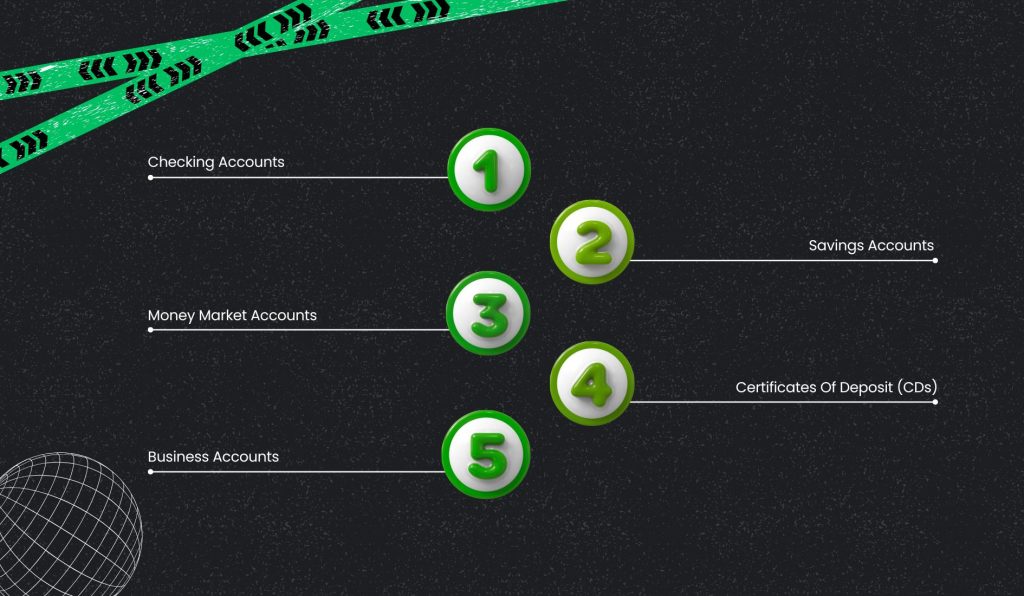
There are different types of bank accounts. Each ot the bank accounts serves a specific purpose. Here are some of the most relevant types of banks worldwide.
1. Checking Accounts
Checking accounts are meant to help people cover daily expenses like shopping, bill payments, and regular transfers.
These accounts are used by people to receive their salaries and pay for everyday expenses with ease.
Hence, these accounts provide easy access to cash at any time, without waiting. Moreover, Banks issue debit cards for cash withdrawals and payments directly from checking accounts.
Thus, customers also apply checks to those payments where either cards or cash are not acceptable.
Online banking allows users to manage money transfers, pay bills, and track spending at any time.
Furthermore, the mobile applications enable customers to view their balance and receive transaction notifications instantly.
However, most checking accounts do not earn interest, focusing instead on convenience and flexibility. But some banks offer interest-bearing checking accounts with minimum balance requirements.
Examples of premium checking accounts include those that offer additional benefits, such as lower fees and higher withdrawal limits.
Additionally, the student checking accounts help young users with low fees and lenient account rules.
2. Savings Accounts
Savings accounts allow individuals to save their money in a secure manner while also earning interest on their deposits over time. Thus, banks offer a variety of savings accounts to meet long- and short-term financial goals.
Individuals save in savings accounts in preparation for the future. They function as emergency funds. Hence. They promote saving since withdrawals are restricted in frequent transactions.
Limited access also helps account holders avoid unnecessary spending. Banks pay interest on the money saved by depositors in savings accounts.
Traditional savings accounts offer moderate returns and easy access to funds through banks.
High-yield savings accounts pay a higher interest rate than regular savings accounts. Online savings accounts do not have branches and offer high interest rates.
In many cases, individuals prefer to bank online because it is more convenient and yields higher returns.
Saving accounts provide security for money and guard against loss. These accounts also help develop the habit of saving money.
3. Money Market Accounts
Money market accounts help individuals earn higher interest while maintaining cash accessibility.
Banks design these accounts by incorporating the features of both checking and savings accounts.
People also use money market accounts to grow their savings with more flexibility. These accounts usually offer higher interest rates than regular savings accounts.
Banks allow limited check writing from money market accounts. Thus, they also issue debit cards that provide quick access to cash. These features are used by the customers for occasional payments and withdrawals.
Banks limit the number of free transactions per month to discourage frequent cash withdrawals from savings accounts.
With money market accounts, many of them require higher minimum balances. Low balances may incur fees or lower interest rates.
These accounts suit people with stable savings and fewer transactions. They promise better returns without tying up money. Thus, money market accounts support smart saving with controlled spending.
4. Certificates Of Deposit (CDs):
Certificates of Deposit help people save money in a secure manner. Banks offer CDs with fixed interest rates for a specific term length.
People use CDs when they do not require immediate access to their funds. The range of CD terms varies from a few months to several years.
Banks offer higher interest rates on CDs than on regular savings accounts. With the fixed interest rate, savers are protected against market fluctuations.
The account holder promises not to touch the money before maturity. Moreover, the banks impose penalties if a customer withdraws their savings before the fixed time expires.
Penalties for early withdrawals: This offsets the earned interest and/or the principal.
CDs are good for those saving for long-term goals such as education or future purchases. They offer certain returns with very little risk.
People usually use CDs to diversify their savings. Some banks may offer a flexible or laddered option.
5. Business Accounts
Business accounts are used to manage a company’s financial operations. These accounts are designed by banks particularly for commercial activities.
Businesses use checking accounts for payment, deposit, and expense transactions.
These businesses save using business savings accounts, which help accumulate funds and earn interest.
Merchant services are provided by banks to accept card payments from customers. These services facilitate in-store, online, and mobile payments.
In this way, business enterprises are assisted in meeting their payroll responsibilities. Account tools enable the owner to easily track cash flow and expenses.
Online business account management is available from many financial institutions. For instance, business accounts tend to incur higher fees than personal accounts.
They may require minimum balances to avoid monthly service charges. They ask for business-related documents, such as registration certificates or tax identification numbers.
Thus, effective account selection ensures smooth operations and business growth. Business owners keep their personal and business finances separated using separate accounts.
This process enhances accounting accuracy and makes tax reporting easier. Also, it helps build trust with banks or investors.
Choosing The Right Bank Account For Your Needs
The choice of a bank account depends on personal financial objectives or requirements.
Individuals can choose whether they require easy access, saving options, or favorable interest rates.
They should also consider the interest rates, fees, minimum balance requirements, and access options.
Future income changes and spending plans could also be a variable in the choice.
Expert Tips For Managing Your Bank Accounts
Proper management of bank accounts keeps one in control and avoids unnecessary fees.
Regular checking of account balances and transactions helps to identify any errors and prevent overdraft charges.
Setting up automatic transfers to savings accounts promotes regular saving with minimal effort. Online banking tools enable users to pay bills, monitor spending, and receive instant alerts.
Each of these features tends to make money management in daily life easier and more efficient.
Bank accounts allow users to get various types of loans. Moreover, these loans include Microcredit loans and home renovation loans.
The banks have figured out various ways to overcome the digital divide. Thus, concepts like Micro ATM have played a pivotal role in connecting people in rural areas to banking services.
Frequently Asked Questions
Here are the answers to some of the most commonly asked questions about various types of bank accounts.
1. What Is The Difference Between A Checking And A Savings Account?
The checking accounts serve as a wallet, hence people generally do not get any interest from the checking accounts.
On the other hand, the holders of the savings accounts benefit in various ways. Savings accounts allow you to store money.
However, you will have to keep money in the account up to a certain limit. The banks can impose a penalty fee.
2. Can I Earn Interest With A Checking Account?
Yes, some checking accounts allow clients to earn money. However, most of the checking accounts do not actually allow you to earn any interest.
3. What Is A High-Yield Savings Account?
A high-yield savings account generally pays much more interest to people. Generally, this amount is 10-20% higher than in normal savings accounts.
However, the authorities regulate high-yield savings accounts to reduce risk. The bank is federally insured to cover balances of at least $250,000.
4. Are There Fees Associated With Money Market Accounts?
Yes, the money market the accounts (MMAs) can involve fees. Moreover, these fees include monthly maintenance charges of $10-$25.
Share this article: