- What Is The Future Of Banking And How Is The Sector Changing?
- 1. The Rise Of Digital-Only Banks
- 2. AI And Automation In Banking Operations
- 3. Embedded Finance And Banking-As-A-Service
- 4. Open Banking And Consumer Empowerment
- 5. The Role Of ESG In Banking
- What Is The Future Of Banking And What Will Happen To The Physical Bank Branches?
- Expert Insights And Best Practices
- Things To Remember About The Future Of Banking
- Frequently Asked Questions
- 1. Is Banking Going To Be Replaced By AI?
- 2. Will Banks Still Exist In The Future?
- 3. What Is The 30% Rule In AI?
How Will The Future of Banking Impact Consumers And Businesses?
New technological gadgets and digital tools are emerging rapidly, rapidly changing banking.
Recent reports have shown an increase in online banking and digital payment methods.
These stalwarts-BCG, Accenture, and Mastercard-are predicting phenomenal growth in digital financial services.
Hence, the methods for managing money in business have completely changed. Now people save and spend their money in different ways.
Therefore, understanding future banking helps the user make better financial choices. This article seeks to inform you about the future of banking.
We will clearly try to understand all the emerging trends and various changing dynamics in the banking sector.
What Is The Future Of Banking And How Is The Sector Changing?
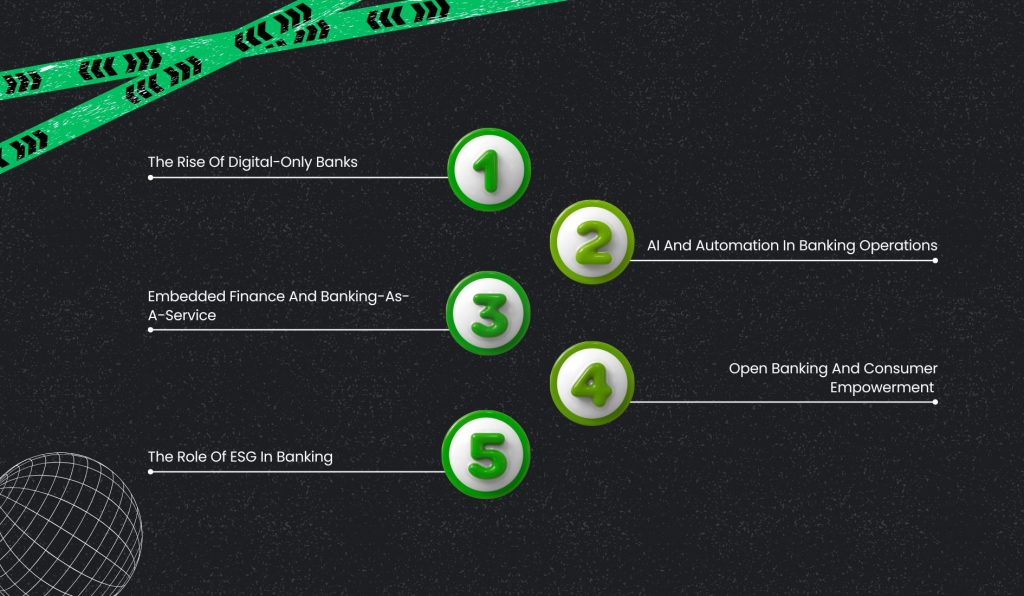
There are several factors that we should consider to completely understand the future of banking. All these factors have been rapidly changing the banking sector.
1. The Rise Of Digital-Only Banks
Digital-only banks are those that provide services entirely online, with no physical presence. They use mobile apps and websites for quick and accessible banking services.
They open accounts, make transfers, and even pay bills, all on their smartphones. Banks do this by eliminating the need for branches and paperwork.
Hence, they charge lower fees than those of conventional banks. Consumers appreciate streamlined account registration and instant transaction notifications.
Digital-only banks develop straightforward apps that help make day-to-day banking easier. They have facilities for twenty-four-hour usage without visiting branches.
Citizens in remote areas can access banking services more easily. Security features such as “biometric login” also help protect customer data.
Digital-only banks facilitate payment transactions. They support fast salary payments and real-time expense tracking.
Business owners can easily link bank accounts with accounting software. This reduces the amount of manual work, thereby saving time.
Startups prefer digital banks for their flexible, cost-effective services. Among the digital-only banks are Revolut, Monzo, and Nubank.
These banks have Millions of customers worldwide. In this regard, digital-only banks redefine modern banking for consumers and businesses alike.
2. AI And Automation In Banking Operations
Banks employ artificial intelligence and automated systems to efficiently manage daily activities.
They use AI technologies in chatbots, payment systems, risk assessment systems, and customer support systems. Moreover, this has completely transformed the landscape of electronic banking.
There is a quick response, quicker service, and personal financial advice for consumers using AI tools.
Artificial Intelligence systems analyze patterns of expenditure and recommend suitable investment or savings options.
By using automation systems, banks can detect fraud quickly. This protects the customers from suffering losses, which builds trust in the banking services.
The benefits for the business are reduced costs due to reduced manual work.
Automation increases the pace of loan approvals, reporting, and backend operations.
AI will help banks analyze data and make more informed lending and investing decisions. These tools enhance precision and prevent human error in financial activities.
However, banks should safeguard their customers’ information from misuse and/or breaches.
They also need to have strong regulations around AI decisions to ensure fairness. Thus, proper regulation enables the safe use of AI in a proper and ethical manner.
3. Embedded Finance And Banking-As-A-Service
Embedded finance integrates financial services into other non-financial applications that consumers are using.
Particular banking features are made possible by the “banking as a service” concept, which enables a company.
Consumers make payments, take out loans, or purchase insurance without having to leave the app while shopping and traveling.
This provides a seamless experience and saves time, particularly for day-to-day transactions. People like having quick checkouts and access to financial services.
Embedded finance is used by businesses to add value and maintain customer engagement.
They can provide cards, wallets, or loans without being banks.
BaaS eliminates the need for banking licenses and systems. Companies focus on products, while partner banks deal with compliance and security issues.
Such as in-app payments on Uber and instant loans on e-commerce platforms. Digital wallets such as Paytm and Apple Pay also show examples of embedded finance.
Hence, embedded finance influences how money is used on platforms.
4. Open Banking And Consumer Empowerment
Open banking enables banks to share customer information with third parties through the use of secure APIs.
The main objective is to foster more financial service industry transparency, competition, and innovation.
Consumers are able to determine who may have access to their financial information and for what period of time.
They also give their consent before their banking information is used by these apps or companies. This type of control helps individuals compare services and select better financial products.
Businesses use data on open banking to provide customized offers and smart money services.
They create budgeting apps, payment systems, or loan products based on shared data. Faster payments and account management are facilitated by open banking.
Regulations safeguard customer information and help avoid misuse or unauthorized access.
Stricter rules guarantee privacy, as well as security and balanced data sharing.
Hence, open banking enables consumers and facilitates innovation throughout the financial system.
5. The Role Of ESG In Banking
Banks today place emphasis on environmental, social, and governance factors in their financial decision-making.
They take into account climate impact, social responsibility, and ethical management practices.
Consumers favour banks that promote sustainability and responsible business practices. Customers choose banks that support green projects and other equitable social projects.
Companies practice ESG guidelines to establish trust and enhance brand values. Investors are attracted to their responsible, transparent business practices.
Banks rely on ESG scores when making loan and investment decisions. Additionally, governments are introducing regulations to enhance ESG reporting.
Regulators require disclosure about climate risks and social issues. Accordingly, modern banking practices form part of the broader ESG.
What Is The Future Of Banking And What Will Happen To The Physical Bank Branches?

Physical bank branches are decreasing while digital bank services are increasing rapidly. Customers like using mobile apps and online channels for their day-to-day banking needs.
The number of branch visits declines as people enjoy the benefits of faster, easier online services. Bank branches are remade into advice centers, not transaction centers.
They are concerned with customer service, digital assistance, and relationship building. Others have smaller smart branches with self-service technology.
Similarly, banking institutions like DBS and ING operate digital banking successfully. So, the banks have geared the physical branches towards supporting digital banking rather than replacing it.
Expert Insights And Best Practices
Banking experts emphasize the essence of digital skills and customer-focused innovation. Industry leaders urge them to hold a balance between technology, trust, and transparency.
Consumers should learn about digital tools and carefully protect their personal financial information.
Thus, they should compare services and select banks that match their needs. This means that to be in business, one has to invest in digital systems.
They should make wise use of data to enhance the customer experience and improve decision-making.
Expert guidance, therefore, enables the success of consumers and businesses in banking in the future.
Things To Remember About The Future Of Banking
The article discussed digital banking, AI, ESG, open banking, and a shift in the role of branches.
Thus, these trends affect how consumers and companies interact with financial services.
Today, banks are focused on developing technologies, building trust, and improving the customer experience. Readers should be well-informed and acquire new banking tools.
Therefore, proactive adaptations ensure that we all succeed in the future of banking. However, a massive chunk of the population still remains digitally deprived.
Thus, this digital divide makes physical banks necessary in many countries, including India.
In countries like India, Micro ATMs have begun playing a crucial role in transforming the future of banking.
Things like microcredit and others will continue to make services like financing more accessible to people in the third world.
Frequently Asked Questions
Here are answers to some of the most commonly asked questions about the future of banking.
1. Is Banking Going To Be Replaced By AI?
AI will never be able to replace human beings. However, AI will completely transform the working procedures in the banking industry.
Moreover, artificial Intelligence has an immense influence on the finance industry at the moment. Hence, experts suggest that the influence shall further increase.
2. Will Banks Still Exist In The Future?
Traditional banks will play a crucial role for at least the next 20 years. However, things will change in the future, and online banking will pave its way.
3. What Is The 30% Rule In AI?
The 30% AI rule suggests that AI should help you with only 30% of your work. Moreover, these tasks should include the daily chores and repetitive work.
On the other hand, the remaining 70% of the work has to be done by human beings. Thus, these works mostly involve thinking and strategizing.
Share this article: