- Understanding Certificate of Incorporation
- Types of Companies Eligible for COI
- Incorporation Requirements at a Glance
- Pre-Incorporation Requirements
- 1. Digital Signature Certificate (DSC)
- 2. Director Identification Number (DIN)
- 3. Name Reservation
- How to Incorporate Your Business in 2026? - Essential Steps
- 1. Filing SPICe+ Part A and Part B
- 2. AGILE Pro Form
- 3. Uploading on MCA V3 Portal
- RUN vs SPICe+ Part A (Decision Lens)
- Government Fee Structure
- Timeline for the Incorporation
- Post-Incorporation Compliance
- 1. Mandatory Filings
- 2. Statutory Requirements
- Common Mistakes and How to Avoid Them
- Incorporate Your Business Now!
- Frequently Asked Questions (FAQs)
How to Apply for a Certificate of Incorporation: Step-by-Step Guide

A Certificate of Incorporation (COI) is basically the government’s “yes, this company exists” stamp. It is issued after your incorporation documents undergo a thorough review on the MCA portal.
This way, your business is no longer an idea but a legal entity under the Companies Act, 2013. As a result, it quietly affects everything that follows.
Hence, businesses must understand the MCA V3 flow, paperwork, and compliance requirements. Therefore, read on to learn more about the certificate of incorporation.
Understanding Certificate of Incorporation

As per Section 7 of the Companies Act, 2013, incorporation means registering your company with the Registrar of Companies through prescribed forms, declarations, and constitutional documents.
The COI is issued once the Registrar is satisfied that the requirements are met. The “conclusive evidence” idea matters because it means third parties can rely on the fact of incorporation without reopening your entire file each time.
In practical terms, banks, vendors, and tax departments treat the company’s existence as settled. Moreover, errors that sneak in before incorporation tend to become expensive to correct afterward. This is because you are no longer fixing a draft. Rather, you are fixing a legal record.
Types of Companies Eligible for COI
In general, most founders bounce between Private Limited, Public Limited, and One Person Company (OPC). Meanwhile, LLP sits in a slightly different lane because it is governed through LLP-specific incorporation flows.
Basically, the eligibility is less about “who can apply” and more about what structure fits your ownership, compliance appetite, and funding intent.
For instance, a Private Limited company usually wins in early-stage fundraising flexibility. On the other hand, OPC is narrower but useful when you are truly solo and want corporate status. Public Limited is typically a later-stage, capital-market-facing structure.
In fact, LLPs can be attractive for professional services because they offer high internal flexibility. However, equity-style fundraising is different.
Incorporation Requirements at a Glance
The following are the major requirements of incorporation:
| Factor | Private Limited | Public Limited | OPC | LLP |
|---|---|---|---|---|
| Ownership baseline | 2+ shareholders | 7+ shareholders | 1 shareholder | 2+ partners |
| Director/partner baseline | 2+ directors | 3+ directors | 1 director (often more in practice) | Designated partners required |
| Compliance feel | Medium | High | Medium | Medium, different filings |
| Funding friendliness | Strong | Strong, later-stage | Limited | Limited for equity-style raises |
| Key constitutional docs | MoA, AoA | Both MoA and AoA | MoA, AoA | LLP Agreement |
In this case, your choice should match how you expect money, control, and reporting to behave over the next two to three years, not just this month.
Pre-Incorporation Requirements
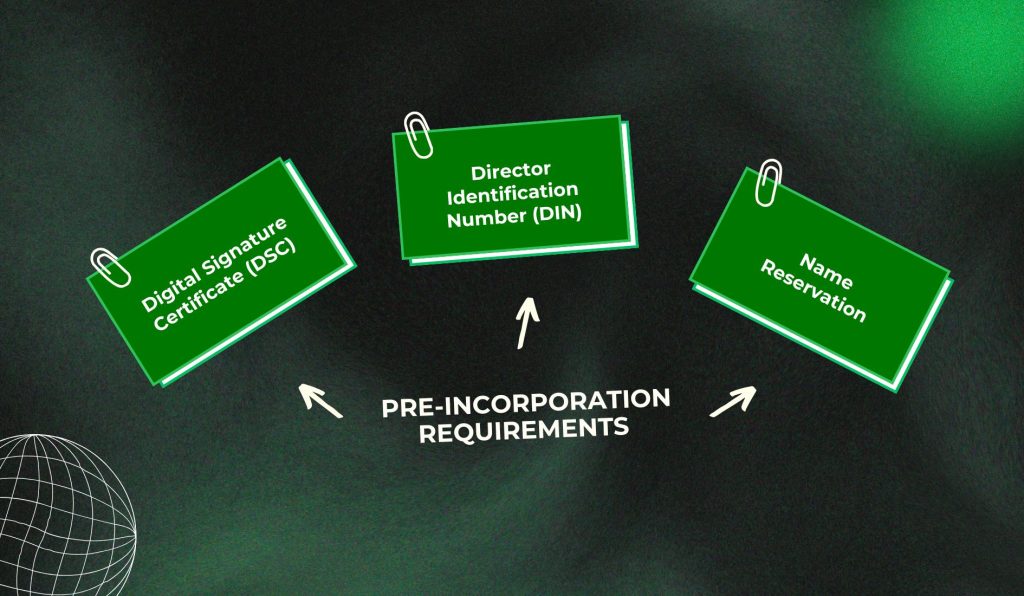
The following are some of the things you have to show before you apply for incorporation:
1. Digital Signature Certificate (DSC)
A Class 3 DSC is still the daily driver for company incorporation and related filings. This is because the MCA ecosystem treats digital signing as non-negotiable.
It is not hard to get a DSC, but the friction usually comes from KYC and matching details. For instance, names, initials, and address formatting across PAN, Aadhaar, and passports can get oddly sensitive.
In general, DSC validity is multi-year, and the cost depends on the issuing authority and any add-ons, such as tokens. So, if you are trying to move fast, apply for DSC first, because everything else queues behind it.
Moreover, always keep a clean folder with ID proof, address proof, a photo, and authorization letters. This is because you have to use them later.
2. Director Identification Number (DIN)
DIN is commonly allotted during incorporation through SPICe+ Part B for proposed directors, rather than being a separate preliminary chase.
Conceptually, DIN is your director identity in the MCA system. Practically, it is a data-quality problem if you do it casually.
In fact, one mismatch between your identity documents and the form can trigger resubmission or scrutiny. Also, if a director already has a DIN, you must use the existing one, and not “create a fresh profile mood.”
Moreover, always keep an eye on the director’s email and mobile access. This is because OTPs and verification steps depend a lot on timing.
3. Name Reservation
You can do name reservation through RUN (Reserve Unique Name) or through SPICe+ Part A. Also, your choice should reflect how confident you are about the name. RUN is more of a standalone attempt, while SPICe+ Part A sits inside the incorporation flow.
If your name is even slightly risky due to resemblance, trademark conflicts, or generic terms, you may prefer to make a dedicated reservation attempt before you spend time preparing the full incorporation pack.
If you want to reduce rejection odds, do the following:
- Do a basic trademark search for close matches and category conflicts, not just exact spelling.
- Avoid names that look like regulated words unless you can justify them with approvals.
- Keep the object alignment believable. A “FinTech” sounding name with a manufacturing object clause can raise eyebrows.
- Use uniqueness. Not fancy uniqueness, just non-confusable uniqueness.
How to Incorporate Your Business in 2026? – Essential Steps
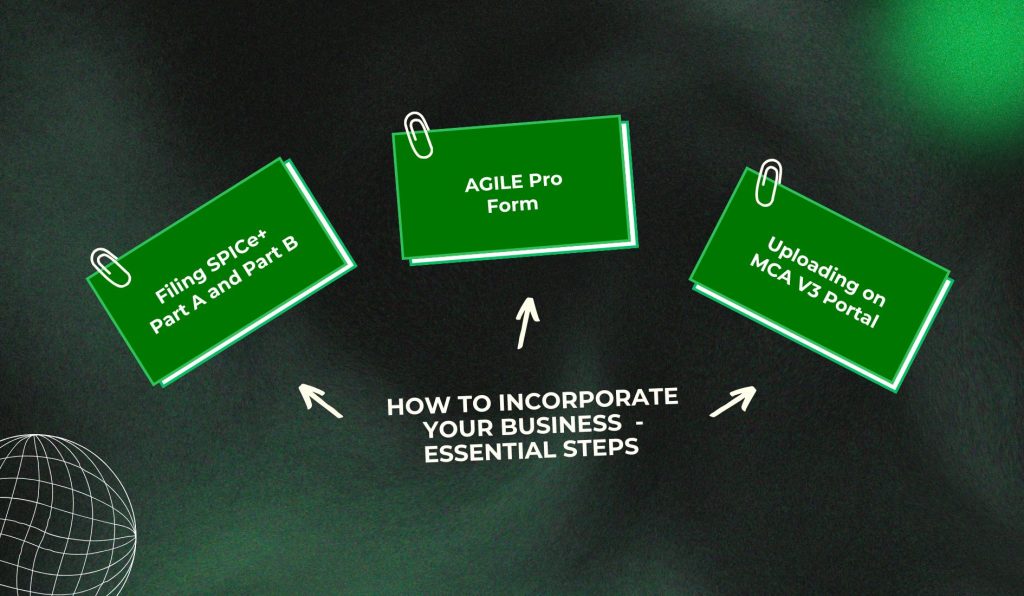
The following are the steps you must follow if you want to incorporate your business in 2026:
1. Filing SPICe+ Part A and Part B
Primarily, SPICe+ is the spine of the incorporation process. In this case,
- Part A focuses on the name
- Part B focuses on incorporation details, including registered office, directors, share capital, and subscriber information.
The process is “integrated,” that is, you are applying for DIN allotment, PAN, TAN, and optionally other registrations through the same journey.
Moreover, attachments like e-MoA (INC-33) and e-AoA (INC-34) are the company’s operating boundaries in plain sight. Meanwhile, a failure to declare INC-9 triggers a resubmission if someone clicks the wrong version or misses a digital signature slot.
This is where the certificate of incorporation is decided long before it is issued. If your objects, address proof, subscriber details, and identity documents are consistent and readable, approval tends to feel routine. If not, you end up in the loop of clarifications, and momentum dies.
2. AGILE Pro Form
AGILE Pro is where registrations such as GST, EPFO, ESIC, and Professional Tax (where applicable) are mostly processed. Basically, the trap is assuming you must select everything.
Sometimes selecting an optional registration prematurely creates a compliance clock you were not ready to run. For instance, take the case of the GST. If you are certain you will cross thresholds quickly or you need GST from day one to invoice clients, opting in during incorporation can be efficient.
Meanwhile, if you are still validating the business model, you should keep the launch lighter and register when the business logic demands it. However, you will need to decide calmly what you are committing to.
3. Uploading on MCA V3 Portal
MCA V3 feels smoother than earlier workflows in some ways. However, it still rewards patience and clean documentation.
Basically, you upload, validate, sign, and submit, and then the portal becomes your status tracker and your stress test. The key updates users notice are more about workflow sequencing and system validations, not a totally new legal standard.
Hence, follow the tips below to upload to the MCA V3 Portal smoothly:
- Keep your file naming consistent
- Keep PDFs readable
- Avoid last-minute or inconsistent scans.
In fact, when resubmission happens, it is usually because something was missing, mismatched, or unclear. So, keep those tips in mind.
RUN vs SPICe+ Part A (Decision Lens)
The following are the major differences between Reserve Unique Name (RUN) and SPICe+ Part A:
| Point of comparison | RUN | SPICe+ Part A |
|---|---|---|
| Best when | You want to test name availability first | You are ready to proceed with the incorporation flow |
| Effort style | Standalone reservation attempt | Integrated with the incorporation sequence |
| Risk control | Good for uncertain names | Efficient if you are confident in the name choice |
| Typical user mistake | Treating it as a guaranteed approval | Rushing name selection without checks |
Government Fee Structure
In general, Government fees hinge on authorized capital and the forms involved. Also, stamp duty varies by state because the stamp is not a single national flat rate.
Mostly, people plan only for “filing fees” and forget the stamp component. In fact, a better way to think about it is to budget in layers:
- Core incorporation fees
- Stamp duty
- Professional support (if used)
- A buffer for resubmission friction.
If you keep your initial authorized capital realistic rather than inflated for optics, you can avoid paying for capacity you do not need yet. Also, capital can be increased later if the business truly demands it.
Timeline for the Incorporation
Although there is no fixed timeline for incorporation, there are some patterns you must be aware of:
| Stage | What usually drives speed | What usually slows it down |
|---|---|---|
| Name approval | Distinct name, aligned object | Similar names, trademark conflicts, vague objects |
| Incorporation processing | Clean KYC, consistent documents | Mismatches, missing proofs, poor scans |
| Immediate post-incorporation | Prepared compliance calendar | Scrambling for bank account, auditor, and INC-20A inputs |
In this case, a simple mental chart helps: if your documents are “one version of truth,” the journey feels linear. However, if every document tells a slightly different story, the journey becomes circular.
Post-Incorporation Compliance
The following are the major post-incorporation compliance issues you have to take into account:
1. Mandatory Filings
INC-20A (Commencement of Business) is one of those filings that carries real consequences if ignored. In fact, it links back to proof of subscription money and the company being actually ready to operate as a legal entity.
Then there is an auditor appointment, which generally must happen within the statutory window. Also, it is not optional just because you run a small business. Many early teams delay this because it feels premature.
To be honest, the law does not wait for your revenue to show up.
2. Statutory Requirements
At the outset, the first board meeting, issuance of share certificates, maintenance of statutory registers, and setting the rhythm for annual filings are really important.
However, you do not need a heavy corporate vibe. Rather, you do need a reliable compliance habit. If you are serious about being ready for due diligence later, build a basic governance file now. Also, keep track of minutes, resolutions, and proof trails.
Common Mistakes and How to Avoid Them

The most common mistake is name rejection. Another repeat offender is incorrect DSC or DIN-related details, especially around spelling, address formatting, and identity document consistency.
Meanwhile, the third mistake is missing or incorrect attachments in SPICe+. This happens usually because someone used an outdated template, forgot to include a signature slot, or uploaded a blurred proof.
If you want to avoid mistakes while incorporating your business, do the following:
- Treat name selection like a compliance step, and not merely for branding. Also, search, cross-check, and document your reasoning.
- Make sure to keep one master data sheet for each promoter and director. Then, copy from it everywhere.
- Always validate attachments before upload. In fact, readability, correct format, correct signatories, and correct version are important.
In general, most incorporation delays are not due to legal complexity. Rather, they result from operational sloppiness.
Incorporate Your Business Now!
Incorporation is not a mere form submission. Rather, it is a chain of identity checks, name logic, document consistency, and post-approval discipline. These processes continue after the Registrar issues the approval.
So, if you get the pre-work right, SPICe+ is easy. However, if you ignore the post-incorporation calendar, you can turn a fresh company into an early compliance defaulter without even noticing.
For most businesses, getting professional assistance does not mean outsourcing intelligence. In fact, it is more about reducing preventable resubmissions, aligning documents, and keeping the certificate of incorporation clean, usable, and future-proof.
Frequently Asked Questions (FAQs)
Here are some of the common questions that might help you learn more about the certificate of incorporation:
SPICe+ creates the company and core IDs (PAN/TAN, DIN). AGILE Pro adds operational registrations such as GST, EPFO, and ESIC as needed.
If the name and documents are clean, approval can be quick; resubmissions for mismatches or unclear proofs usually stretch timelines noticeably.
Yes. Expect notarized/apostilled KYC, possible resident-director planning, and FDI-related reporting after share allotment, depending on the structure and sector rules timeline.
Missing INC-20A can trigger penalties and compliance restrictions, and it flags poorly in banking or investor diligence. File early with subscription proof.
Not always. Register during incorporation only if you must invoice with GST immediately or expect threshold crossing soon; otherwise, register when operationally ready.
Share this article: