- The Growing Complexity Of Modern Demand Generation
- 1. Multiple Channels, Multiple Behaviors
- 2. Misaligned Signals And Planning Disconnects
- Organizational Silos And The Cost Of Poor Handoffs
- 1. Functional Separation Creates Friction
- 2. Accountability And Decision Latency
- Order Fulfillment: Where Strategy Meets Reality?
- 1. Manufacturing Constraints And Execution Variability
- 2. Warehousing And Logistics Challenges
- The Missing Feedback Loop In Planning Cycles
- 1. Learning From Quality And Service Outcomes
- 2. Turning Feedback Into Actionable Insight
- Building A More Connected Order Journey
- 1. Cross-Functional Alignment As A Foundation
- 2. End-to-End Process Visibility
- 3. Integrating Real-Time Feedback Mechanisms
- Closing The Gaps In Consumer Product Order Management
Untangling The Consumer Product Order Journey For Better Responsiveness

Businesses must deliver their services to customers with highest accuracy and fastest delivery times and constant service reliability because the current marketplace has become extremely competitive and more unpredictable than before.
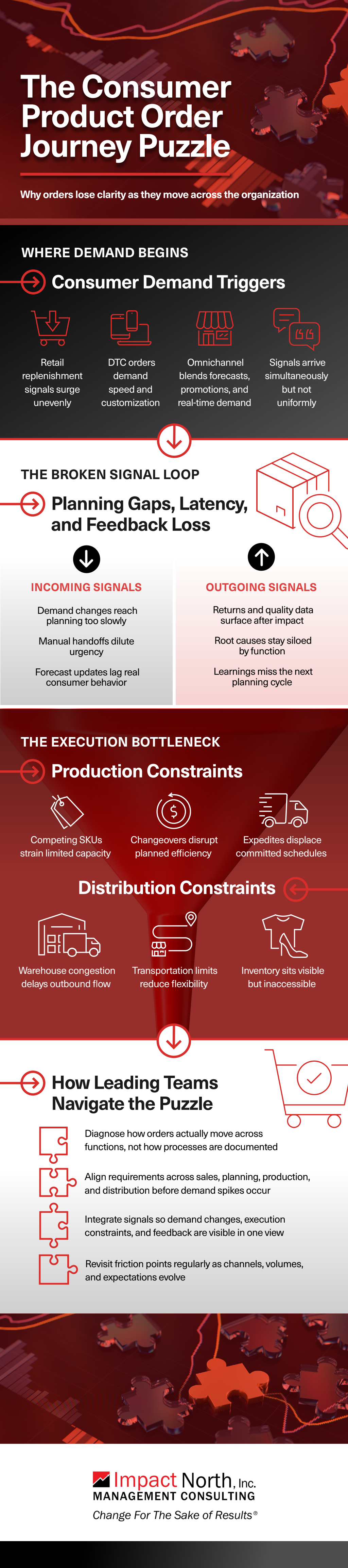
Customers interact with brands across physical retail locations, direct-to-consumer platforms, marketplaces, and digital channels often within the same buying journey.
Organizations fail to achieve operational execution because they encounter difficulties in transforming their demand patterns from multiple customer interactions into unified execution systems.
Different departments of organizations handle demand signals that their enterprise systems receive through different ways when these signals exist as unstructured data.
The process results in incorrect forecasting which leads to planning errors that cause actual order shipments to deviate from expected delivery times.
The system creates a disconnect which hinders organizations from responding to changes while it decreases their trust in operational data.
Consumer product order management hides essential information from departments like sales and demand planning and production and warehousing and distribution.
The Growing Complexity Of Modern Demand Generation
The current demand pattern of markets creates multiple unpredictable pathways which businesses must navigate.
The current demand pattern of markets develops through three different elements which include various channels and ways customers behave and outside factors which continuously change.
Organizations need to grasp this complex situation because it helps them attain better planning results and more dependable execution results.
1. Multiple Channels, Multiple Behaviors
The current demand generation process operates through multiple complex elements.
Retailers make their purchasing decisions by following established patterns and existing contracts which enable them to predict future needs with decent accuracy.
Direct-to-consumer channels require businesses to fulfill orders within short time frames while maintaining flexible stock distribution. The use of omnichannel strategies makes operational processes more difficult to manage.
Promotions and regional pricing differences and seasonal marketing initiatives and online visibility create conditions which make customer demand patterns shift between different weeks.
The system experiences demand fluctuations through multiple signals which occur frequently and unpredictably while creating problems that require complete system integration to solve.
2. Misaligned Signals And Planning Disconnects
Organizations experience a problem when their planning systems receive demand signals because their systems lack proper alignment.
The market forecast needs to match with actual market behavior which causes planners to redo their assumptions using manual methods.
The organization loses its ability to project upcoming demand changes because of its usage of reactive planning methods which also hinder effective inventory control and disruption-free service delivery.
Organizational Silos And The Cost Of Poor Handoffs
The process of execution becomes disrupted when internal systems fail to meet actual requirements.
The existence of organizational silos prevents teams from sharing their knowledge which results in business operations experiencing growing inefficiencies during consumer product order management processing.
1. Functional Separation Creates Friction
Operational performance depends on two main factors which include accurate demand forecasts and internal handoff procedures.
The separate operation of sales demand planning supply planning and operations functions results in inefficient handling of urgent requests.
It require priority changes through email and spreadsheet and other unconnected software systems.
The absence of structured communication creates a greater possibility for both manual mistakes and inconsistent messaging to occur.
The teams display distinct ways of understanding priorities which results in both decision conflicts and execution problems.
2. Accountability And Decision Latency
Information fragmentation leads to diminished accountability. Teams must resolve conflicts between various data sources before they can proceed with their decisions which results in extended decision-making times.
The latency issue affects all processes from production scheduling to shipment confirmation which results in delays for order fulfillment that harm customer satisfaction.
Order Fulfillment: Where Strategy Meets Reality?
The order fulfillment process tests planning assumptions against the actual constraints that exist in the world.
This stage shows the differences which exist between the planned strategy and actual operations therefore it requires both visibility and coordination to function properly.
1. Manufacturing Constraints And Execution Variability
Order fulfillment serves as the critical point which testing planning assumptions against actual world limitations.
The manufacturing team needs to handle multiple ongoing demands. It require them to switch between tasks while they deal with material shortages and operational capacity constraints.
Any disruption that happens during production processes will create a chain reaction which results in both decreased production capacity and extended delivery times.
2. Warehousing And Logistics Challenges
The warehousing and logistics teams must handle their own execution challenges which occur after manufacturing operations.
The finished goods movement process experiences delays because of space limitations and workforce fluctuations and interruptions in transportation services.
Organizations experience operational challenges when their various functions lack proper visibility. Since it leads to late problem identification which makes it difficult to resolve issues.
Teams need integrated systems because they currently lack the ability to track how production delays impact shipment schedules and how inventory shortages affect customer service performance.
The Missing Feedback Loop In Planning Cycles
Many organizations dedicate their resources to both planning and execution work yet they fail to address what occurs after they complete their deliveries.
The market provides essential feedback which organizations need to use for determining their future decisions while avoiding past errors.
1. Learning From Quality And Service Outcomes
Organizations show their neglect of one important aspect of consumer product order management experience.
Since they do not use customer feedback for handling quality problems and product returns and service interruptions.
The findings from this process provide essential indicators which identify the points where basic beliefs fail to hold true.
Organizations need rapid feedback systems which provide direct information to save valuable time for future development work.
The organization will face three major challenges which include recurring quality problems and repeated service interruptions and ongoing operational problems.
2. Turning Feedback Into Actionable Insight
Organizations that fail to integrate these insights into their planning processes risk reinforcing a cycle of inefficiency.
The organization needs to collect feedback right away and distribute it across departments.
While using information to enhance their forecasting abilities and production processes and inventory management systems.
Building A More Connected Order Journey
The solution to these problems needs to be designed with purpose because temporary solutions will not succeed.
A connected order journey unites people and processes and systems to achieve common goals.
1. Cross-Functional Alignment As A Foundation
Organizations need to develop new ways of planning and forecasting which go beyond their existing tools to solve their current problems.
The organization needs to establish cross-functional alignment between its strategic objectives and operational processes.
The sharing of context and priorities and performance metrics among teams leads to quicker and more reliable decision-making processes.
2. End-to-End Process Visibility
Organizations use continuous evaluation of their order process. It starts with demand capture and ends with delivery to discover bottlenecks and determine their effects on lead times and customer satisfaction.
The complete order journey enables organizations to take preventive actions instead of waiting to fix problems after they happen.
3. Integrating Real-Time Feedback Mechanisms
The integration of real-time feedback into planning and execution systems. It allows organizations to retain information from returns and quality reviews and service incidents.
The information transforms into a learning cycle which enhances the decision-making process for upcoming situations.
Closing The Gaps In Consumer Product Order Management
The process of closing order management gaps requires organizations to establish connections throughout their entire business operations.
Organizations that succeed treat visibility, alignment, and feedback as their main strategic advantages.
The process of closing all gaps in consumer product order fulfillment needs to be approached through complete system evaluation.
Organizations need to develop better business processes which need better internal connections and all employees in the organization need to understand important business metrics.
The synchronization of demand with planning and execution allows organizations to achieve operational agility. It enables them to adapt to market shifts with full confidence.
The company achieves better team collaboration because it decreases operational barriers between departments. While also enhancing service delivery standards and building stronger operational capabilities.
The resource from Impact North which provides ERP mining solutions demonstrates how complete visibility and interconnected systems establish modern order management processes.
Share this article: