- Components Of Final Pay Computation
- Step-By-Step Guide To Calculating Final Pay Computation
- Step 1: Getting The Immportant Doccument For Final Payment Computation
- Step 2: Calculating The Salaries For Un-Paid Works
- Step 3: Calculating The Leave Enhancement
- Step 4: Checking Bonus Eligibility
- Step 5: Calculating Gratuity
- Step 6: Calculating The PF Dues
- What Are The Main Legal And Policy Considerations After Final Pay Computation?
- Which Are The Best Tools And Resources For Final Pay Computation?
- Things To Remember About Final Pay Computation
- Frequently Asked Questions
- 1. What Are The Answers To Some Of The Most Commonly Asked Questions About Final Pay Computation?
- 3. What Is Final Pay Computation?
- 3. How Is Gratuity Calculated In India?
What Is Final Pay Computation For Employees: Key Points To Know

Computation of final pay means computing the final payment made to the employee when he/she quits.
This includes unpaid salaries, unpaid leaves, bonuses, and any other money that is pending.
This payment helps employees manage the costs of living once they have left the workplace. Hence, it is essential for employers to compute it correctly and make timely payments.
The regulations and laws mandate that companies and employees follow certain laws in India.
For instance, under the Payment of Wages Act, 1936, workers are paid on time. It also prevents unfair deductions from salary.
Furthermore, the Payment of Gratuity Act, 1972, addresses the payment of gratuity. This law provides gratuity to employees with long service. Hence, the laws protect the employee and facilitate equitable payment.
This article seeks to provide a proper guide for final pay computation in India.
Components Of Final Pay Computation

Unpaid salary covers the days the employee worked in the final month. Employers calculate it based on the monthly wage and days worked.
Then, they divide the month’s salary by the total working days. Then, they multiply by the days actually worked.
Leave Encashment: It is the payment for leaves that are accrued but have not been availed.
In addition to this, employers calculate the pay for leave with respect to the last drawn salary.
That means that unutilized days of leave add up to the amount of the final payment. Bonus may also form part of the final pay if applicable. Companies include earned or announced bonuses in the settlement.
Gratuity is applicable to all eligible employees under the law. Gratuity is calculated by employers based on the last salary and years of service.
They come under the provisions of the Gratuity Act, 1972. Hence, the company has to settle its Provident Fund dues.
Workers can draw on the sum or transfer it to a new job. The employer finally deducts taxes, loans, or salary advances. These deductions lower the total amount of the final payment.
Step-By-Step Guide To Calculating Final Pay Computation
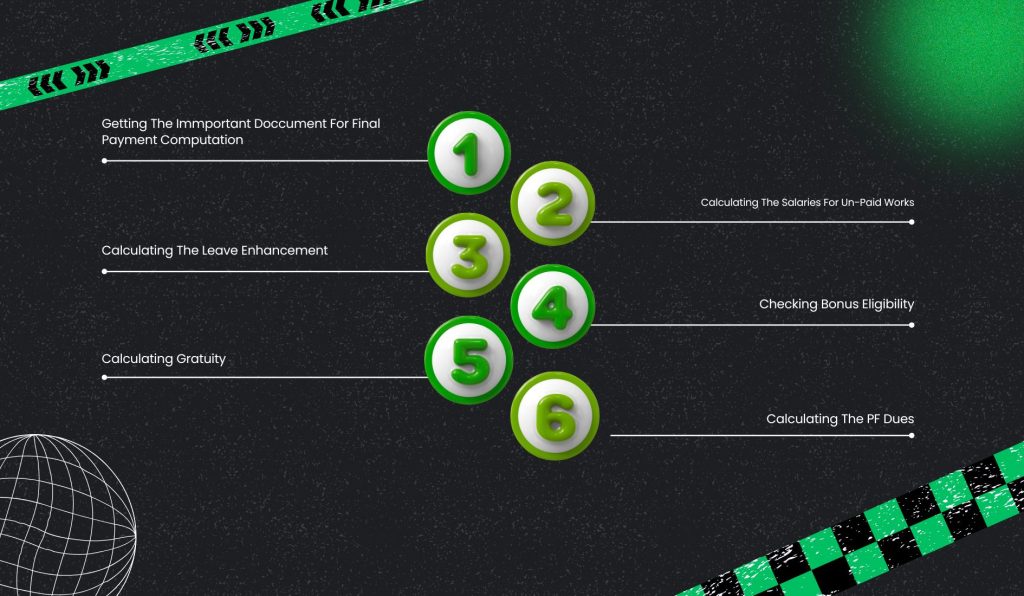
This step-by-step guide will make your work really easy. Follow these steps to perform final pay computation with ease.
Step 1: Getting The Immportant Doccument For Final Payment Computation
First, we should have some important documents like our last salary receipt and leave record.
Also, collect your tax details and bonus information.
Step 2: Calculating The Salaries For Un-Paid Works
Now, you should calculate the unpaid salaries for the days worked. We can use the following formula for this: Unpaid Salary = (Days Worked ÷ 30) * Monthly Salary.
Hence, you should now divide it by 30 days. Then multiply it by the number of days worked.
Step 3: Calculating The Leave Enhancement
Next, calculate the leave encashment for the unutilized earned leaves. Unused leave days – multiply by salary rate per day.
Step 4: Checking Bonus Eligibility
Then check bonus eligibility as per company policy. Add the bonus amount if approved by the company.
Step 5: Calculating Gratuity
Calculate gratuity for eligible employees. Gratuity can be found by using these steps:
Gratuity = (Last Drawn Salary × 15 × Years of Service) / 26. The formula can be applied to get the gratuity amount correctly.
Step 6: Calculating The PF Dues
Lastly, we add the Provident Fund dues and deduct. Finally, subtract any taxes, loans, or advances from the total.
What Are The Main Legal And Policy Considerations After Final Pay Computation?
There is a requirement for employers to meet the legal deadline for the settlement of final pay.
Timely payment is required after resignation or termination, as per labor laws. Typically, the dues are cleared within a few days of work.
Therefore, companies must avoid payment delays. Furthermore, employers have certain roles to play in the process. They must accurately calculate all due amounts.
The employees should include salary, leave pay, bonus, gratuity, etc., in the calculation. In addition, they have to provide the required documents and settlement details.
Employees also have clear rights. They have a right to be paid in full. They can question errors or missing payments. In case of any disputes, they can contact the labor authorities.
Hence, the law is for the employee and provides fair treatment.
Which Are The Best Tools And Resources For Final Pay Computation?

One can easily calculate their final pay with the help of online calculators. There are many reliable websites offering simple salary and gratuity calculators.
These tools also assist you in checking unpaid salaries and leave encashments. So you can get a quick estimate before settlement. Calculation templates can also be used for manual work.
Several websites offer free downloadable Excel or PDF templates. These templates assist you in listing your salaries, bonuses, and deductions.
Thus, one can easily compute it step by step. There are instances when you should seek professional assistance.
You can ask an HR professional for assistance with these calculations. You can also consult a legal expert for more complex cases. The support guarantees a fair and accurate final pay calculation.
Things To Remember About Final Pay Computation
This article explained the computation of final pay in simple terms. We have included salary, leave pay, bonus, gratuity, and PF settlement. It also addressed the issue of laws and employee rights in India.
Finally, review your final pay details. To ensure accuracy, use online calculators and simple templates.
In case you need to, you can consult someone from the HR department or a legal expert.
Frequently Asked Questions
Here are the answers to some of the most commonly asked questions about final pay computation.
1. What Are The Answers To Some Of The Most Commonly Asked Questions About Final Pay Computation?
Final pay computation explains how employers calculate an employee’s final settlement after resignation or termination.
It includes unpaid salary, leave encashment, bonus, gratuity, PF settlement, and applicable deductions under labour laws.
3. What Is Final Pay Computation?
Final pay computation involves calculating the payment received at the end after quitting a job. It also includes unpaid salaries and pending dues.
Employers deduct taxes or loans as necessary. This process ensures full and correct payment.
3. How Is Gratuity Calculated In India?
In India, employers calculate gratuity under the Payment of Gratuity Act, 1972.
They use the formula: Gratitude= (Last Drawn Salary × 15 × Years of Service) ÷ 26. The last drawn salary would include basic pay and dearness allowance.
The employee should have at at least completed five years of service to receive gratuity.
Share this article: