- Mergers And Acquisitions Strategy Foundations: Clarity Before Complexity
- 1. Defining The Strategic Rationale
- 2. Anticipating Deal Complexity
- Alignment Across The Deal Lifecycle
- 1. Executive And Board Alignment
- 2. Cross-Functional Coordination
- Integration: The Real Driver Of Value Creation
- 1. Planning Integration In Parallel
- 2. Cultural Alignment As A Strategic Lever
- Operational Discipline And Control
- 1. Structured Data Management
- 2. Risk Management Frameworks
- Agility In Dynamic Market Conditions
- 1. Scenario Planning And Flexibility
- 2. Maintaining Strategic Momentum
- 3. Leadership Cohesion As A Confidence Multiplier
- 4. Shared Decision-Making Structures
- 5. Extending Confidence Beyond The Boardroom
- Beyond The Closing Date
- 1. Post-Merger Value Tracking
- 2. Periodic Strategic Reassessment
- More Than A Timeline
The Architecture Of M&A Success: Alignment, Agility, And Control

Mergers and acquisitions strategy is crucial for business which organizations use to grow faster while gaining stronger market positions.
However, during times of rapid technological changes, complex regulations, and changing international investment patterns.
The actual success of a project exists beyond its completion date despite the fact that signing events and media announcements receive most public attention.
The achievement of sustainable results relies on the successful implementation of strategies, the establishment of leadership alignment and operational flexibility, and the enforcement of control systems during all stages of the project.
The strategic framework that supports a project determines its value creation potential despite having a structured timeline that shows project progress.
M&A execution requires more than just business transactions because it needs architectural design.
Mergers And Acquisitions Strategy Foundations: Clarity Before Complexity
Every effective transaction begins with a clearly defined purpose. Before engaging advisors, initiating valuation models, or approaching targets, leadership teams must articulate the mergers and acquisitions strategy intent behind the deal.
1. Defining The Strategic Rationale
The organizations need to learn about their acquisition needs and their reasons for those needs. The objective may include multiple goals, which include the following objectives:
- Market expansion
- Capability enhancement
- Product diversification
- Vertical integration
- Geographic penetration
- Digital transformation.
The process starts with this step because it creates a framework that enables stakeholders to make decisions through organized methods.
The due diligence process will concentrate on the elements that most significantly impact the creation of sustainable value.
2. Anticipating Deal Complexity
The process of transaction execution leads to increasing difficulties that show up during the execution of financial operations.
Financial discoveries have the potential to change existing belief systems. The regulatory agencies will establish their specific requirements for compliance.
Cultural gaps can emerge at any moment. The financing structures of organizations get affected by macroeconomic factors, which include interest rate changes and currency value alterations.
Organizations that expect complicated situations and develop flexible planning methods maintain their ability to adjust while keeping their main business goals.
The governance structures act as protective boundaries that maintain organizational agility while ensuring accountability.
Alignment Across The Deal Lifecycle
Strategic clarity must extend beyond executive vision. It requires cross-functional alignment throughout the organization.
1. Executive And Board Alignment
Senior leadership and board members must agree on:
- Value creation targets
- Risk tolerance thresholds
- Synergy expectations
- Performance metrics
When alignment exists at the top, decision-making accelerates and internal friction decreases.
2. Cross-Functional Coordination
The legal team, financial team, operational team, human resources team, and technology team need to work together in a common framework.
The lack of this unity results in communication failures, which create obstacles to progress while introducing extra dangers.
The workstreams require integrated leadership models to maintain operational consistency throughout their activities.
Integration: The Real Driver Of Value Creation
Although negotiation and closing attract attention, integration ultimately determines financial success.
1. Planning Integration In Parallel
Too often, with mergers and acquisitions strategy, integration planning begins after closing. However, value realization improves significantly when an integration strategy is developed during due diligence. Early preparation enables organizations to:
- Identify synergy capture opportunities
- Align technology systems
- Harmonize operational processes
- Develop unified reporting structures
As a result, disruption is minimized, and momentum is preserved.
2. Cultural Alignment As A Strategic Lever
People do not properly evaluate the importance of cultural integration in their assessments.
The different leadership approaches and decision-making speeds, together with the distinct performance standards, create barriers that disrupt organizational synergy.
The organization needs to perform cultural assessments while creating clear procedures for communication between all parties involved.
The employees gain better engagement through their understanding of strategic goals and their observation of leaders working together throughout the organization.
Operational Discipline And Control
Modern M&A transactions involve extensive documentation, sensitive data, and cross-border collaboration. Without mergers and acquisitions strategy and structured systems, inefficiencies quickly accumulate.
1. Structured Data Management
Secure digital platforms, particularly virtual data rooms, enable centralized document management and controlled access. This ensures:
- Version control consistency
- Audit trail transparency
- Confidentiality protection
- Efficient due diligence workflows
By implementing disciplined process frameworks, organizations reduce operational friction and maintain compliance standards.
2. Risk Management Frameworks
Effective transactions incorporate proactive risk oversight across several domains:
- Financial exposure
- Regulatory compliance
- Cybersecurity integrity
- Talent retention
- Operational continuity
Rather than reacting to emerging issues, disciplined oversight allows companies to mitigate threats before they escalate.
Agility In Dynamic Market Conditions
While discipline provides structure, agility enables adaptability.
1. Scenario Planning And Flexibility
Interest rate fluctuations, political events, and sudden regulatory investigations create new challenges for handling business transactions.
The organizations need to use scenario planning together with stress testing as their operating method.
The flexible integration roadmaps, together with the contingency financing strategies, create a deal structure that maintains its strength during all changes.
2. Maintaining Strategic Momentum
Agility does not mean abandoning structure. Organizations should adapt their operational methods to achieve their established long-term goals.
The combination of disciplined systems with built-in adaptability enables organizations to maintain their operational speed while preserving their strategic direction.
3. Leadership Cohesion As A Confidence Multiplier
Imprinted upon every core in the lack of uniform leadership is the unassailable fact that acquisitions are still as tough or as tender as they are likely to be.
4. Shared Decision-Making Structures
While, early agreement on governance forums, reporting protocols, and performance dashboards prevents confusion later in the process. However, when decision rights are clearly defined, accountability strengthens.
5. Extending Confidence Beyond The Boardroom
The leadership of the organization establishes credibility through its effective management of investors, employees, regulators, and business partners.
Consequently, the organization establishes trust through its open communication, which eliminates uncertainty among people.
However, the external stakeholders view the transaction as a managed process that follows a strategic plan.
Beyond The Closing Date
Closing marks a transition, not a conclusion.
1. Post-Merger Value Tracking
Integration often spans 12 to 36 months. During this period, organizations must actively monitor:
- Firstly, synergy realization timelines
- Secondly, cost reduction targets
- Thirdly, revenue growth acceleration
- Fourthly, employee retention rates
- Finally, operational efficiency improvements
Continuous performance tracking ensures that strategic intent translates into measurable financial outcomes.
2. Periodic Strategic Reassessment
While markets evolve, integration strategies may require recalibration. However, regular reviews allow leadership to adjust priorities without compromising overall direction.
More Than A Timeline
So, in conclusion, a structured timeline remains a vital coordination tool. However, it should serve a broader strategic architecture.
However, when alignment, agility, transparency, and control are embedded across every stage from strategy development to post-merger integration, organizations move confidently through complexity.
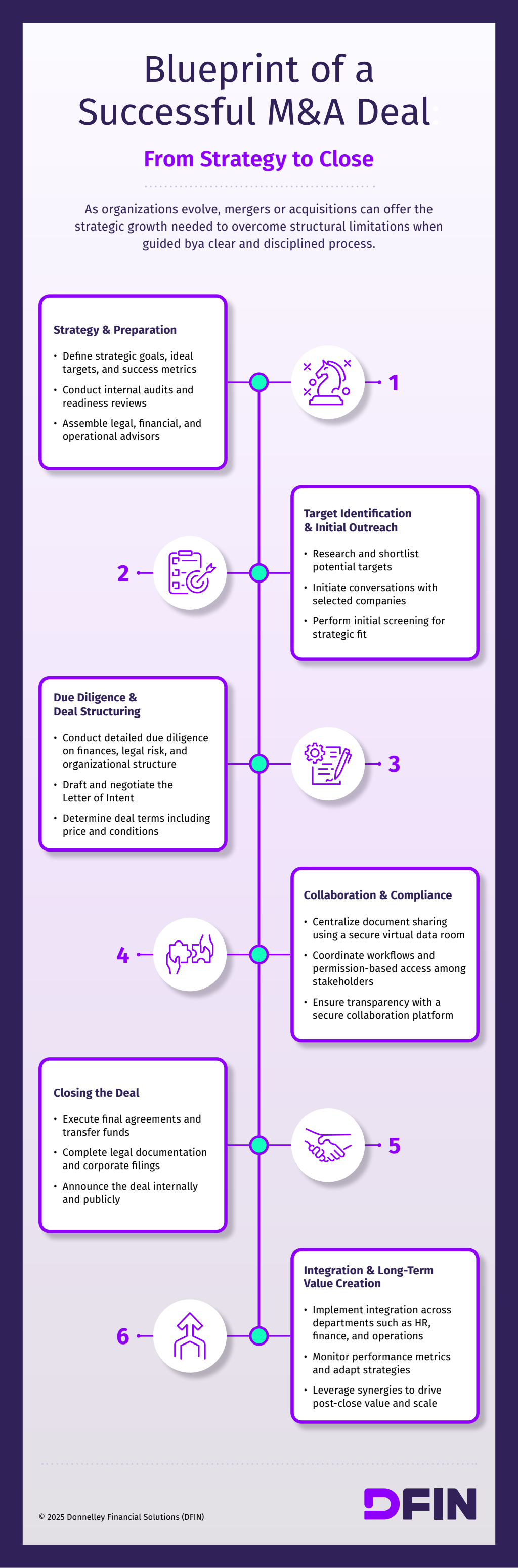
For a visual breakdown of the M&A process from strategy through integration, explore the companion resource from Donnelly Financial Services, a provider of virtual data room solutions.
When architecture replaces improvisation, mergers and acquisitions strategy transform from isolated transactions into catalysts for durable growth and competitive advantage.
Share this article: