- What Is Credit Risk Management, And Why Does It Matter?
- Core Concepts & Metrics(The Vocabulary Every Reader Must Know)
- 1. Probability Of Default (PD):
- 2. Loss Given Default (LGD):
- 3. Exposure At Default (EAD):
- 4. Expected Loss (EL) Vs Unexpected Loss (UL):
- Regulatory & Governance Foundations (What Supervisors Expect)
- Credit Risk Frameworks & Lifecycle (Practical Stages)
- 1. Origination & Underwriting
- 2. Pricing & Risk-Based Pricing
- 3. Portfolio Management & Concentration Limits:
- 4. Monitoring & Early-Warning Systems:
- 5. Collections, Workout & Recovery
- Modelling & Analytics: How Modern Shops Quantify Credit Risk?
- 1. Statistical Models (Logit, Survival Analysis) For PD:
- 2. LGD And EAD Modelling Approaches & Data Needs
- 3. Stress Testing And Scenario Analysis (Macro Overlays, IFRS 9 Forward-Looking Provisioning)
- 4. Model Validation, Governance, And Back Testing
- What Are The Things That You Should Consider While Understanding Credit Risk Management?
- Frequently Asked Questions
- 1. What Is The Quickest Way To Stand Up A Basic Credit Risk Model?
- 2. How Much Does Implementing Credit Risk Management Cost?
- 3. How Long Before A Credit Risk Model Is “Production Ready”?
What Is Credit Risk Management?
Credit risk is the possibility that a borrower will not repay the amount borrowed or the interest that has accumulated over the given period.
Banks and financial institutions observe this risk when offering loans to individuals or organizations.
This risk is higher when a borrower’s income level is relatively low or when a borrower does not have a stable financial condition or a good credit record.
The lender reviews the borrower’s past records and income levels before granting a loan.
The lender generally charges high interest rates on the loan to cover the risk for such borrowers.
What Is Credit Risk Management, And Why Does It Matter?
Credit risk is the likelihood that the borrower is not able to pay the loan or the interest on the loan as per the due date.
Banks control credit risk to preserve capital, safeguard profitability, and facilitate long-term financial stability.
Also, they manage it to ensure it meets regulatory requirements and does not disrupt the system’s finances.
According to the Basel Committee, banks are required to hold adequate capital for their credit risk exposures.
These principles are set by the Bank for International Settlements to enhance the safety of the world’s banking systems.
Core Concepts & Metrics(The Vocabulary Every Reader Must Know)
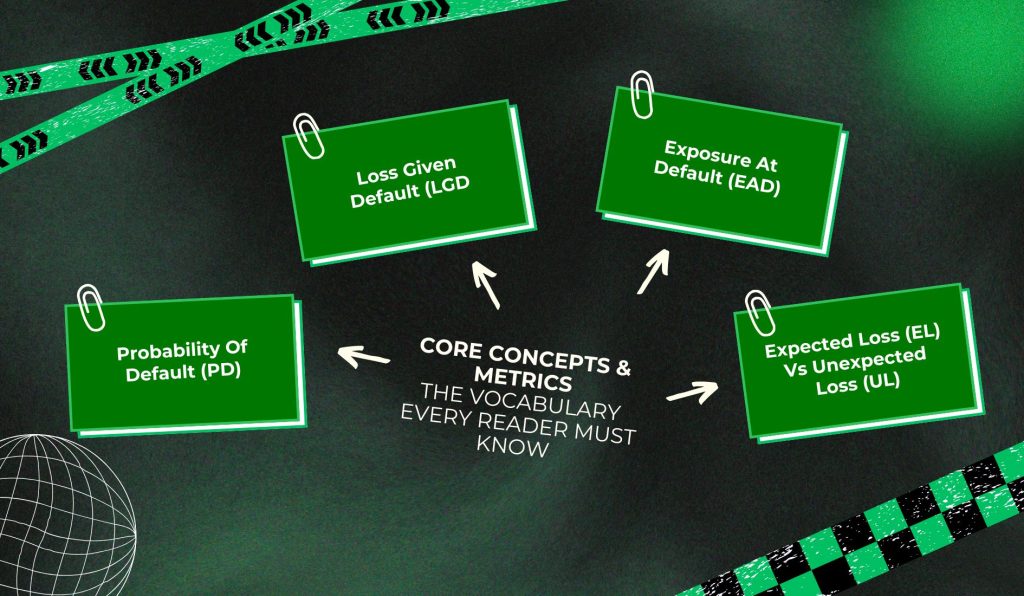
The banks analyze several things before providing a loan to an employee, and deciding on the interest rates.
Hence, here are some of the factors that banks generally consider before providing loans to borrowers.
1. Probability Of Default (PD):
Probability of Default (PD) is the probability that a borrower will default on a loan.
It indicates how prone an individual is to defaulting within a particular time period. This is determined through credit scores and historical data by lenders.
They also apply financial ratios, stability of income, and statistical models of credit assists banks in risk management and proper pricing of loans.
2. Loss Given Default (LGD):
Loss Given Default (LGD) measures how much loss a lender can expect given a borrower’s default.
It shows the amount of money not recovered by lenders through legal action or recovery mechanisms.
Collateral has an important role to perform in LGD reduction.
Therefore, better collateral and enforcement restrain the loss of default.
3. Exposure At Default (EAD):
Exposure at Default (EAD) is the total risk to the lending bank in the event of a default.
It encompasses outstanding balances, accrued interest, and future anticipated drawdowns at default. EAD changes depending on the structure.
Banks use current balances in term loans and estimates of likely usages in credit lines.
Therefore, precise estimation of EAD can be useful for calculating losses and for planning capital.
4. Expected Loss (EL) Vs Unexpected Loss (UL):
Expected Loss (EL) represents the mean credit loss and is calculated as PD × LGD × EAD.
It represents expected losses considered routine by banks and priced into interest rates.
UL stands for Unexpected Loss, defined as a loss beyond that captured by EL due to rare, extreme default events.
UL demands additional capital buffers to absorb unexpected jolts against one’s finances.
Regulatory & Governance Foundations (What Supervisors Expect)
Basel principles and BIS emphasize good governance, a sound credit policy, and responsible risk management.
The refresh in 2025 reinforces model risk management and data quality and supervisory expectations.
It also reinforces capital planning and stress testing to absorb severe but plausible shocks.
Importantly, compliance supports sound decision-making rather than simply ticking a regulatory box.
So, Basel compliance is the backbone of any effective and resilient risk management system.
Credit Risk Frameworks & Lifecycle (Practical Stages)
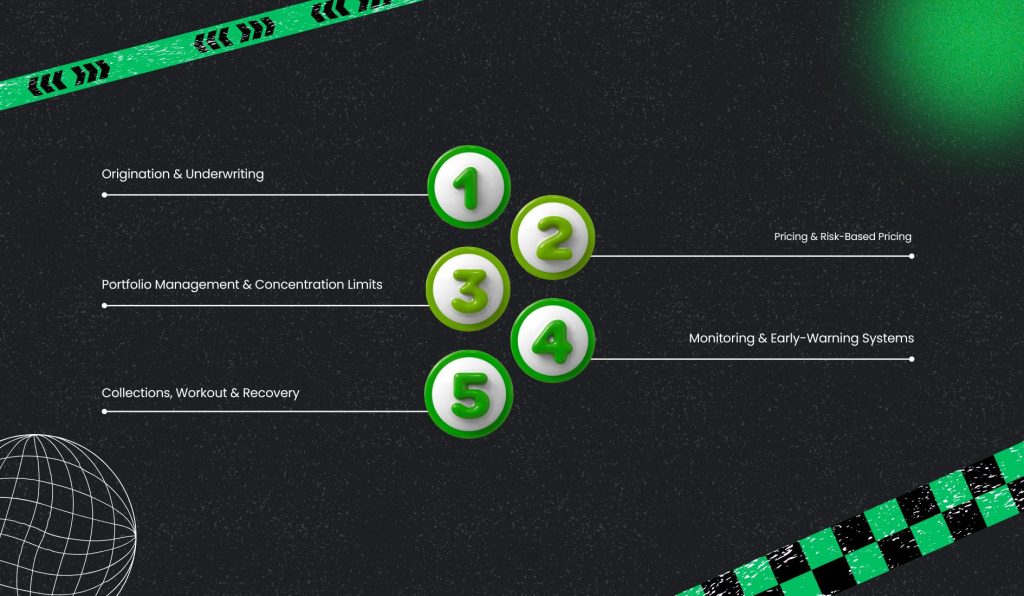
Credit risk frameworks involve several components, including origination, underwriting, pricing, and risk-based pricing.
1. Origination & Underwriting
Origination and underwriting provide the rules for sanctioning loans and conducting initial credit risk management.
Banks have clear policies and follow KYC procedures to verify their borrowers’ identities and authenticity. They analyze affordability using income, expenses, and repayment capacity.
Hence, credit-scoring models help quantify the risk and assist in making informed lending decisions.
2. Pricing & Risk-Based Pricing
Pricing shows a direct relationship between loan interest rates and the credit risk associated with them. PD, LGD, and EAD together provide an estimate of a borrower’s losses.
These measures are incorporated into the pricing strategies of banks. Therefore, higher risk exposures require higher interest rates to offset potential losses.
3. Portfolio Management & Concentration Limits:
Portfolio management controls credit risk across the entire loan book. Banks set concentration limits by sector, geography, and single borrower exposure.
According to the Bank for International Settlements, diversification reduces systemic vulnerability.
Thus, concentration limits protect banks from correlated losses and large single-name defaults.
4. Monitoring & Early-Warning Systems:
Through these systems, borrowers are being monitored to track rising credit risks.
Missing payments, reduced cash flows, and credit score degradation are among such indicators.
They have a watchlist of high-risk accounts that require more monitoring and immediate action.
This means covenant breaches trigger alerts, as conveyed by McKinsey & Company’s risk practices.
5. Collections, Workout & Recovery
Collections and recovery manage accounts after missed payments or default. Banks segment delinquent borrowers by risk, age, and repayment behavior.
They apply restructuring playbooks such as rescheduling or temporary payment relief. Thus, structured workout strategies improve recoveries and reduce overall credit losses.
Modelling & Analytics: How Modern Shops Quantify Credit Risk?
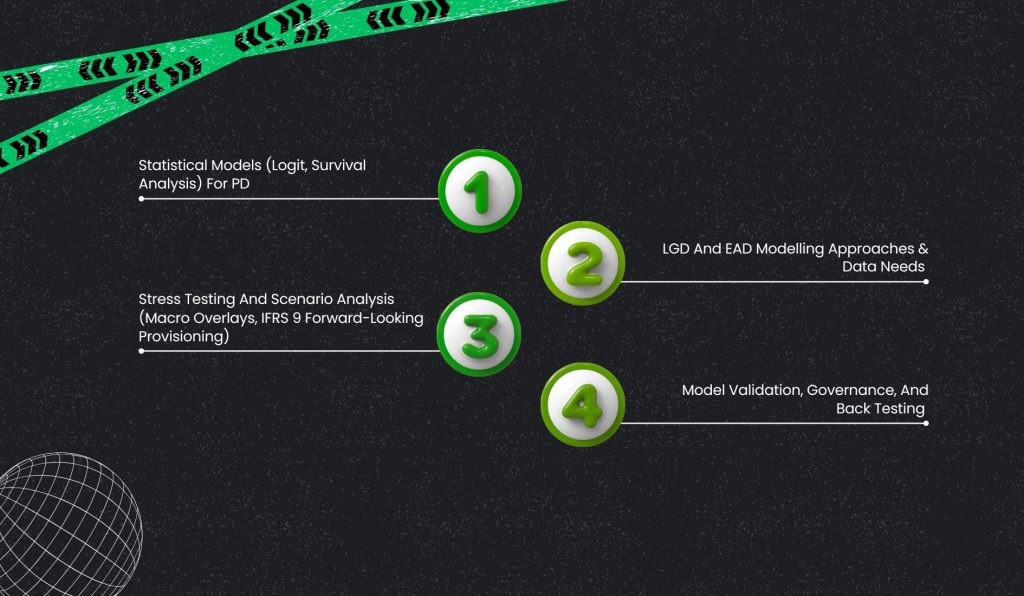
Modern shops quantify credit risks using reliable data and analytics. This involves statistical models, EAD and LGD modelling, Stress testing and scenario analysis, and several others.
1. Statistical Models (Logit, Survival Analysis) For PD:
Statistical models help estimate the Probability of Default based on the borrower’s and loan’s characteristics.
Logit models use both financial and behavioral variables to predict the likelihood of default.
Survival analysis estimates the time of default, if any, during the lifetime of a loan.
According to Investopedia, these models rely on historical data and statistical probability.
Hence, they are used to enhance the accuracy of PDs and bank credit decisions.
2. LGD And EAD Modelling Approaches & Data Needs
EAD and LGD models use historical recoveries, exposures, and default rates to estimate losses.
LGD modeling involves the use of collateral values, timing factors, and legal costs.
EAD modelling calculates the potential future drawdowns and outstanding balances. The Bank for International Settlements explains that data quality is critical.
Therefore, a granular, consistent dataset helps ensure regulatory accuracy and reliability.
3. Stress Testing And Scenario Analysis (Macro Overlays, IFRS 9 Forward-Looking Provisioning)
Stress testing is a measure used to check the robustness of banks in unfavourable economic situations.
Scenario analysis utilizes macro layers to assess the potential for credit deterioration.
Banks employ a forward-looking approach to data under IFRS 9 for the purpose of provisioning expected credit losses.
The IMF reports that these practices strengthen financial stability and preparedness.
4. Model Validation, Governance, And Back Testing
Model validation checks whether credit models remain accurate and reliable. Banks use governance frameworks and back testing to review model performance.
According to the Bank for International Settlements, regulators expect independent validation. Thus, strong oversight ensures trustworthy risk and capital decisions.
What Are The Things That You Should Consider While Understanding Credit Risk Management?
Credit risk management also involves using several types of data, such as transaction history, collateral, macro-overlays, and tooling.
Moreover, several other risk factors have already emerged in supply-chain finance, such as climate credit risk.
Furthermore, there are ESG considerations in lending, like model bias and fairness, and other data privacy implications.
To address credit risks, bankers and lenders in developing countries have begun lending money to individuals through the microcredit system.
Furthermore, other forms of non-conventional financing have emerged, such as Green Financing.
Credit consolidation is also used for home renovation loans. Thus, banks assess a person’s ability to repay when there is minimal or no collateral involved.
Frequently Asked Questions
Here are the answers to some of the most commonly asked questions about credit risk management.
1. What Is The Quickest Way To Stand Up A Basic Credit Risk Model?
You should build a credit scorecard (logit) using credit history of at at least 12-18 months of clean historical data. Furthermore, run back tests.
You should do it within three to six months of MVP when the data is available.
2. How Much Does Implementing Credit Risk Management Cost?
Enterprise IRB programs often budget their credit risk management at low to mid seven figures.
On the other hand, smaller banks often start with $ 50,000 for tooling and implementing credit risk management.
3. How Long Before A Credit Risk Model Is “Production Ready”?
A simple PD model can take up to 3-6 months. On the other hand, an IRB-grade-validated system can require at least 9-18 months in total.
Share this article: