- Key Takeaways
- Why Income Tax Notices Salaried Individuals
- The 5 Most Common Reasons Salaried Employees Receive Tax Notices
- Notice Type Cheat Sheet
- Structural Breakdown Of Modern Tax Notices
- 4 Core Characteristics Of A Tax Notice
- Real Life Scenario: The Double Form 16 Trap
- Pros And Cons Of Automated System Checking
- The Trade-Offs of Digital Tax Monitoring
- Should Beginners Fear Tax Notices?
- The 3 Most Common Alerts Salaried Employees Receive
- 1. Data Mismatches And Technical Errors
- 2. The Routine Audit Call
- 3. The Math Correction Update
- Actionable Framework: The 4-Step Peace Of Mind Strategy
- Step 1: Verify The Document's Legitimacy
- Step 2: Compare Your Data With Official Logs
- Step 3: Pick Your Response Angle
- Step 4: Periodically Audit Your Portal
- Common Beginner Mistakes That Trigger System Alerts
- How to Protect Your Financial Record Going Forward
- Summary Box For Quick Reference
- Frequently Asked Questions
Income Tax Notices for Salaried Individuals: Meaning, Types & How to Respond
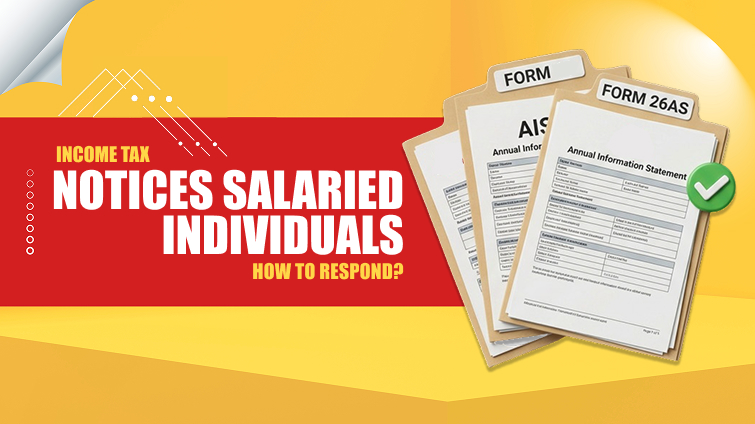
Getting an Income Tax email can instantly ruin your week. For a salaried employee, it feels like being pulled over by the police when you know you were driving under the speed limit.
You pay your taxes through your employer via TDS (Tax Deducted at Source), file your return on time, and still, an alert pops up on your phone. Panic sets in.
If you are a beginner investor or someone who just started working, this guide is your stress-relief blueprint. We will look at exactly:
- Why these happen, using real-life stories
- How to read them without needing a finance degree;
- How to fix them effortlessly.
Key Takeaways
- Notices are common: An alert does not mean you did something illegal; it often just means an automated computer system found a data mismatch.
- Never ignore them: Ignoring an alert can turn a minor math correction into frozen bank accounts.
- Check authenticity first: Always verify your communication on the official portal before responding to avoid scams.
- Keep records clean: Match your filings to official tax records, such as Form 26AS and AIS, annually.
Why Income Tax Notices Salaried Individuals
An income tax notice is a communication from the concerned department asking you to verify information, provide documents, or respond to a tax mismatch.
It involves a formal request for clarification or missing paperwork. It offers a structured way to fix honest mistakes and clear your record. But comes with the risk of heavy penalties or legal action if you ignore the timeline.
Think of it like a bank statement mismatch. The department runs your filed return through an advanced software system that cross-references your reported data with banking and employer logs.
When the numbers do not match perfectly, the system automatically flags it and sends a letter.
The 5 Most Common Reasons Salaried Employees Receive Tax Notices
- Interest income not reported
- Two Form 16s after changing jobs
- Capital gains omitted
- AIS mismatch
- Wrong ITR form
Notice Type Cheat Sheet
| Notice | Meaning | Risk Level |
|---|---|---|
| 143(1) | Automated processing | Low |
| 142(1) | Request for information | Medium |
| 143(2) | Scrutiny | High |
| Demand Notice | Additional tax payable | Medium |
Structural Breakdown Of Modern Tax Notices
4 Core Characteristics Of A Tax Notice
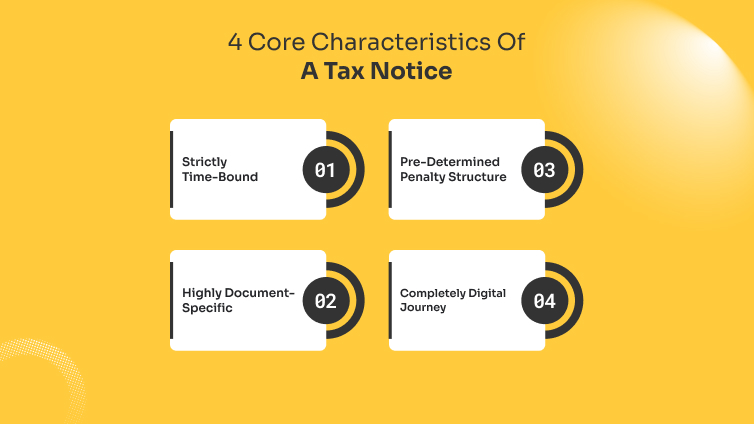
Understanding how a notice behaves helps remove the fear factor. Every official alert has four defining elements:
- Strictly Time-Bound: Every letter specifies an exact deadline, usually 15 to thirty days. Missing this window automates penalties.
- Highly Document-Specific: The system does not just say “you owe money.” It states the exact section, transaction, or missing document it wants to see.
- Pre-Determined Penalty Structure: Fines are not arbitrary. They follow fixed legal rates based on the nature of the mistake.
- Completely Digital Journey: From delivery to final resolution, everything happens online via the e-filing portal. No physical visits required.
Real Life Scenario: The Double Form 16 Trap
Let us look at Rahul, a software engineer who switched jobs midway through the financial year in November.
His first employer deducted tax based on a lower initial slab. His second employer did the same, assuming Rahul had no other income for the year.
When Rahul filed his tax return, he simply looked at his second Form 16 and hit submit. He completely forgot to combine his total salary.
Three months later, a notice arrived. The tax department’s system had matched his PAN card against two different corporate payrolls.
The software calculated that Rahul owed an additional 30,000 rupees because his combined income placed him in a higher tax bracket.
Rahul panicked and thought about hiring an expensive lawyer.
Instead, he logged into the portal, calculated his aggregate income across both companies, paid the residual tax online, and updated his return. The case was closed within an hour.
Pros And Cons Of Automated System Checking
While getting a notice is frustrating, the automated processing system has distinct advantages and disadvantages for regular employees.
The Trade-Offs of Digital Tax Monitoring
| Pros (Why it helps) | Cons (Where it hurts) |
|---|---|
| Rapid Corrections: Flags math errors early before interest accumulates over multiple years. | High Anxiety: The formal legal language can terrify innocent beginners unnecessarily. |
| Transparent Process: Eliminates corruption since you deal with a portal, not an individual officer. | System Errors: Sometimes, automated bots flag valid deductions due to small technical bugs. |
| Clear Timelines: You get an exact timeframe to fix your record online without leaving home. | Strict Deadlines: Rigid windows leave little room for personal emergencies or delays. |
Should Beginners Fear Tax Notices?
No, beginners should absolutely not fear them. A notice is simply a request for information, not a criminal charge.
In over 90% of cases for salaried individuals, it is an automated request to fix a data entry error or to upload a missing receipt.
As long as you did not hide major income streams on purpose, a notice is just an administrative step you can resolve from your laptop.
The 3 Most Common Alerts Salaried Employees Receive
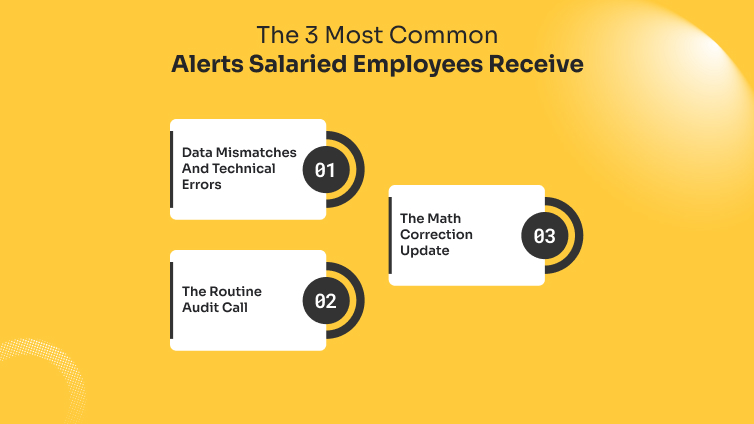
You do not need to memorize the entire tax book. For salaried employees, almost every notice falls into one of three buckets based on recent web search patterns.
1. Data Mismatches And Technical Errors
This happens when what you write in your tax form does not align with what your bank or employer reported.
The department receives data from mutual funds, banks, and companies. If you claim you earned less interest than what your bank logged under your PAN card, the system flags it.
2. The Routine Audit Call
Sometimes, you get a section 142(1) income tax notice. Do not panic if you see this section code. This is a standard letter where an officer asks you to produce basic documents to support your return.
It is very common if you claim a large tax refund or sudden high-value deductions that do not match your historical trends.
3. The Math Correction Update
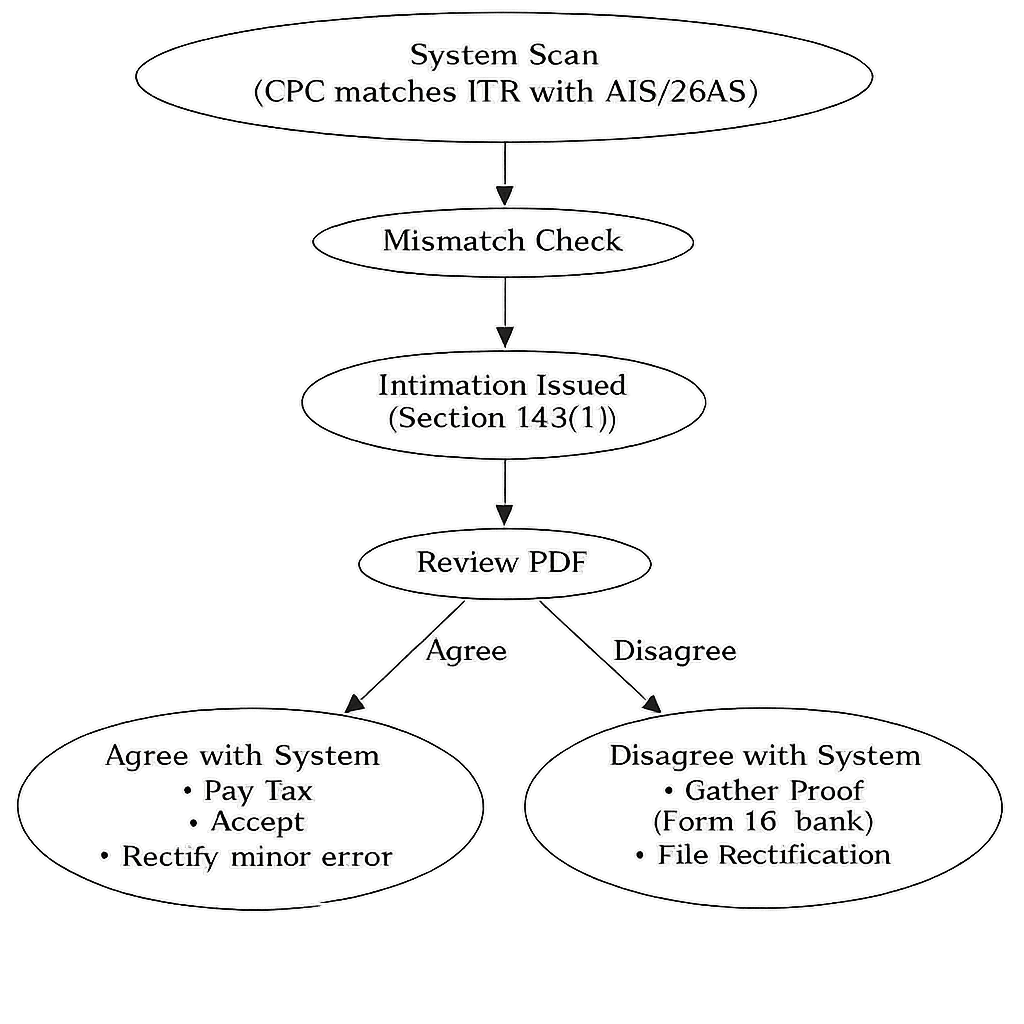
This arrives as an income tax demand notice 143(1). This is technically an “intimation” or an account summary rather than a punitive notice.
The system sends this to every taxpayer, showing three distinct color-coded outcomes:
- Green: Your calculations match the government’s data perfectly. Your return is processed.
- Blue: A minor structural change was made, or you are owed a refund.
- Red: The system found an error, disallowed a deduction, and created a tax demand.
Actionable Framework: The 4-Step Peace Of Mind Strategy

If your phone buzzes with a tax alert, do not rush to hit reply immediately without thinking. Follow this step-by-step method used by financial advisors to handle the issue cleanly.
| [Step 1: Check Authenticity] ──► [Step 2: Read the Demand] ──► [Step 3: Choose Response] ──► [Step 4: Update Portal] |
Step 1: Verify The Document’s Legitimacy
Scammers often send fake emails that look exactly like tax alerts. Before clicking any external link, log in to the official income tax portal directly.
Go to the “Services” tab and click “Authenticate Notice/Order Issued by ITD.” Enter the document number to confirm it is real. If it is not on the portal, ignore it.
Step 2: Compare Your Data With Official Logs
Open the notice and see what the system is questioning. Then, open your online dashboard and download your AIS (Annual Information Statement) and Form 26AS. These are logs of every rupee associated with your PAN card. Check if your bank interest, dividend payouts, or salary numbers match what you wrote in your return.
Step 3: Pick Your Response Angle
Once you find the discrepancy, you have two choices on the portal under the “Response to Outstanding Demand” section:
- Agree: If you made a mistake (such as Rahul’s dual-job scenario), accept the demand. Pay the due tax online, note down the challan number, and submit a rectification request to update your log.
- Disagree: If you have the proofs (like your actual house rent receipts that the system somehow missed), click disagree. Upload clear PDF copies as evidence, then submit.
Step 4: Periodically Audit Your Portal
Make it a habit to log into your account once every three months. Sometimes email alerts end up in the spam folder. Checking the portal directly ensures you never miss a compliance window.
Common Beginner Mistakes That Trigger System Alerts

Ignoring Small Income Patches: Many beginners think a five-thousand-rupee profit from a stock app or bank savings interest does not matter. The system tracks every single rupee via your PAN card. Always declare side income.
- Using Fake Receipts for HRA: Submitting fabricated rent receipts or fake medical bills is an easy way to trigger a deep review. Modern tracking algorithms flag unusually high rent claims that do not align with your salary scale.
- Picking the Wrong Base Form: If you have simple salary income, you file ITR-1. If you sold crypto, stocks, or own multiple houses, you must file ITR-2. Filing the wrong form automatically makes your return defective.
How to Protect Your Financial Record Going Forward
Filing your taxes cleanly is part of building your long-term investing foundation. When you apply for a home loan, an education loan, or a visa, your clean tax history serves as definitive proof of your character and financial health.
Regulators like the Central Board of Direct Taxes (CBDT) are making the entire infrastructure fully automated. The systems are getting smarter each day.
The best way to stay safe is to avoid aggressive, shady tax-saving shortcuts. Stick to legitimate avenues such as Section 80C, regular health insurance claims, and transparent investment tools.
Summary Box For Quick Reference
- What it is: An automated system alert flagging a mismatch between your reported data and official government records.
- Immediate action: Log into the official portal, verify the notice’s document number, and check your AIS log.
- The fix: Either pay the tax gap online if you made a math error, or upload your clean receipts if the system missed them.
- Golden rule: Never give an instant response in a panic. Verify, match your documents, and reply systematically online within the deadline.
Frequently Asked Questions
If you miss the response window, the system automatically treats the temporary tax demand as final. The department can disallow your deductions, levy a flat penalty interest on the unpaid amount, and adjust the balance against any future tax refunds you are supposed to receive.
For basic issues like reporting missed bank interest, matching Form 16 logs, or fixing typographical errors, you can easily do it yourself online. If the notice involves complex business income or foreign assets, it is highly recommended to seek professional advice.
Absolutely not. Over ninety-five percent of communications sent to regular employees are simple technical clarifications or automated adjustment logs. It is just the system’s way of asking you to complete your paperwork properly.
Your employer only tracks the salary they pay you. They do not know about your savings account interest, stock market profits, or income from a past job. If you have these additional streams, your total tax liability increases, which can trigger an alert if left unaddressed.
Once you submit your digital response or pay the residual tax via a rectification request, the automated system typically processes it and updates your status within 15 to 30 days. You will receive a confirmation email once your record is marked clean.
Share this article: