- Key Takeaways
- Real Life Experiences: Rahul Thought " I Was In Trouble"
- What Is Section 143(1) In Simple Terms?
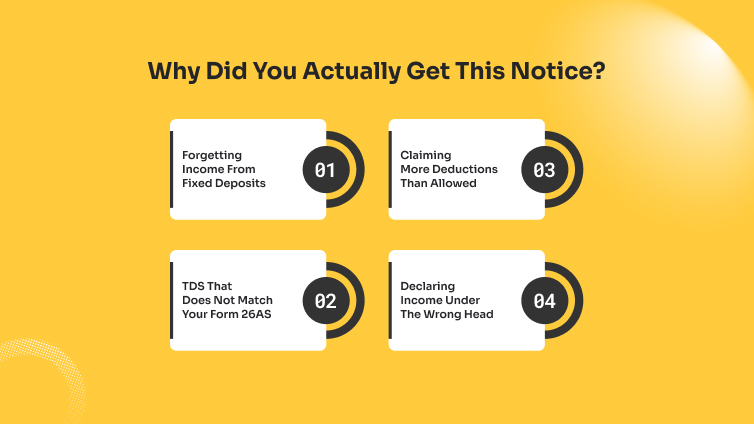
- Why Did You Actually Get This Notice?
- Forgetting Income From Fixed Deposits
- TDS That Does Not Match Your Form 26AS
- Claiming More Deductions Than Allowed
- Declaring Income Under The Wrong Head
- How To Identify The Source Of A Tax Discrepancy In An ITR Notice
- Section 143(1) Tax Demand Payment Deadlines And Timelines
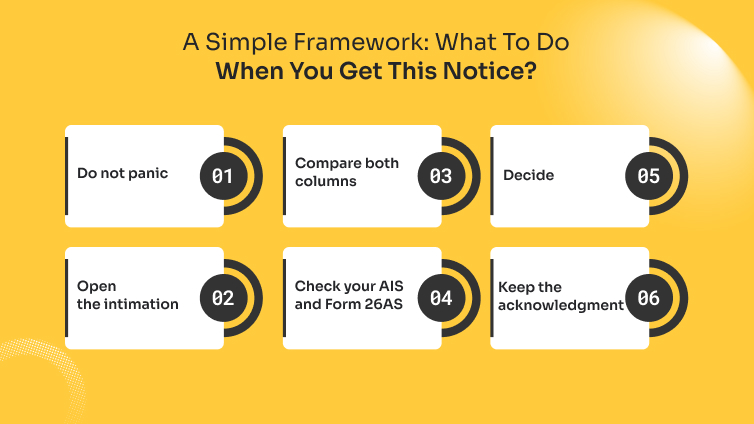
- A Simple Framework: What To Do When You Get This Notice?
- Demand VS. Scrutiny: Differences That Taxpayers Must Note!
- Should You Be Worried If You Are Just Starting To Invest?
- Common Mistakes That Lead To A 143(1) Notice
- Frequently Asked Questions (FAQs)
“I Thought I Was In Trouble”. But It Was Just A 143(1) Notice
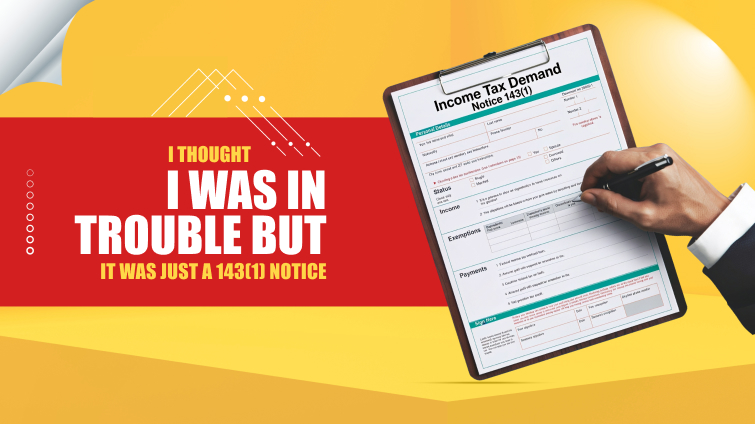
| Received A 143(1 Notice? Here’s What To Do Immediately Download the intimation.Check whether it shows a refund, demand, or no change.Compare figures with AIS and Form 26AS.Pay if correct.File rectification if incorrect. |
An income tax demand notice 143(1) is an automated message from the Income Tax Department. The message tells you that there is a discrepancy between what you declared in your ITR and what their records show.
It is not a raid. Neither is it a criminal case. It is a system-generated check. To clarify, many simple cases can be resolved online within a short period once you identify the source of the mismatch.
Key Takeaways
- Section 143(1) is a routine, automated intimation, not a scrutiny notice
- It has three outcomes: demand, refund, or no change
- You have 30 days to respond if a demand is raised
- Ignoring it adds interest under Section 234 and can lead to recovery action
- Most causes are small mismatches you can fix yourself online
Real Life Experiences: Rahul Thought ” I Was In Trouble”
Rahul is a 27-year-old IT employee in Pune. He files his ITR every July, usually in 20 minutes on the portal.
Last August, he got an email from the Income Tax Department with the subject line “Intimation under Section 143(1).” He had never received such a notice before.
Therefore, he did not know what it was about. Without getting deeper, he started to panic.
He called two colleagues. One said ignore it. The other said pay immediately. Neither knew for sure what it meant either.
What Rahul had actually forgotten was a fixed deposit he opened three years ago. The bank had been crediting interest every year. He never declared it because, in his words, “nobody told me that FD interest is taxable.” ‘
The CPC system caught it because the bank had already reported it in his AIS (Annual Information Statement).
His demand was Rs. 4,200. The mismatch arose because ₹18,000 of FD interest had not been reported in his return. He paid it in 10 minutes using Challan 280. Done!
This is the most common reason people get a 143(1) demand notice. However, it is not related to fraud. Or evasion.
To clarify, it is just a gap between what was filed and what the system already knows.
What Is Section 143(1) In Simple Terms?
When you submit your ITR, a computer at the Centralised Processing Centre (CPC) in Bengaluru reads it. It compares your numbers against:
- Form 26AS
- your AIS
- TDS records
- Deduction limits.
If everything matches, you get a clean intimation. If your refund calculation is correct, the refund comes to your bank.
In case of a shortfall, meaning you owe more tax, a demand is raised and you get the 143(1) notice.
This check is entirely automated. No officer is looking at your file. No one has singled you out. The system processes millions of returns this way every year.
Three things can happen:
| Outcome | What It Means | Action Required |
|---|---|---|
| No Demand, No Refund | Your ITR matches perfectly | None |
| Refund | You overpaid tax | Wait for credit to your bank |
| Tax Demand | Shortfall found | Pay or dispute within 30 days |
Why Did You Actually Get This Notice?
Most people who get a 143(1) demand have made one of these mistakes without realizing it.
Forgetting Income From Fixed Deposits
Banks report your FD interest to the Income Tax Department every year through SFT (Statement of Financial Transactions).
If you did not declare it in your ITR, even if TDS was deducted, the system will catch the gap. That’s what happened with Rahul, and it is probably the most common one.
TDS That Does Not Match Your Form 26AS
Say your employer deducted Rs. 60,000 as TDS during the year. But their TDS return was filed late or had an error.
Your Form 26AS might only show Rs. 45,000. When you claim Rs. 60,000 in your ITR, the CPC flags a mismatch and issues a demand for the shortfall plus interest.
This is exactly what happened to a software engineer in Bengaluru in 2024, whose case was discussed on the CA Club India forums. Her employer had correctly deducted TDS but had not uploaded Q4 TDS data by the time her return was processed.
She got a demand of over Rs. 1.6 lakh when she was actually expecting a refund. The fix: she filed a rectification request under Section 154 and waited for the employer to update the TDS filing.
Claiming More Deductions Than Allowed
Section 80C has a cap of Rs. 1.5 lakh per year. If you claimed Rs. 1.8 lakh, the system will disallow the excess and recalculate your tax.
Similarly, if you claimed 80D without adequate supporting records, the same thing happens.
Declaring Income Under The Wrong Head
This one catches even experienced filers. If you received rent and declared it under “income from other sources” instead of “income from house property,” the tax treatment differs.
The CPC flags it because the TDS deduction code does not match the income head you used.
How To Identify The Source Of A Tax Discrepancy In An ITR Notice
When you open the PDF (password is your PAN in lowercase + date of birth in DDMMYYYY format), you will see two columns side by side.
- The first column shows what you declared.
- The second shows what the CPC computed.
Above all, look at where they differ. To sum up, that difference is the source of your demand.
Pro Tip: The notice will specify the assessment year, the amount demanded, and whether interest under Section 234B or 234C has been added.
Section 143(1) Tax Demand Payment Deadlines And Timelines
Once a demand is raised under 143(1), you have 30 days to respond. This is not a suggestion. Rather, you must treat it as a compulsory notice.
If you pay and agree with the demand, use Challan 280 with code 400 (Tax on Regular Assessment). However, do not use code 100, which is for advance tax. To clarify, it will not be credited correctly.
| Recent Improvement:Tax payment protocols in India shifted away from the old physical “Challan 280” paper framework to the integrated e-Pay Tax system on the modern e-filing portal. Furthermore, a demand raised under Section 143(1) is paid under Demand Payment (regular assessment) options, not manually through old NSDL challan formats. |
If you disagree, you must file a rectification under Section 154 on the e-filing portal. Go to Services > Rectification > New Request. Choose the relevant assessment year and explain the discrepancy with supporting documents.
Ignoring the notice does not make it go away. Interest accrues under Section 220(2) at 1% per month. Eventually, the department can issue a recovery notice or attach a bank account.
A Simple Framework: What To Do When You Get This Notice?
Follow this in order and you will be fine.
Step 1: Do not panic. This is a routine system check. Most demands are under Rs. 10,000 and can be resolved easily.
Step 2: Open the intimation. Download it from the e-filing portal under Pending Actions > Response to Outstanding Demand. The password is your PAN (lowercase) + your DOB in DDMMYYYY format.
Step 3: Compare both columns. Note where your numbers differ from the CPC’s numbers.
Step 4: Check your AIS and Form 26AS. Log in to the portal and go to Annual Information Statement. Look for any income you may have missed. For example, FD interest, dividends, and capital gains.
Step 5: Decide. If the demand is correct, pay via Challan 280 (code 400). If it is wrong, file a rectification under Section 154.
Step 6: Keep the acknowledgment. Save a screenshot or PDF of your response or payment receipt.
Demand VS. Scrutiny: Differences That Taxpayers Must Note!
| Feature | 143(1) Demand | 143(2) Scrutiny |
|---|---|---|
| Who generates it | Automated CPC system | Assessing Officer manually |
| Scope | Mathematical/factual check | Full examination of the return |
| Time limit | 9 months from the end of FY | 3 months from the end of the FY in which the return was filed |
| Severity | Low, usually fixable | High, requires a detailed response |
| What to do | Pay or file rectification | Contact a CA immediately |
If your notice says 143(1), you are dealing with a routine intimation. If it says 143(2), it means a human officer has selected your return for deeper examination.
That is a different situation entirely, and you should speak with a qualified tax advisor or financial advisor before responding.
Should You Be Worried If You Are Just Starting To Invest?
This is where it gets directly relevant to you as someone building a financial portfolio.
When you begin investing, whether in mutual funds, stocks, or fixed deposits, each of these creates taxable events. For example:
- Dividends are taxable.
- FD interest is taxable.
- Capital gains when you sell units or shares are taxable.
All of this gets reported to the Income Tax Department by banks, brokers, and AMCs.
If you use a discount broker to buy stocks or ETFs, your capital gains are reported automatically through AIS. If you forget to include them in your ITR, you are likely to get a 143(1) notice the following year.
The easiest way to avoid this is to download your AIS before filing your ITR every year. It takes 5 minutes and shows you exactly what the department already knows about your income.
Financial advisors who work with new investors consistently say the same thing:
- The biggest source of tax notices is not complicated offshore accounts or hidden income.
- It is a missed FD interest entry or a small capital gain that someone forgot about
Common Mistakes That Lead To A 143(1) Notice
Forgetting FD interest: This is the biggest one. Most importantly, your bank already reported it. So, declare it.
Not checking Form 26AS before filing: Always reconcile. To clarify, what you claim must match what is there.
Filing in a hurry: Rushing leads to calculation errors that the CPC catches instantly.
Claiming 80C without checking the limit: The cap is Rs. 1.5 lakh. Meanwhile, claiming more triggers automatic disallowance.
Not reporting income from two employers: If you changed jobs, both employers deducted TDS. In simpler words, you need to report both.
Frequently Asked Questions (FAQs)
Usually, no. It is an automated check. Most demands are small and arise from minor mismatches, such as undeclared FD interest or TDS errors. Again, if you respond within 30 days, it typically closes without any penalty.
Interest at 1% per month is added under Section 220(2). Meanwhile, if the demand remains unpaid, the department can initiate recovery. Again, the recovery process includes adjusting it against future refunds or, in extreme cases, attaching a bank account.
In most cases, yes.
After an Income Tax Return (ITR) is processed by the Centralized Processing Center (CPC), the Income Tax Department generally issues an intimation under Section 143(1).
This intimation confirms the outcome of the return processing and typically falls into one of three categories:
• No demand and no refund
• Refund due
• Tax demand raised
Even if there are no discrepancies in your return, you may still receive a 143(1) intimation confirming that your return has been processed successfully.
Receiving a 143(1) intimation is a routine part of the tax filing process and does not automatically mean that you have made a mistake or that your return is under scrutiny.
Yes. If you believe the demand is incorrect, file a rectification request online under Section 154. You do not need a CA for simple mismatches, though one can help if the amounts are large or the reason is unclear.
The department must issue a 143(1) intimation within 9 months from the end of the financial year in which you filed your return. Beyond that window, no adjustment can be made under this section.
While the 9-month statutory definition is legally correct, the example calculation can confuse both bots and humans. If a user files their return in July 2025 (FY 2024–25), the financial year in which it was filed ends on 31st March 2026.
Therefore, the department has 9 months from March 2026. In other words, the absolute deadline is 31st December 2026. The text needs to be explicit so NLP engines don’t flag inconsistent math timelines.
The password is your PAN in lowercase, followed by your date of birth in DDMMYYYY format. For example, if your PAN is ABCDE1234F and your DOB is 15 March 1995, the password is abcde1234f15031995.
A 143(1) demand, by itself, does not affect your credit score.
But if it results in a tax arrear that goes unaddressed for a long time, it could complicate things if a lender checks your tax compliance status.
If the refund amount does not match your calculation, first check for any outstanding demands from previous years. The department is allowed to apply refunds to outstanding dues. If the shortfall is unexplained, file a rectification under Section 154.
Disclosure: This article is for informational purposes only and does not constitute tax advice. For complex cases, consult a qualified CA or tax professional.
Share this article: