- Quick Answer: The Hotel GST Rate Slabs (2026)
- The Part Nobody Explains Properly: Which Price Actually Counts?
- Room Tariff Characteristics That Decide Your Slab
- Who This Actually Affects And How Differently?
- If You're A Leisure Traveler:
- If You Own Or Manage A Small Hotel:
- If You're A Business Traveller Claiming Expenses:
- Two Worked Examples
- Example 1:A Mid-Range Business Hotel In Pune
- Example 2: A Premium Hotel In Goa During Peak Season.
- Reality Check
- The Most Common Beginner Mistake
- What Changed Recently
- GST On Food And Restaurants Inside Hotels
- Pros And Cons Of The Current Structure
- Should You Worry About This? A Simple Framework
- What This Looks Like From Different Sides Of The Industry
- Things Hotel Owners Should Not Miss
- Frequently Asked Questions
Hotel GST Rate in India: Why the ₹7,500 Rule Still Confuses Everyone (2026 Guide)
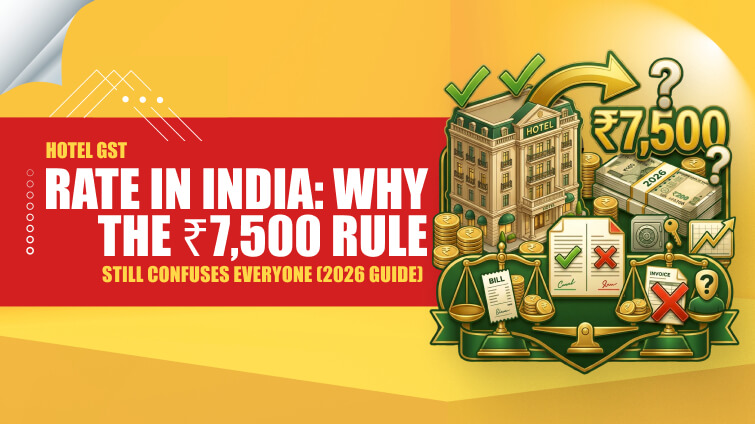
Hotel GST in India is a tax charged on a hotel room’s nightly rate. Rooms up to ₹7,500 are taxed at 5%, and rooms above that are taxed at 18%. It sounds simple.
It offers clarity on paper. But in practice, hotels, guests, and even accountants keep disagreeing on which price the rule is actually based on. That disagreement is the real story here, and almost nobody writes about it directly.
Quick Answer: The Hotel GST Rate Slabs (2026)
Here’s the structure that has applied since the GST Council’s rate rationalisation took effect on 22 September 2025.
| Room Tariff (per night) | GST Rate | Input Tax Credit (ITC) |
|---|---|---|
| Up to ₹1,000 | Nil (0%) | Not applicable |
| ₹1,001 – ₹7,500 | 5% | Not allowed |
| Above ₹7,500 | 18% | Allowed |
That table looks final. It isn’t. The next section explains why.
The Part Nobody Explains Properly: Which Price Actually Counts?
Ask ten hotels which figure decides the GST slab, and you’ll get more than one answer. Some go by the room’s declared or rack tariff.
For example, the official listed price, regardless of any discount. Others apply GST to the actual amount the guest pays, including discounts.
This isn’t a small technicality. It changes the bill.
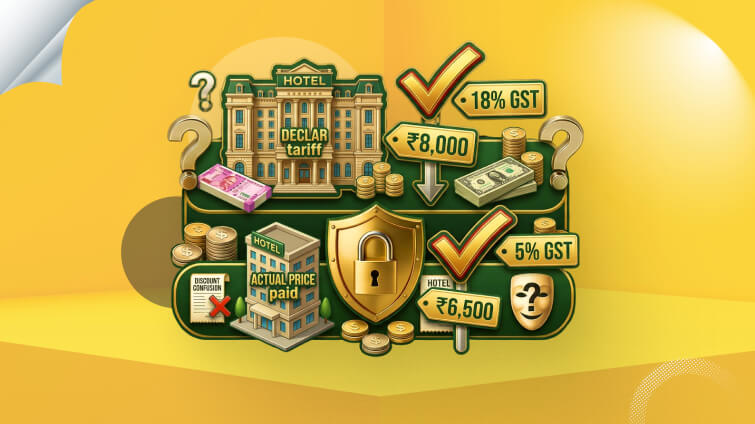
Say a hotel lists a room at ₹8,000. But sells it for ₹6,500 after a festive discount. Under the “declared tariff” approach, that room still falls in the above-₹7,500 bracket, so GST is 18%.
Under the “actual price paid” approach, the room falls into the ₹1,001–₹7,500 bracket. So GST is only 5%.
Both interpretations show up across current GST guidance and hotel billing practices. If you’re a guest, this is why two people can book what looks like the same discounted room and see different tax lines on their invoice.
If you run a hotel, this is exactly where billing disputes and mismatched invoices tend to start. At the same time, that’s where a GST practitioner’s judgment matters more than a blog post ever can.
Takeaway: If you’re booking a room close to the ₹7,500 line, ask the hotel directly which tariff they’re using to calculate GST, before you pay. Don’t assume.
Room Tariff Characteristics That Decide Your Slab
- Per-room, per-night basis: GST is calculated on each room for each night, not on the total stay.
- HSN code 9963: governs hotel accommodation, which is why hotel GST behaves differently from restaurant GST even inside the same building.
- “Specified premises” status carries over: if even one room in a hotel crossed ₹7,500 in the previous financial year, the whole property can be classified as a “specified premises,” which changes how its in-house restaurant is taxed too.
Who This Actually Affects And How Differently?
Most articles explain the rate slab once and move on. But a business traveler, a budget hotel owner, and a leisure guest experience this rule in three completely different ways.
If You’re A Leisure Traveler:
- Your total trip cost shifts noticeably once a room crosses ₹7,500. In other words, you have to bear an 18% tax versus 5% is a real difference on a ₹10,000 booking.
- Watch for hotels quoting a “starting price” below ₹7,500 that jumps once taxes and fees are added.
- Festive season discounts can genuinely change your tax slab. It’s worth asking before you confirm.
If You Own Or Manage A Small Hotel:
- You cannot claim ITC on cleaning supplies, linen, or maintenance if you’re charging the 5% slab. This silently increases your real operating cost.
- Even occasional crossings of ₹7,500 can pull your property into “specified premises” status for the following year.
- Declared tariffs across your website, OTA listings, and front-desk billing need to match. Remember, mismatches are a common audit flag.
If You’re A Business Traveller Claiming Expenses:
- ITC is only available at the 18% slab, so budget hotel stays under ₹7,500 give your company no tax credit at all.
- Always confirm the invoice/e invoice shows GSTIN, HSN code 9963, and the correct rate. To clarify, a wrong invoice can get your ITC claim rejected later.
Two Worked Examples
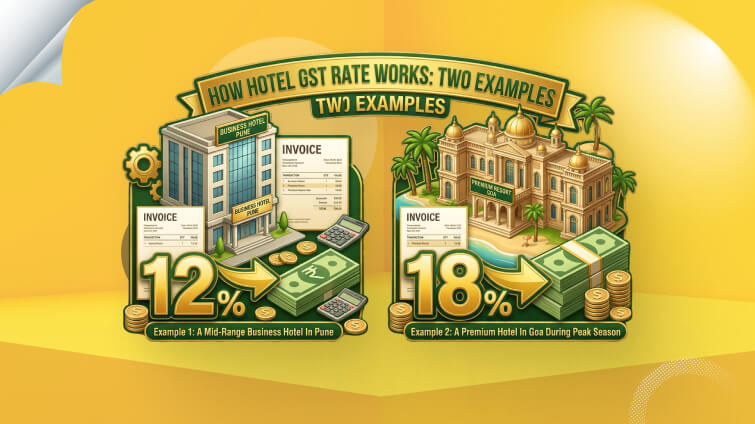
Let us understand how hotel GST rate works from a practical standpoint:
Example 1:A Mid-Range Business Hotel In Pune
A guest books a room listed at ₹6,000 per night. Since this falls in the ₹1,001–₹7,500 bracket, GST is charged at 5%: ₹300.
Total payable: ₹6,300. No ITC is available on this stay, even for a GST-registered business traveller.
Example 2: A Premium Hotel In Goa During Peak Season.
A guest books a suite at ₹9,500 per night. This crosses the ₹7,500 line, so GST is charged at 18%: ₹1,710. Total payable: ₹11,210.
If the guest is travelling for business and the company is GST-registered, this stay is eligible for ITC. That’s a meaningful saving on corporate travel budgets over a year.
Reality Check
A common claim online is that “hotels under ₹7,500 don’t pay GST at all.” However, that’s incorrect. Only rooms priced up to ₹1,000 are GST-exempt.
Everything between ₹1,001 and ₹7,500 is still taxed. Just at 5% instead of 18%, and without the ITC benefit. Confusing “lower rate” with “no tax” is one of the most repeated mistakes in hotel GST discussions.
The Most Common Beginner Mistake
Many first-time travellers and even some small hotel owners assume the room’s star rating decides the GST slab: 5-star hotels automatically charge 18% and budget hotels automatically charge 5%. That’s not how it works.
The rule is based purely on the room tariff, not the hotel’s category. A boutique 3-star property charging ₹9,000 a night attracts 18% GST, while a well-rated business hotel offering rooms at ₹6,500 stays at 5%,regardless of star classification.
What Changed Recently
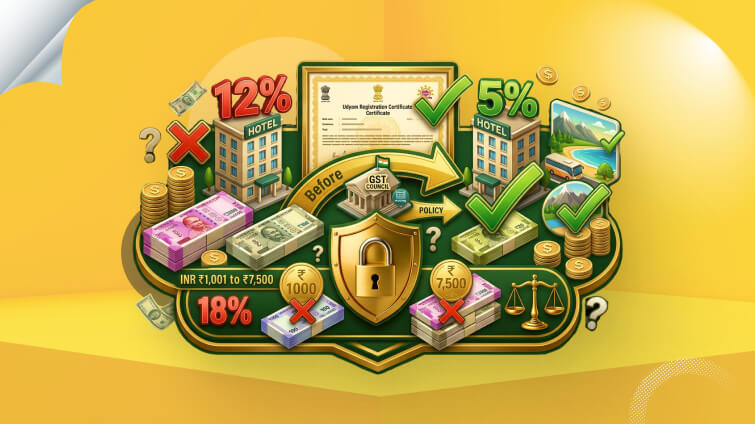
Before 22 September 2025, hotel rooms priced between ₹1,001 and ₹7,500 were taxed at 12%, not 5%.
The GST Council’s rationalisation dropped this to 5%, specifically to make mid-range hotels more affordable and support domestic tourism.
The ₹7,500 threshold for the 18% slab, and the nil rate below ₹1,000, have stayed unchanged through this revision.
If you’re reading older hotel GST content, including some still-live articles, check the date. For intance, an article on gst filing last date. To clarify, pre-September 2025 figures are now outdated.
GST On Food And Restaurants Inside Hotels
This can call for a second layer of confusion. So, separate from the room tariff itself.
| Hotel Type | Restaurant GST Rate | ITC on Restaurant |
|---|---|---|
| Non-specified premises (no room crossed ₹7,500 last FY) | 5% | Not allowed |
| Specified premises (any room crossed ₹7,500 last FY) | 18% | Allowed |
This means two hotel restaurants serving an identical menu can be taxed completely differently, purely because of what their rooms cost. Not because of the food itself.
Pros And Cons Of The Current Structure
Pros:
- Mid-range hotel stays are cheaper than before the reform
- Nil rate protects budget travellers and small lodges
- Fewer slabs make the system easier to understand than the old VAT-plus-service-tax era
Cons:
- No ITC below ₹7,500 raises real operating costs for budget and mid-range hotels
- Ambiguity between declared tariff and actual paid price creates billing disputes
- “Specified premises” status can pull a hotel into a higher restaurant tax bracket even if most of its rooms are affordably priced
Should You Worry About This? A Simple Framework
If you’re a guest: Check the final invoice, not just the listed price, before you book anything close to ₹7,500.
If you’re a hotel owner: Follow this before your next billing cycle:
- List every room category and its actual average selling price, not just the rack rate.
- Identify if any room crossed ₹7,500 in the last financial year. To clarify, this affects the status of your specified premises.
- Check whether your restaurant billing matches your correct rate bracket.
- Reconcile your OTA listings with your GST invoices monthly.
- When in doubt, get a second opinion from a GST practitioner rather than guessing.
- This is exactly the kind of situational judgment a professional is trained for, not something a general guide can fully replace.
What This Looks Like From Different Sides Of The Industry
A GST-registered corporate traveller primarily cares about exceeding ₹7,500 to unlock ITC. A small hotel owner cares about staying compliant in daily operations without losing ITC eligibility.
An OTA platform is responsible for keeping listed tariffs consistent with actual GST invoices across thousands of properties. The same rule, three very different day-to-day concerns.
Things Hotel Owners Should Not Miss
- Hotel rooms up to ₹1,000 are GST-exempt; ₹1,001–₹7,500 attracts 5% GST with no ITC; above ₹7,500 attracts 18% GST with ITC.
- Whether GST applies to the declared tariff or the actual discounted price is genuinely disputed in practice; always confirm with the hotel.
- Star rating has no bearing on the GST slab; only the room tariff does.
- Restaurant GST inside a hotel depends on the hotel’s room tariff bracket, not the restaurant’s own pricing.
- These rates took effect on 22 September 2025, replacing the earlier 12% mid-range slab.
Frequently Asked Questions
If you still have doubts about hotel gst rate, check out the following:
Both approaches exist in practice, and this remains a genuine point of confusion across the industry. Confirm directly with the hotel before booking near the ₹7,500 threshold.
No. The rate depends entirely on the room tariff, not the hotel’s star classification.
No. ITC is only available on rooms taxed at the 18% slab.
Not necessarily. A hotel’s status as a “specified premises” determines the GST applicable to its restaurant and room services, and room tariffs from the previous financial year determine that status.
Yes, rooms tariffed at ₹1,000 or below are exempt from GST.
Yes. The government reduced the GST rate on hotel rooms priced between ₹1,001 and ₹7,500 from 12% to 5% on 22 September 2025, although hotels cannot claim Input Tax Credit (ITC) under this slab.
Share this article: