- Key Takeaways
- Why Your Bank Already Knows More Than You Think
- How the System Actually Works: SFT, AIS, And Form 26AS In Plain Language
- Here's The Current Picture:
- The First-Time Money Moments Beginners Don't See Coming
- The 6 Life Moments That Matter
- Reality Check: "But My UPI Payments Are Between Friends, Right?"
- Common Beginner Mistake: Assuming Salaried Employees Are Automatically Safe
- The Notice Almost Everyone Gets: Section 143(1)
- When It Goes Beyond Routine: Other Notices Salaried Employees Should Know
- If You Freelance Or Run A Small Business: E-Invoices Are Building A Trail You Can't Undo
- What About Instant Loan Apps Like Google Pay, Navi, or CASHe?
- What Changed Recently?
- Should You Actually Worry? A Simple Way To Decide
- A Simple 4-Step Framework To Check Your Own Exposure
- Frequently Asked Questions
Income Tax High-Value Transactions: The Everyday Money Moments That Put You On The Tax Department’s Radar
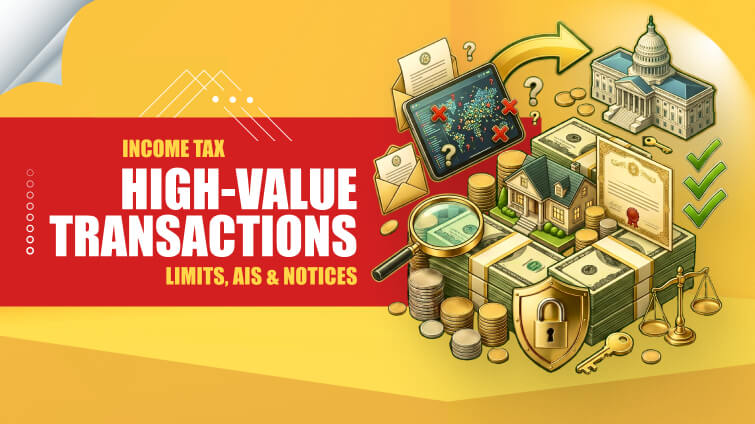
Income tax high-value transactions are financial activities like large cash deposits, property purchases, or big mutual fund investments.
Banks and other institutions must report them to the Income Tax Department once they exceed a fixed limit.
It sounds alarming, but it isn’t a punishment. It’s a matching exercise, and most people cross one of these limits without ever meaning to.
Key Takeaways
- Banks, mutual fund houses, property registrars, and even the post office report certain transactions to the tax department once they cross a set value. This is called SFT: Statement of Financial Transaction.
- This is completely separate from whether the transaction was legal or fair. A cash deposit of ₹12 lakh from your own savings is reported exactly the same way as a suspicious one would be.
- Getting flagged doesn’t mean you did something wrong. It means your paperwork needs to agree with your bank’s paperwork.
- Loans, gifts, salary hikes, and even wedding cash can all quietly cross a reporting threshold without you realizing it.
- The fix is almost always the same: check your AIS before filing your return and keep proof for anything unusual.
Why Your Bank Already Knows More Than You Think
Here’s something most beginners don’t expect: you don’t need to be rich, self-employed, or run a business to perform income tax high-value transactions and attract the tax department’s attention.
You just need to do one normal thing at an unusual scale. For instance, deposit a bonus in cash, buy your first flat, or invest a lump sum you inherited.
Every one of those moves is automatically tied to your PAN. Your bank doesn’t ask your permission before reporting it, and it isn’t trying to catch you out.
It’s simply doing what the law requires under Section 285BA of the Income Tax Act. For instance, filing something called a Statement of Financial Transaction, or SFT, once your activity crosses a defined limit.
The real question isn’t “will this get reported.” For a lot of first-time earners, it already has been, at some point, without them noticing.
The real question is whether the information reported by banks, registrars, and financial institutions matches what you declared in your tax return.
That gap, not the transaction itself, is what actually causes trouble.
How the System Actually Works: SFT, AIS, And Form 26AS In Plain Language

Three terms get thrown around a lot here, and beginners usually mix them up.
SFT (Statement of Financial Transaction) is the report itself. Banks, registrars, and mutual fund companies file it, not you.
AIS (Annual Information Statement) is where that data lands for you to see. Log into the income tax e-filing portal, go to Services, and you’ll find it.
Think of it as a financial diary that other people have been keeping about you, whether you knew it or not.
Form 26AS is the older, more limited version of the same idea. That is originally built for TDS credit; now it also shows high-value transactions in one section.
Once your ITR is filed, an automated system compares what you declared with what appears in your AIS.
If a salaried person reporting ₹6 lakh in annual income suddenly shows ₹20 lakh in bank deposits, the system doesn’t accuse you of anything. It just asks, politely at first, for an explanation against the income tax high-value transactions.
Remember that most beginner guides stop with a list of numbers. But numbers only matter once you see them next to real life.
Here’s The Current Picture:
| Transaction type | Reporting threshold (per financial year) | Reported by |
|---|---|---|
| Cash deposits in savings account(s) | ₹10 lakh or more (aggregated across accounts) | Banks |
| Cash deposits/withdrawals in current account(s) | ₹50 lakh or more | Banks |
| Fixed deposits | ₹10 lakh or more | Banks, post offices |
| Credit card bill payments | ₹1 lakh or more in cash, or ₹10 lakh or more through any other mode | Banks, card issuers |
| Buying or selling a static property | ₹30 lakh or above (or the stamp duty value, if higher) | Property registrars |
| Mutual funds, shares, bonds, debentures | ₹10 lakh or more | Mutual fund houses, companies, RTAs |
| Foreign currency purchase (forex cards, remittance) | ₹10 lakh or more | Banks, authorized dealers |
| Dividend, interest, capital gains | No minimum, every rupee is reported | Companies, banks, brokers |
Notice the last row. There’s no “safe” amount for interest or dividend income. It all gets reported.
Again, that is exactly why forgetting to add your savings account interest to your return is one of the most common and most avoidable mistakes. Those are the reasons for a mismatch notice.
The First-Time Money Moments Beginners Don’t See Coming
This is the part most articles skip entirely. However, it is actually a very critical part. Nobody wakes up planning to trigger an SFT entry.
It happens in the middle of ordinary life. Here’s a simple way to think about your own exposure, grouped by how likely each situation is to cross a threshold.
The 6 Life Moments That Matter
| Life Moment | Why It Might Cross A Threshold | Risk Level | What To Do |
|---|---|---|---|
| Depositing a bonus or gratuity in cash | Adds directly to your annual cash deposit total | Medium | Prefer a bank transfer; if cash, keep the pay slip or gratuity letter |
| Buying your first flat with family help | Property value often exceeds ₹30 lakh even in smaller cities | High | Register at full value; retain the sale deed and payment proof |
| Getting wedding cash gifts from relatives | Gifts from specified relatives are tax-free, but large cash amounts still look unusual in a bank statement | Medium | Keep a simple written note of who gave what: a gift deed isn’t required for close relatives, but a record helps |
| Investing a lump sum (say, from an FD maturity) into mutual funds | Easily crosses ₹10 lakh, especially if you’re moving money rather than “new” money | Medium | No action needed beyond declaring any capital gains later; this is normal, not risky |
| Taking a personal loan through an app | The loan itself isn’t income, but large disbursals or repayments still appear in your account | Low | Save the loan agreement and sanction letter |
| Receiving your first big salary hike or bonus, paid via multiple accounts | Interest and other income across all your accounts gets aggregated by PAN, even if you forget one | Medium | Check every bank’s AIS entry, not just your primary account |
None of this means you should avoid these moments. It means you should expect them to show up somewhere, and have a one-line explanation ready if asked.
Reality Check: “But My UPI Payments Are Between Friends, Right?”
A common belief among younger earners is that UPI is somehow invisible to the tax department because it’s “just an app.” It isn’t quite that simple.
A single ₹2,000 UPI transfer to split a dinner bill isn’t going anywhere. But what if your account shows repeated high-value income tax transactions of ₹2-3 lakh a month? That doesn’t match your declared income.
The pattern itself can draw attention. Even if no single transaction crosses a reporting threshold. The system isn’t just watching for big numbers. It’s watching for numbers that don’t add up.
This matters especially if you receive money from freelance work, side gigs, or informal business through UPI and treat it as “not really income” because it wasn’t a bank transfer or cheque. It is income. UPI is just the delivery method.
Common Beginner Mistake: Assuming Salaried Employees Are Automatically Safe
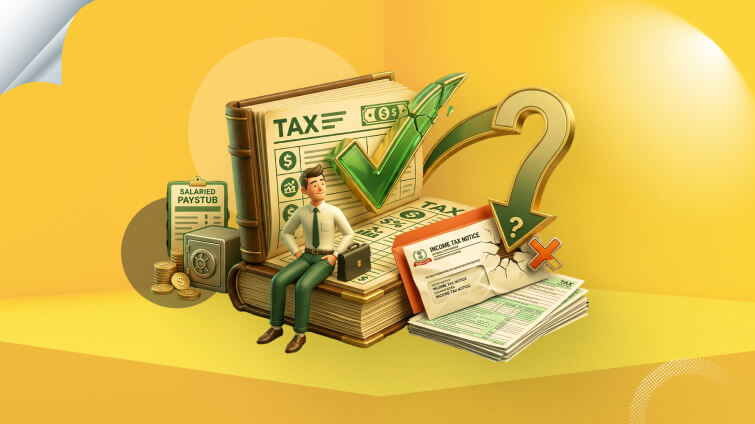
If tax is already deducted from your salary every month, it’s tempting to assume you’re covered. Most notices land on people who never expected one, precisely because of this assumption.
In reality, salaried employees get flagged for reasons that have nothing to do with dishonesty. It is mostly forgetfulness.
Switching jobs mid-year and forgetting to add your previous employer’s income is one of the most frequent triggers. To clarify, the system shows two Form 16s, but your return only accounts for one.
Claiming HRA without adjusting for a rent-free period, missing out on interest income from an old savings account, or not declaring capital gains from a few mutual fund units you sold years ago are small gaps that usually cause the mismatch, not deliberate underreporting.
The Notice Almost Everyone Gets: Section 143(1)
If you’ve filed an ITR before, you’ve probably already received one of these and not realised what it was. An income tax intimation under Section 143(1) is the most routine communication the department sends.
It’s generated automatically after your return is processed at the Centralised Processing Centre in Bengaluru, comparing your numbers with what’s on file.
Three things can happen: it confirms your return matches, it shows a small tax demand, or it shows a refund. None of these are cause for panic.
If you spot an error in the intimation itself like a calculation mistake on the department’s end, for instance, you can file an online rectification request rather than treating it as a dispute.
What you shouldn’t do is ignore it. A silent, unpaid demand can quietly grow into a bigger problem later.
When It Goes Beyond Routine: Other Notices Salaried Employees Should Know

Section 143(1) is the gentle one. A handful of others are worth recognizing by number alone, so you don’t panic unnecessarily. Or worse, ignore something serious because it looked routine.
- Section 139(9): your return had an error or missing detail and needs correction.
- Section 143(2): your return has been picked for a closer, more detailed review. This one needs a proper response, ideally with a professional’s help.
- Section 245: the department wants to apply a pending refund to an outstanding balance.
- Section 148: there’s a reason to believe some income wasn’t reported in an earlier year.
For a deeper walkthrough of how to respond to each of these as a salaried employee, including timelines and which documents to have ready, it’s worth reading a dedicated guide on income tax notices for salaried individuals.
If You Freelance Or Run A Small Business: E-Invoices Are Building A Trail You Can’t Undo
If your side hustle or small business has grown past ₹5 crore in annual turnover, GST rules already require you to generate an e invoice for every B2B sale, reported in real time to the government’s Invoice Registration Portal.
Most freelancers won’t cross this threshold early in their careers. Even so, understanding how e-invoicing works now can prevent surprises later, as it changes the way tax authorities track business transactions.
Once e-invoicing applies to your business, the system timestamps and digitally signs every qualifying sale before recording it on the government’s Invoice Registration Portal. The GST system then automatically pulls that data into your returns.
Tax authorities increasingly compare this GST turnover trail with the revenue and profit you report in your income tax return. As a result, a mismatch here doesn’t follow the usual SFT or AIS process. Instead, it can trigger direct GST scrutiny.
It’s handled through GST scrutiny, which can be more direct and less forgiving.
The lesson for anyone scaling up a business: your GST filings and your ITR need to tell the same story, because the systems checking them are no longer separate.
What About Instant Loan Apps Like Google Pay, Navi, or CASHe?
This is one of the most common points of confusion for first-time borrowers, and it deserves a direct answer: the tax treatment of a Google Pay loan or similar apps is the same as any other loan.
The principal amount you receive is not income. It doesn’t get taxed, no matter which app, bank, or NBFC it comes from.
Where it gets slightly more nuanced:
- If a lender waives part of your loan or agrees to settle it for less than you owed, the tax department may treat the waived amount as taxable income.
- Large loan disbursements and repayments still appear as bank credits and debits.
- They aren’t SFT-reportable. In this way, they are different from an FD or a property purchase.
- But if your account shows unusual activity overall, an unexplained large credit is exactly the kind of thing that invites a question. So keep your loan agreement and sanction letter somewhere safe.
- Stick to RBI-registered NBFCs or bank-backed lending apps. Unregulated loan apps create legal risk that has nothing to do with tax, and everything to do with data misuse and harassment during recovery.
In short: the loan won’t get you a notice. However, an unexplained gap in your bank statement might.
What Changed Recently?
Finance rules don’t stay still, and this is one area where “recent” genuinely matters. From 1st April 2026, the Income Tax Act, 2025 replaced the Income Tax Act, 1961, as India’s core tax law.
The high-value transaction reporting mechanism, aka “SFT” continues under the new Act with the same underlying logic. Meanwhile, the sections and forms are gradually being renumbered as the transition settles in.
Alongside this, reporting has expanded to cover a few newer categories, including stamp paper purchases and crypto-asset transactions, and the penalty structure for reporting entities that file incorrectly has been capped rather than left open-ended.
None of this changes what you, as an individual, need to do. Simply put, check your AIS. Meanwhile, make sure it matches your return, and keep documentation for anything large or unusual.
Should You Actually Worry? A Simple Way To Decide
Worry if: your AIS shows a transaction you can’t explain, your declared income is clearly lower than your spending or investment pattern, or you’ve received an actual notice with a deadline attached.
Don’t worry if: you’ve made a large, legitimate transaction like an FD, a property purchase, a mutual fund investment, and you have the paperwork to back it up. Being reported isn’t being suspected.
Wait and check first if: you are not sure whether something in your AIS belongs to you. Joint accounts and shared PAN details occasionally cause institutions to attribute a transaction to the wrong person. Submit feedback on the AIS portal before assuming the worst.
A Simple 4-Step Framework To Check Your Own Exposure
- List your big-money moves for the year, such as property, FDs, mutual funds, large cash deposits, loans, andgifts received.
- Download your AIS from the income tax portal and match each entry against your list.
- Flag anything unfamiliar and use the AIS feedback option to correct or dispute it before you file.
- File your return only after this check, not before. To clarify, a pre-filing AIS review takes 15 minutes and prevents most notices from being sent.
Again, do you have anything that goes beyond a routine mismatch? For instance, a scrutiny notice, a large undeclared capital gain, or a genuinely confusing AIS entry also counts as income tax high-value transactions.
That is where a chartered accountant or a registered financial advisor would be helpful for you. Their real value isn’t filling out forms.
Instead, their real value lies in translating a dense notice into three plain sentences you can act on. Treat the checklist above as your first line of defense, and a professional as your second, not your first.
Frequently Asked Questions
No. Most notices are automated queries generated when your AIS doesn’t match your return. An actual audit or scrutiny assessment is a separate, much rarer process under Section 143(2), and it comes with its own formal notice.
Individual UPI transactions aren’t flagged one by one. But if your inflows aggregate to a reportable amount, or clearly don’t match your declared income, they will eventually reflect in your AIS.
No. Loan principal isn’t taxable income regardless of the lender. Keep your loan documents handy in case a large transaction needs to be explained later.
Form 26AS is narrower and older, focused mainly on TDS credit with a section for high-value transactions. AIS is the newer, more complete version covering nearly all your reported financial activity in one place.
Not necessarily. It’s the standard, automated response every return gets after processing. It only becomes something to act on if it shows a demand or a discrepancy you disagree with.
Log into the e-filing portal, go to the Compliance Portal under Pending Actions, and check the e-Campaign section. Submit an honest, documented response rather than ignoring it. In other words, silence is what turns a routine query into a bigger problem.Disclaimer: This article is for general understanding and reflects the rules applicable as of mid-2026. Tax rules change with each Budget, so for decisions involving large sums, always confirm current provisions with a chartered accountant.
Share this article: