- What Is Udyam Aadhar?
- Which Category Your Enterprise Falls Under?
- Udyam Aadhar Registration At A Glance
- Who Actually Needs This, and Who Can Skip It
- If you're asking "do I even qualify as a business":
- If You're Asking "Will Registration Actually Change Anything For Me":
- If You're Asking "Is This Only For Manufacturers":
- What Changed Recently
- Udyam VS. The Other Registrations Beginners Confuse It With
- Udyam VS. GST Registration
- Udyam VS. Shop And Establishment License
- Udyam VS. Startup India (DPIIT) Recognition
- Udyam VS. Company Registration
- The Biggest Beginner Mistake: Treating Udyam Aadhar As A One-Time Event
- Reality Check
- Eight Mistakes That Only Cost People Money Or Time
- 1. Wrong NIC Code.
- 2. Including Export Turnover In The Total.
- 3. Registering As An Individual When The Business Is Actually A Partnership Or Company.
- 4. Not Linking GSTIN When You Already Have One.
- 5. Never Migrating From The Old Udyog Aadhaar Memorandum.
- 6. Wrong Pan Mapping For The Entity Type.
- 7. Applying For A Loan Right After A GST Update, Before Udyam Has Re-Synced.
- 8. Entering Estimated Or Rounded-Off Turnover Instead Of The Exact Filed Figure.
- Should You Register? A Straight Answer
- Exclusive Financeteam.net Guide: A Simple Decision Framework Before You Register
- Where Udyam Overlaps With Other Paperwork You'll Hear About
- · HUF PAN card:
- · E-invoice:
- · Income Tax Section 43B(h):
- What Professionals Actually Think Of Udyam Registration?
- · Bank Loan Officers
- · Chartered Accountants
- · Government Tender Officers
- · Financial Advisors
- A Beginner Investor's Detour: Why Business Formalization Connects To Personal Money Decisions
- Useful Official Resources
- Frequently Asked Questions
- Decision Making Tips For MSMEs
The Invisible Pitfalls of Speed-Running Your Udyam Aadhar Registration

Udyam Aadhar is the Government of India’s free, Aadhaar-based registration that recognizes a business as a Micro, Small, or Medium Enterprise (MSME).
It’s a self-declaration process linked to your PAN and GST data. In addition, it offers loan priority, access to tenders, and legal payment protection. But only if the details you file stay accurate over time.
Most people still search for it as “Udyam Aadhar” or “Udyam Aadhaar.” However, the system has operated officially as Udyam Registration since 2020.
All three names point to the same portal and the same certificate. This article uses them interchangeably. Why?
That’s the way business owners actually search for it. But Udyam Aadhar registration is what most first-time applicants are looking for when they land here.
But why did I have to write an article on Udyam registration in the right place? Many MSMEs and entrepreneurs make unnecessary and silly mistakes when filling out the form.
Meanwhile, the internet lacks a genuine one-stop guide that prompts you at every step to stop making such errors.
Here we look at what actually goes wrong after registration and how Udyam compares to other registrations beginners often confuse it with. We also cover how to avoid the traps that specifically trip up first-timers.
What Is Udyam Aadhar?
Udyam Aadhar (officially Udyam Registration) is the government’s free, self-declaration-based system for recognizing Micro, Small, and Medium Enterprises.
It runs on Aadhaar, PAN, and GST verification with no document uploads. Once approved, you get a permanent Udyam Registration Number (URN) and a QR-coded e-certificate.
| Issued by: Ministry of Micro, Small and Medium Enterprises (MSME)Cost: Free, on the official portal (udyamregistration.gov.in)Based on: Composite criteria of investment in plant/machinery or equipment, and annual turnoverValidity: Lifetime, but classification is re-checked every financial year using your ITR and GST filingsLegally mandatory: No. But without it, MSME loans, tender preference, and delayed-payment protection are unavailable to you |
Which Category Your Enterprise Falls Under?
MSME classification calculator: adjust investment and turnover to see your Udyam category and where it sits relative to the limits
MSME Udyam Classification Calculator
Udyam composite investment & turnover criteria
Your category
Micro enterprise
Well within Micro limits on both criteria.
Based on composite criteria effective 1 April 2025 (Notification S.O. 1364(E)). Both figures are checked together — crossing either limit moves you up a category; you only move down if both figures fall below the lower tier.
Udyam Aadhar Registration At A Glance
| Detail | Information |
|---|---|
| Registration Fee | Free (official portal only) |
| Issuing Authority | Ministry of MSME, Government of India |
| Legal Basis | MSMED Act, 2006; Notification S.O. 1364(E), 21 March 2025 |
| Validity | Lifetime, no expiry or renewal |
| Update Requirement | Annual re-verification via ITR/GST data |
| Certificate Format | Digital, downloadable anytime with URN + Aadhaar-linked mobile |
| Core Eligibility | Any manufacturing, service, or trading enterprise within investment and turnover limits |
| Main Benefits | Priority lending, CGTMSE collateral-free loans, 45-day payment protection, tender preference, trademark fee rebate |
Who Actually Needs This, and Who Can Skip It

Here is a detailed list you need to check out:
If you’re asking “do I even qualify as a business”:
- Freelancers and consultants working under their own name or a proprietorship
- Home-based sellers on Instagram, Meesho, or their own website
- Anyone running a shop, workshop, or service unit, even without a formal company structure
Yes, all of these qualify. You don’t need to be a registered company. A sole proprietor with just a mobile number linked to Aadhaar can register.
If You’re Asking “Will Registration Actually Change Anything For Me”:
- If you’re only ever paid in cash by walk-in customers and never plan to take a business loan, the payment-protection benefit won’t matter much to you.
- If you sell mainly to individuals rather than other businesses or government departments, tender access is irrelevant.
- If you already deal with other businesses (B2B) as a GST-registered entity, Udyam becomes far more useful,
- because the 45-day payment rule under the MSMED Act applies directly to those transactions.
If You’re Asking “Is This Only For Manufacturers”:
- No. Traders (retail and wholesale, including online sellers) can register too, but with a caveat:
- The Ministry has clarified that trader benefits are largely restricted to priority-sector lending,
- not to the full tender and procurement advantages that manufacturing or service businesses get.
- This is one of the most commonly misunderstood points about the scheme.
What Changed Recently
Finance rules don’t stay still, and Udyam’s classification limits are a good example. In the Union Budget 2025-26, the government enhanced investment limits by 2.5 times and turnover limits by 2 times, effective 1 April 2025 under Notification S.O. 1364(E).
This wasn’t a cosmetic tweak. It moved a meaningful number of growing businesses into more favorable categories or kept them from being pushed out of MSME status altogether.
| Category | Investment Limit (pre-2025) | Investment Limit (from Apr 2025) | Turnover Limit (pre-2025) | Turnover Limit (from Apr 2025) |
|---|---|---|---|---|
| Micro | Up to ₹1 crore | Up to ₹2.5 crore | Up to ₹5 crore | Up to ₹10 crore |
| Small | Up to ₹10 crore | Up to ₹25 crore | Up to ₹50 crore | Up to ₹100 crore |
| Medium | Up to ₹50 crore | Up to ₹125 crore | Up to ₹250 crore | Up to ₹500 crore |
Source: https://www.indiafilings.com/learn/msme-new-definition
A business is classified using both figures together under the composite criteria set out in the MSMED Act, not just one. If either your investment or your turnover crosses into the next bracket, you move up.
You only move back down if both figures fall below the lower bracket’s limits. So one strong year on turnover alone won’t demote or promote you permanently.
Why this matters for a beginner: if you registered before April 2025 and haven’t logged back in since then, your classification may be outdated. The portal doesn’t automatically notify you to recheck it. You have to go do it.
Udyam VS. The Other Registrations Beginners Confuse It With
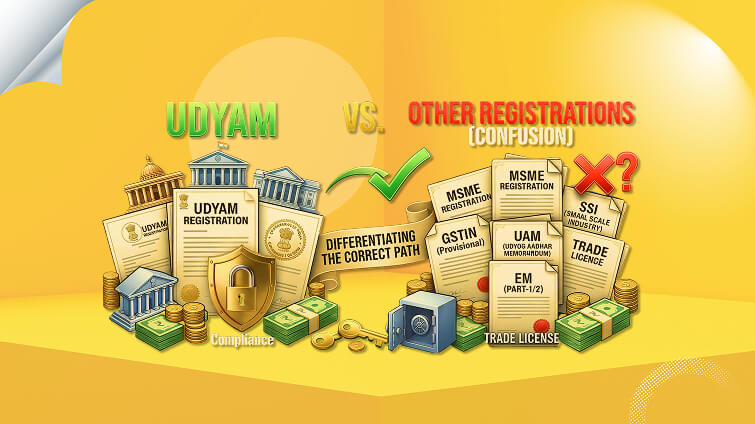
This is where most guides stop short, and where most of the real confusion actually brews. Udyam isn’t the only registration a small business runs into. At the sme time, it isn’t a substitute for the others.
Udyam VS. GST Registration
These solve different problems entirely. Udyam gets you MSME recognition and benefits. On the other hand, the GST registration makes you tax-compliant.
According to the Ministry of MSME clarifications, GSTIN is not mandatory for Udyam registration. However, that holds if:
- your turnover is below the GST threshold:
- ₹40 lakh for goods
- ₹20 lakh for services
- lower in special-category states
- or if you deal exclusively in GST-exempt goods.
Once you exceed that threshold, GST registration becomes compulsory regardless of your Udyam status. In other words, the two aren’t linked in that sense, even though the Udyam portal uses your GST data to auto-verify turnover once you have a GSTIN.
Udyam VS. Shop And Establishment License
Udyam is a central government recognition of your business size. Meanwhile, the Shop and Establishment License is a state-level requirement to legally operate physical commercial premises.
They serve completely different purposes. For instance, one is about MSME benefits. While, the other is about labor law compliance (working hours, safety standards, employee records) enforced by your state government.
Most banks require a Shop Act license before opening a current account, separate from anything Udyam provides.
A purely home-based freelancer with no physical premises may not need one. In contrast, a business with a storefront or office almost always does, and it’s typically due within 30 days of starting operations.
Udyam VS. Startup India (DPIIT) Recognition
Udyam classification is purely size-based. Therefore, the two parameters that matter here are investment and turnover, nothing else.
Startup India recognition from the DPIIT is innovation-based. In other words, you have to demonstrate a scalable, novel business model.
And it’s only open to companies, LLPs, and partnership firms under 10 years old, not sole proprietorships. A traditional local business, such as a bakery, a tailoring unit, or a small trading firm, will typically qualify for Udyam but not for Startup India.
A tech-enabled startup with a genuinely new product can often qualify for both, and the two stack:
- Udyam gives you CGTMSE collateral-free loans and payment protection
- DPIIT recognition unlocks the Section 80-IAC tax holiday and angel tax exemption that Udyam does not provide.
Udyam VS. Company Registration
This trips up a lot of beginners: Udyam is not a business structure registration at all. Registering a Private Limited Company, LLP, or Partnership happens through the Ministry of Corporate Affairs (MCA) or the Registrar of Firms. After that, it creates your legal entity.
Udyam is layered on top of whatever structure you already have. For instance, a proprietorship, partnership, LLP, or company can all apply for Udyam once they exist and meet the size criteria.
Registering on Udyam doesn’t create a company. At the same time, incorporating a company doesn’t automatically register you on Udyam. To clarify, they’re two separate steps.
| Registration | Purpose | Mandatory? | Issued By |
|---|---|---|---|
| Udyam Registration | MSME size recognition | No, but needed for MSME benefits | Ministry of MSME |
| GST Registration | Tax compliance | Yes, above turnover threshold | GST Network / Ministry of Finance |
| Shop & Establishment License | Labour law compliance for premises | Yes, for most physical establishments | State Government |
| Startup India (DPIIT) | Innovation recognition | No, optional | DPIIT, Ministry of Commerce |
| Company/LLP Registration | Legal entity formation | Yes, if choosing that structure | Ministry of Corporate Affairs |
The Biggest Beginner Mistake: Treating Udyam Aadhar As A One-Time Event
Here’s a pattern of mistakes that beginners still make in 2026. Someone completes their Udyam Aadhar registration in their first year of business.
However, once they get the certificate, they never open the portal again:
- Not when their turnover grows
- Or when they switch from a proprietorship to a partnership
- Most never open it to update their GST details when they change.
The problem: your Udyam classification is meant to update every financial year based on your latest Income Tax and GST filings. If you don’t file returns, or don’t revisit the portal, your data can go stale.
Then, a year or two later, when applying for a loan or a tender, the mismatch between your actual numbers and your Udyam record can cause delays. Sometimes even rejections.
A simple way to think about it: Udyam isn’t a certificate you frame and forget. It’s closer to a KYC record that needs a yearly health check.
Reality Check
A lot of first-time entrepreneurs assume that once they’re “MSME registered,” every government scheme automatically applies to them. In reality, most schemes still have their own eligibility criteria in addition to Udyam registration.
For instance, the collateral-free loan schemes, subsidy programs, and tender reservations each have their own conditions. Udyam gets your foot in the door. However, it doesn’t automatically give you every benefit that comes with it.
Eight Mistakes That Only Cost People Money Or Time

There are lots of errors that beginners make. However, you need to avoid these 8 mistakes at all costs. Keep reading to know why:
1. Wrong NIC Code.
This is the activity code that describes what your business does. Pick the wrong one, and it can delay a delayed-payment complaint by weeks, or even affect subsidy eligibility later.
2. Including Export Turnover In The Total.
Ministry of MSME guidelines specifically exclude export turnover when calculating MSME classification. Including it by mistake can push you into a higher category than you actually belong to, losing benefits meant for smaller businesses.
3. Registering As An Individual When The Business Is Actually A Partnership Or Company.
This creates a mismatch with PAN records that surfaces later, usually at the worst possible time. For instance, during a loan application.
4. Not Linking GSTIN When You Already Have One.
Without this link, the portal can’t auto-verify your turnover from GST data, which slows down every future update.
5. Never Migrating From The Old Udyog Aadhaar Memorandum.
If you registered under the pre-2020 system and never migrated to Udyam, most banks and tender portals now won’t recognize you as MSME-registered.
6. Wrong Pan Mapping For The Entity Type.
A partnership registered against an individual’s PAN instead of the firm’s, or an LLP registered against a partner’s personal PAN.
These mismatches usually go unnoticed until a bank’s due diligence team cross-checks Udyam data against your PAN records and flags the inconsistency.
7. Applying For A Loan Right After A GST Update, Before Udyam Has Re-Synced.
Udyam pulls turnover data from your GST and IT filings. But the sync isn’t always immediate.
If you file a large GST return and immediately apply for a loan quoting the new turnover, your Udyam record may still show the older, lower figure. And the mismatch becomes the bank’s problem to question, and your problem to explain.
8. Entering Estimated Or Rounded-Off Turnover Instead Of The Exact Filed Figure.
During bank due diligence, even small mismatches between your self-declared Udyam turnover and your actual GST returns can raise a flag. Hence, delaying loan processing while you produce a reconciliation.
Should You Register? A Straight Answer
- Register immediately if
you plan to apply for a business loan in the next couple of years, sell to other businesses or government departments, or want legal protection against late payments under the MSMED Act.
- Register soon if
your business is growing, and you expect to formalize further. In other words, you are moving from cash transactions to invoiced ones, or from local sales to wider distribution.
- Wait briefly if
you haven’t finalized your business structure yet (proprietorship vs partnership vs company), since your Aadhaar/PAN linkage depends on that.
Sort the structure first, then register, to avoid the “registered under the wrong name” mismatch mentioned above.
Exclusive Financeteam.net Guide: A Simple Decision Framework Before You Register
Step 1: Confirm your structure. Proprietorship, partnership, LLP, or company. To clarify, this decides whose Aadhaar goes on the form.
Step 2: Gather your numbers honestly. Actual investment in plant/machinery or equipment (not land or buildings), and turnover from your GST returns or ITR, with exports excluded.
Step 3: Register once, correctly. Use the official portal (udyamregistration.gov.in) directly. However, not a paid third-party site pretending to be official. Registration itself is free.
Step 4: Set a yearly reminder. After every financial year’s ITR and GST filing, log back in and confirm your classification is current.
Step 5: Connect it to your actual next step. If you’re taking a business loan, exploring invoice financing through TReDS, or comparing the best trading app for parking short-term surplus cash once revenue stabilizes, your MSME status is one of the factors a bank or platform will consider.
Where Udyam Overlaps With Other Paperwork You’ll Hear About
A few other terms tend to show up in the same breath as Udyam, and it helps to know how they connect rather than treating each as a separate island.
· HUF PAN card:
If your business is run through a Hindu Undivided Family structure rather than as an individual proprietorship, the Karta’s Aadhaar is used for Udyam registration, and a separate HUF PAN card is needed for the entity itself. People often only discover this distinction after their registration gets rejected once.
· E-invoice:
Once your turnover crosses the government-notified threshold, e-invoicing under GST becomes mandatory for B2B transactions. It’s a different requirement from Udyam, but the same turnover data that determines your MSME category often overlaps with what triggers your e invoice obligation. So the two conversations tend to happen around the same time in a growing business’s life.
· Income Tax Section 43B(h):
This rule, tied to the MSMED Act, disallows a buyer’s tax deduction if they pay a registered Micro or Small supplier after 45 days. It’s one of the most compelling reasons Udyam registration matters, even for very small suppliers. To sum up, bigger buyers now have a direct tax incentive to pay you on time.
What Professionals Actually Think Of Udyam Registration?
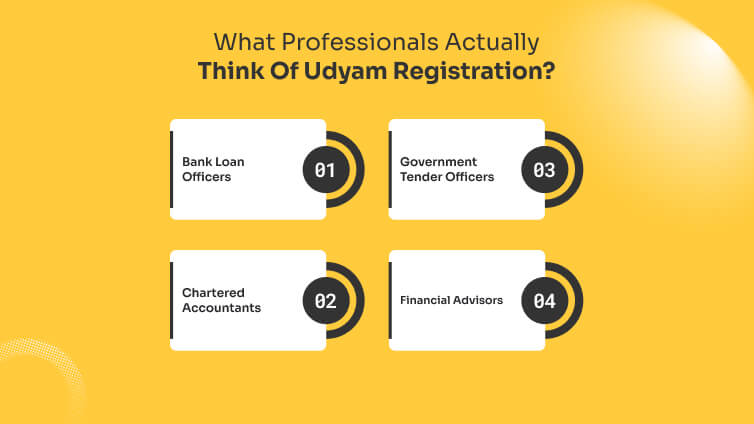
We surveyed different people who deal with MSMEs. You’ll hear different priorities when you see the report we arrived at.
Here, note that the individual identities and designations of people we surveyed have been withheld due to our Non-disclosure policy.
· Bank Loan Officers
They care about it mainly for priority-sector lending classification.
It can mean a lower interest rate or a collateral-free loan under CGTMSE, with guarantee cover running into several crores for micro and small enterprises.
· Chartered Accountants
They tend to flag it as a compliance item requiring annual attention, not a one-time form, because misclassification increases tax and audit exposure over time.
· Government Tender Officers
They treat it as a gatekeeping document; without it, a business is simply not visible in the MSME procurement quota system, regardless of how good the product is.
· Financial Advisors
They are the ones who work with small business owners and generally recommend registering early. However, not because of the loan benefits alone.
Rather, because it becomes one less thing to untangle later when the business needs funding under time pressure.
Their broader role in cases like this is less about knowing every tax rule by heart and more about translating a scattered set of government requirements into a short, sequenced checklist that a business owner can actually follow.
To sum up, this is exactly the kind of simplification beginners tend to need most.
A Beginner Investor’s Detour: Why Business Formalization Connects To Personal Money Decisions
If you’re someone who’s just started earning, say you’re 25, earning around ₹30,000 a month, running a small side business alongside a job, Udyam registration is a good move. On the other hand, if you want to know how should I start investing for long-term growth, check concerned financeteam.net articles.
A registered MSME with clean financial records finds it easier to access formal credit later. Again, that affects how much you rely on personal savings versus business loans when you want to grow.
That said, keep the two domains distinct: Udyam registration has nothing to do with market-linked instruments, and it won’t affect something like Bank Nifty expiry day mechanics or your personal trading account.
One is business formalization. While, the other is personal investing. Beginners sometimes conflate the two, assuming that MSME status somehow influences market decisions. But in reality, it doesn’t.
Useful Official Resources
- Udyam Registration Portal: udyamregistration.gov.in
- Ministry of MSME: msme.gov.in
- CGTMSE (Credit Guarantee Fund Trust for Micro and Small Enterprises): cgtmse.in
- Government e-Marketplace (GeM) for MSME tenders: gem.gov.in
- TReDS platforms for invoice discounting: accessible via RBI-authorised TReDS operators
Frequently Asked Questions
No, it’s voluntary. But without it, a business cannot access MSME loans, tender preference, or the 45-day delayed-payment protection under the MSMED Act.
Yes. Freelancers and independent consultants operating as sole proprietors are eligible to use their own Aadhaar and PAN.
Yes. LLPs, along with proprietorships, partnerships, private limited companies, HUFs, cooperative societies, and trusts, can all register, using the authorized signatory’s Aadhaar.
Yes, if your turnover is below the GST registration threshold or you deal in GST-exempt goods or services. Above the threshold, GST registration becomes compulsory separately, and your Udyam and GST details should match.
Yes. A home bakery, tailoring unit, or online seller without separate commercial premises can register on Udyam using only Aadhaar, PAN, and basic business details.
No. The registration has lifetime validity with no renewal fee. That said, you only need to update your details annually to keep your classification accurate.
Log in to the portal with your URN and Aadhaar-linked mobile OTP, and use the “Update Details” section. To clarify, the system auto-fetches turnover from your latest GST and Income Tax filings where available.
If your investment or turnover crosses into a higher bracket, you’re automatically reclassified (say, Micro to Small). You’re only moved down a category if both figures fall below the lower bracket’s limits.
Decision Making Tips For MSMEs
Udyam Aadhar registration itself is simple. What actually determines whether it helps or quietly costs you later is what happens after you get the certificate. For instance:
- Whether you picked the right structure
- Entered turnover correctly
- Understood how it differs from GST, Shop Act, Startup India, and company registration
- Remembered that it needs a yearly look, not a one-time click.
Treat it as an ongoing part of running your business, not a form you file away.
Share this article: