- Do You Need An LLP Audit? The Quick Answer
- Why Do These Audit Limits Exist In The First Place?
- LLP Audit Applicability At A Glance
- When Is Audit Mandatory? Breaking Down The Two Triggers
- Trigger 1: Turnover Exceeds ₹40 Lakh
- Trigger 2: Partner Contribution Exceeds ₹25 Lakh
- LLP Audit VS Income Tax Audit: They're Not The Same Thing
- Real Examples: Working Through The Numbers
- Example 1
- Example 2
- Example 3
- Example 4
- Example 5
- A Simple Way To Check Whether Your LLP Needs An Audit
- Did your LLP's annual turnover exceed ₹40 lakh?
- Documents You'll Need For The Audit
- A Typical LLP Compliance Timeline
- April To March
- After The Financial Year Ends
- Before filing Form 8
- Annual filing period
- Penalty For Not Conducting A Required Audit
- Who Can Conduct An LLP Audit?
- Common Mistakes LLPs Make
- Waiting Until The Deadline To Check Applicability.
- Common Myths About LLP Audit Applicability
- A Five-Minute Checklist Before You Decide You're Audit-Exempt
- Frequently Asked Questions
- Disclaimer:
LLP Audit Applicability Explained: Turnover Limits, Partner Contribution Rules & Examples
If you run an LLP in India, one question comes up every single year around March: do I actually need an audit this time?
Most guides answer this with a definition. “Audit means an independent examination of financial records…” That’s technically correct.
But it’s also not what you need at 11 PM before a filing deadline. What you need is a fast, accurate way to check where your LLP audit applicability stands. And then a clear picture of what happens next.
That’s what this guide does. At financeteam.net, we do not indulge in jargon walls or any legal Sanskrit. Rather, we tell you just the rule, a few real-number examples, and the steps that follow.
Do You Need An LLP Audit? The Quick Answer
Here’s the short version. After this, we’ll unpack it.
An LLP in India must get its accounts audited if, in a financial year, either:
Only one of these needs to happen. Not both. If your turnover is ₹10 lakh but your partners have put in ₹28 lakh as capital, you still need an audit.
To clarify, the rule doesn’t care which number tripped the wire. Rather, it just cares that one did.
This comes from Rule 24(8) of the LLP Rules, 2009, read with Section 34(4) of the LLP Act, 2008.
Rule 24(8) of the Limited Liability Partnership Rules, 2009 provides that an LLP is exempt from statutory audit unless its turnover exceeds the prescribed limit or the partners’ contribution crosses the prescribed threshold.
Why Do These Audit Limits Exist In The First Place?
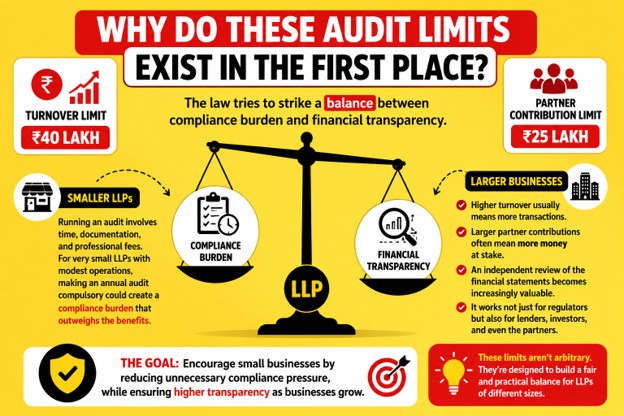
At first glance, the ₹40 lakh turnover limit and ₹25 lakh contribution limit can seem arbitrary. Why these numbers? Why not audit every LLP?
The answer is largely practical.
Running an audit involves time, documentation, and professional fees. For a very small LLP with modest operations, making an annual audit compulsory could create a compliance burden that outweighs the benefits.
As the business grows, however, the picture changes. Higher turnover usually means more transactions.
On the other hand, larger partner contributions often mean more money at stake. That’s where an independent review of the financial statements becomes increasingly valuable.
Again, it works not just for regulators but also for lenders, investors, and even the partners themselves.
In other words, the law tries to strike a balance. Smaller LLPs receive some relief from compliance costs. Meanwhile, the businesses handling larger amounts of money are expected to maintain a higher level of financial transparency.
LLP Audit Applicability At A Glance
| Condition | Audit Required? |
|---|---|
| Turnover ≤ ₹40 lakh and Contribution ≤ ₹25 lakh | No |
| Turnover > ₹40 lakh (contribution doesn’t matter) | Yes |
| Contribution > ₹25 lakh (turnover doesn’t matter) | Yes |
| Both thresholds crossed | Yes |
| LLP renders professional services (law, CA, architecture, etc.) | Check with your CA; some professional LLPs face audit regardless of turnover |
Keep this table bookmarked. It answers 90% of the “am I exempt?” questions LLP owners ask.
When Is Audit Mandatory? Breaking Down The Two Triggers
These 2 triggers deserve the maximum limelight, when we talk about LLP audit applicability:
Trigger 1: Turnover Exceeds ₹40 Lakh
“Turnover” here means the total value of sales, services, and other business receipts during the financial year (1 April to 31 March). It’s a gross figure, before you subtract expenses.
A services-based LLP (consulting, design, digital marketing, etc.) hits this faster than people expect, because turnover counts invoiced revenue, not take-home profit.
For instance, an LLP that billed ₹42 lakh but kept only ₹9 lakh after costs still crosses the threshold.
Trigger 2: Partner Contribution Exceeds ₹25 Lakh
This is the capital that partners have formally contributed to the LLP. I am talking about cash, assets, or anything recorded as contribution in the LLP agreement.
It’s not the same as turnover, nor is it the same as a partner’s personal net worth. It’s specifically what’s been contributed to the LLP as capital.
This trigger surprises new LLP owners the most. Two founders, each contributing ₹15 lakh to get the business off the ground, have already crossed ₹25 lakh in contributions. Even if the LLP hasn’t billed any clients yet. Revenue has nothing to do with it.
LLP Audit VS Income Tax Audit: They’re Not The Same Thing
One of the biggest reasons LLP owners get confused is that the words “audit” and “tax audit” are often used interchangeably. They don’t.
Think of them as two different compliance checks that happen under two different laws.
An LLP audit is governed by the Limited Liability Partnership Act, 2008. Its purpose is to verify whether the LLP’s books of account fairly reflect its financial position. Whether an audit is compulsory depends mainly on the LLP’s turnover and partner contribution.
A tax audit, on the other hand, is governed by the Income Tax Act. It looks at whether the books support the income reported for tax purposes and whether the business has complied with the tax rules applicable to it.
That means an LLP can fall into any one of these situations:
| Situation | LLP Audit | Tax Audit |
|---|---|---|
| Small LLP below both limits | Not required | Usually not required |
| LLP crosses LLP Act threshold only | Required | May not be required |
| LLP crosses tax audit threshold only | Not required under LLP Act | Required |
| LLP crosses both thresholds | Required | Required |
The safest approach is to check both laws separately every financial year. Assuming that one automatically covers the other is a mistake that catches many first-time business owners off guard.
Real Examples: Working Through The Numbers
Reading a rule is one thing. Applying it to numbers you’d actually see on a balance sheet is another. Here are five scenarios that cover the situations LLP owners run into most often.
Example 1
Below both limits: Turnover: ₹32 lakh. Contribution: ₹20 lakh. → No audit required. Neither threshold is crossed. Standard filing (Form 8 and Form 11) is still mandatory.
Example 2
Turnover crosses the line. Turnover: ₹70 lakh. Contribution: ₹18 lakh. → Audit required. Turnover alone is enough to trigger it, regardless of the (comfortably low) contribution figure.
Example 3
Contribution crosses the line, turnover doesn’t: Turnover: ₹12 lakh. Contribution: ₹30 lakh. → Audit required. This is the scenario founders miss most — a new LLP with heavy initial capital but almost no revenue yet still needs an audit.
Example 4
Right at the edge. Turnover: ₹39.8 lakh. Contribution: ₹24.5 lakh. → No audit required, but only just. A single late invoice booked in the current year instead of the next could tip this over. This is exactly the situation where talking to a CA in February, not October, saves a scramble.
Example 5
Both limits crossed. Turnover: ₹85 lakh. Contribution: ₹40 lakh. → Audit required. Doubly so, but the outcome is identical to Example 2 or 3. That is to say one trigger is as good as two.
These are illustrative figures to show how the rule behaves, not case studies from specific businesses. To sum up, the maths works the same way whatever numbers your LLP actually has.
A Simple Way To Check Whether Your LLP Needs An Audit
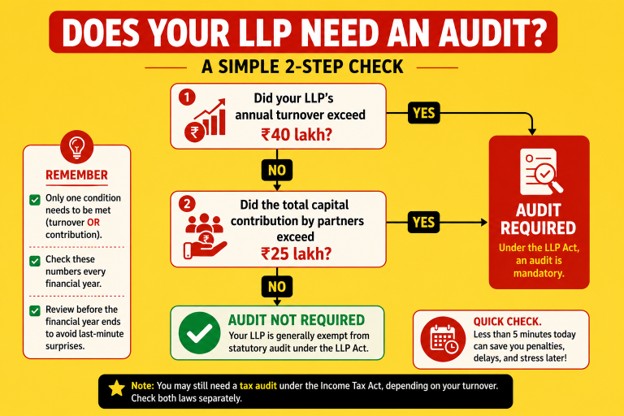
If you’ve read this far and are still wondering where your LLP fits, try this quick exercise.
Start with one question.
Did your LLP’s annual turnover exceed ₹40 lakh?
If the answer is yes, your LLP will generally be required to undergo an audit under the LLP Act.
If the answer is no, don’t stop there.
Look at the total capital contribution recorded in your LLP agreement.
Has it crossed ₹25 lakh?
If it has, the audit requirement still applies even though your turnover is comfortably below the limit.
Only when both numbers remain within the prescribed limits does the LLP normally qualify for exemption from statutory audit.
It takes less than five minutes to check these figures. Doing that review before the financial year closes is far easier than discovering the requirement as filing deadlines approach.
Documents You’ll Need For The Audit
Once you know an audit applies, gather these before you approach a Chartered Accountant. To clarify, it shortens the process considerably:
- Bank statements for the full financial year
- Sales and purchase invoices
- The LLP Agreement (and any supplementary agreements on capital contribution)
- Books of account: ledger, cash book, journal
- Details of fixed assets and any loans taken or given
- Previous year’s Form 8 and Form 11, if this isn’t your first audit
- GST returns, if registered, for cross-verification of turnover
A Typical LLP Compliance Timeline
Many LLP owners don’t miss deadlines because they ignore the rules. They miss them because they’re unsure what comes first.
A simple timeline makes the process much easier to follow.
April To March
Maintain proper books of account throughout the financial year. Waiting until year-end to organize records usually makes the audit slower and more expensive.
After The Financial Year Ends
Check whether your turnover or partner contribution has crossed the audit limits. If an audit is required, appoint a practicing Chartered Accountant early rather than waiting until filing season is busy.
Before filing Form 8
Complete the audit, finalize the financial statements, and resolve any differences found during the review.
Annual filing period
File Form 8 and Form 11 within their respective due dates. These filings remain compulsory even for LLPs that are not required to have an audit.
A little planning goes a long way here. Most compliance problems stem from delayed preparation rather than from difficult paperwork.
Penalty For Not Conducting A Required Audit
Skipping a mandatory audit doesn’t just delay your filing. It exposes the LLP and each designated partner to penalties.
Under the LLP Act, penalties for audit and filing non-compliance can range from ₹25,000 up to ₹5,00,000 for the LLP, with designated partners separately liable as well.
Persistent non-filing (Form 8 or Form 11 missed for two consecutive years) can also lead to the Registrar of Companies striking the LLP off the register.
Separately, if your LLP also crosses the tax audit threshold under the Income Tax Act (turnover above ₹1 crore for businesses, or ₹50 lakh for professional receipts, with a higher ₹10 crore limit if most transactions are digital), a missed tax audit attracts a penalty of 0.5% of turnover, capped at ₹1,50,000, under Section 271B.
These are two separate audits with two separate rulebooks. More on that below.
Who Can Conduct An LLP Audit?
Only a Chartered Accountant in practice can audit an LLP’s accounts. To clarify, that’s someone holding a valid Certificate of Practice from ICAI.
A friend who’s “good with numbers” or an in-house accountant, however capable, can’t sign the audit report. The auditor also needs to be formally appointed by the partners, usually by a simple resolution recorded in the LLP’s minutes.
Common Mistakes LLPs Make
- Confusing LLP Act audit with Income Tax audit.
These are governed by different laws, with different thresholds, and an LLP can be liable for one, both, or neither. Passing on Rule 24(8) doesn’t mean you’re automatically exempt under Section 44AB of the Income Tax Act.
- Checking only turnover, and ignoring contribution.
As Example 3 above shows, a capital-heavy, revenue-light LLP can trip the audit requirement in its very first year.
- Treating “voluntary audit” as pointless.
Even LLPs under both thresholds sometimes choose to get audited anyway. Usually because a bank, investor, or larger client wants audited financials before signing off on a loan or contract.
If you’re planning to raise money or are thinking about investing for the long-term growth of the business rather than just running it year to year, a voluntary audit can make that conversation considerably easier.
Remember, it already signals your numbers have already been independently checked.
Waiting Until The Deadline To Check Applicability.
Turnover and contribution numbers can move during the last quarter of the financial year.
Checking your position only in October, right before the Form 8 deadline, leaves no time to arrange a CA if you’re audit-liable and hadn’t planned for it.
Common Myths About LLP Audit Applicability
Some misunderstandings refuse to disappear, no matter how often professionals explain the rules. Here are a few worth clearing up.
Myth: My LLP made very little profit, so an audit can’t apply.
Reality: Profit has nothing to do with the applicability of an LLP audit. The law looks at turnover and partner contribution, not how much money was left after expenses.
Myth: My LLP is newly registered, so I automatically get an exemption.
Reality: A newly incorporated LLP can still require an audit if its contribution or turnover crosses the prescribed limits.
Myth: We aren’t registered under GST, so audit rules don’t affect us.
Reality: GST registration and LLP audit requirements are governed by different laws. One does not decide the other.
Myth: Missing an audit is only a paperwork issue.
Reality: It can lead to financial penalties, filing complications, and unnecessary compliance problems later on.
Understanding these small distinctions early saves far more time than trying to fix mistakes after notices start arriving.
A Five-Minute Checklist Before You Decide You’re Audit-Exempt
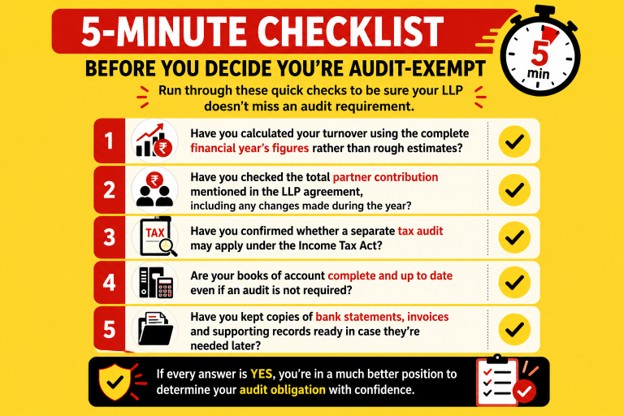
Before you conclude that your LLP doesn’t need an audit this year, pause for a moment and run through this short checklist.
- Have you calculated your turnover using the complete financial year’s figures rather than rough estimates?
- Did you check the total partner contribution mentioned in the LLP agreement, including any changes made during the year?
- Have you confirmed whether a separate tax audit may apply under the Income Tax Act?
- Are your books of account complete and up to date even if an audit is not required?
- Have you kept copies of bank statements, invoices and supporting records ready in case they’re needed later?
If every answer is “yes,” you’re in a much better position to determine your audit obligation with confidence.
Frequently Asked Questions
No. Only LLPs that cross the ₹40 lakh turnover or ₹25 lakh contribution threshold are required to get audited under the LLP Act. Everyone else still has to maintain books and file annual forms, just without a CA’s audit report attached.
A turnover of zero doesn’t automatically mean you’re exempt. So, check your contribution figure, too. A dormant LLP with high initial capital can still need an audit.
No. GST registration and GST turnover are separate from the LLP Act’s audit thresholds. However, your GST returns are often used to cross-verify the turnover figure reported elsewhere, so keep them consistent.
No. Form 8 (Statement of Account and Solvency) and Form 11 (Annual Return) are mandatory for every LLP regardless of turnover, profit, or audit applicability.
Check turnover against the Income Tax Act thresholds separately. Generally, ₹1 crore for businesses (₹10 crore if most transactions are digital and cash dealings stay under 5%) or ₹50 lakh for professional receipts. It’s entirely possible to need one audit and not the other, or both.
Yes! Use the at-a-glance table earlier in this guide. If you’re anywhere near the ₹40 lakh or ₹25 lakh line, that’s the point to loop in a Chartered Accountant, even just for a quick applicability check before deadlines get close.
Disclaimer:
This article explains the general rule as it stands under the LLP Act, 2008 and LLP Rules, 2009. Individual situations, such as professional-service LLPs, LLPs with unusual capital structures, or LLPs also liable for a tax audit, can have additional nuances, so it’s worth confirming your specific numbers with a practicing Chartered Accountant before the filing deadline.
Share this article: