- What I Am Going To Share Here?
- The Quick Answer: Why Gold Rate Is Increasing?
- 1. Central Banks Are Buying Gold Like Never Before
- Why Are They Doing This?
- 2. Interest Rates And "Real" Returns
- 3. A Weaker, Less-Trusted US Dollar
- 4. Geopolitical Tension And War-Risk Buying
- 5. A Wave Of Ordinary Investors, Not Just Institutions
- 6. Limited Supply Meeting Record Demand
- Gold Is A "Trust Barometer," Not Just An Investment
- What Is The Current Equation?
- TDI = (Real Interest Rate Gap) + (Central Bank Net Buying Growth) + (Geopolitical Risk Score)
- What Will Be The After-Effects Of An Expensive Gold?
- Effect On Households And Jewelry Buyers
- Effect On Gold Loans And Lending
- Effect On A Country's Trade Balance
- Effect On Mining Companies And Their Stock Prices
- Effect On Inflation Psychology
- Effect On Silver And Other Precious Metals
- The Opportunities This Gold Price Rally Creates
- Sovereign Gold Bonds (SGBs) And Gold ETFs:
- Digital Gold:
- Gold Loan Against Existing Jewelry:
- Mining And Precious Metals Equities:
- Selling Old Or Unused Gold:
- Portfolio Diversification:
- The Warnings That Apply To Retail Gold Customers
- You Might Be Buying At, Or Near, The Top
- Opportunity Cost Is Real
- Making Charges And Taxes Eat Into Jewelry "Returns"
- A Stronger Dollar Or Resolved Conflicts Could Trigger A Sharp Correction
- Household Debt Tied To Gold-Backed Loans Carries Risk
- Central Banks Can Slow Down
- Mathematical Projection: Where Could Gold Rates Go Next?
- Step 1: Establish The Historical Growth Rate (CAGR)
- Step 2: Build Three Scenarios Instead Of One Guess
- Step 3: What The Math Tells Us
- Frequently Asked Questions
- What This Means For You
Why Gold Rate Is Increasing? What It Means for You And Where Prices Could Go Next
I’m sure you are also equally shocked by the sudden ascend in gold prices lately. But like me, if you also have no explanation for why gold rate is increasing, this article is for you! ,
If you don’t know how bad the scenario is, just open the gold rate ticker on your banking app. You’ve probably had the same reaction as everyone else: “Wait, gold costs how much now?”
As of today, gold is trading at $4,122 per troy ounce internationally. Meanwhile, 24-karat gold in India is going for about ₹14,570 per gram (₹1,45,700 for 10 grams).
A year ago, gold was already considered expensive. Now it’s up almost 19% since then. Again, earlier this year, in late January 2026, it briefly spiked to an all-time high near $5,590 an ounce before cooling off.
Most articles I checked on this topic provided me with a checklist. I could only find the generalized logic there.
For instance, central banks are buying, the dollar is weak, interest rates are higher, and things like that. That’s true, but it’s only half the story, and honestly. Simply put, t doesn’t tell you anything useful about what to do with this information.
What I Am Going To Share Here?
This article takes a different approach. Instead of just listing causes, we’re going to:
- Explain the real reasons behind why gold rate is increasing
- Show you the one underlying idea that ties all those reasons together (an angle most gold articles miss)
- Walk through who actually benefits and who gets hurt when gold rises
- Look at real opportunities this creates along with the downsides nobody warns you about
- Build an actual, numbers-based projection of where gold could be headed, with the math shown
Let’s get into it.
The Quick Answer: Why Gold Rate Is Increasing?
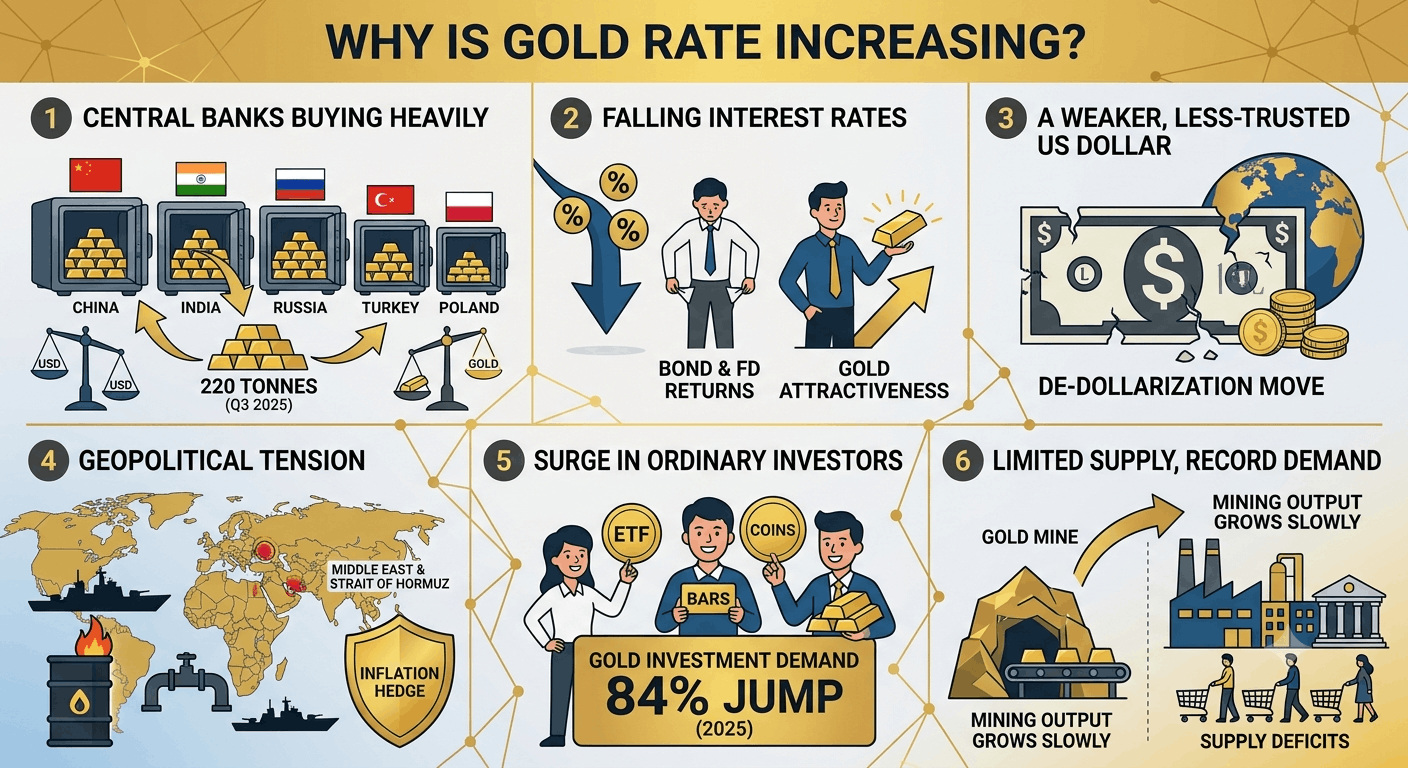
Why gold rate is increasing? In simple terms, gold rates are increasing because more people are losing a bit of faith in paper money and moving their savings into something they can hold. That said, governments, big investors, and regular households are equally buying into this logic.
So what are they investing in? Gold, ofcourse! So, now let’s investigate how they are hoarding gold and how that is affecting economics:
1. Central Banks Are Buying Gold Like Never Before
Yes, this is the most obvious reason why gold rate is increasing. But central banks are buying gold not because individual investors are trusting in it.
They are trying to increase gold’s asset strength. Once that happens, the ones with maximum volume will be able to strengthen their economy, currency, and command over international trade all at once.
That said, China, India, Russia, Turkey, and Poland have been buying gold at a pace not seen since the 1960s. In Q3 2025 alone, central bank gold purchases came in at around 220 tonnes, roughly 28% higher than the same period a year before.
Why does this matter so much?
A country’s central bank is not just another day trader. So, the asset they buy will remain with them for ages. That means gold prices now will be stabilized and cemented as banks buy it.
Why Are They Doing This?
The biggest explanation is to break free from the USD loophole. In simpler words, they don’t want to stock more USD in terms of FDI.
That strengthens the foreign economy by default. At the same time, that practice makes their own currency weaker compared to the dollar. But you need to understand what triggered this move.
In 2022, the USA froze Russian dollar reserves. For those who don’t know, the USA has all rights to do so. But that also showed how big a threat it is.
Today, you strengthen your economy by increasing your foreign currency reserves. Tomorrow, the USA will freeze them or apply sanctions for some socio-political reason! Crazy, right?
Again, you cannot stock foreign reserves in a currency other than the dollar.
That’s where gold comes in as a savior. No country can independently freeze your gold. Or put sanctions on your gold reserve.
2. Interest Rates And “Real” Returns
Gold doesn’t earn interest or pay dividends. That means when fixed deposits and bonds offer high returns, many investors prefer them over gold.
But when interest rates start falling, those investments become less rewarding. As a result, gold becomes more attractive because you’re giving up less by holding it instead.
This is exactly what happened during 2025 and into 2026. As investors expected the US Federal Reserve to cut interest rates, returns on bonds and savings accounts looked less attractive. More investors turned to gold, helping drive its price higher.
3. A Weaker, Less-Trusted US Dollar
Gold is indirectly proportional to the worth of the USD in the global market. As gold price hikes, the USD’s valuation against other currencies plummets. However, that is a logic that the rest of the global nations are not going to rely on!
Indeed, when the dollar becomes weak, other currencies gain strategic importance. However, many nations are now trying to end the supremacy of the USD once and for all! But how to do that?
The simplest way out is diversifying your assets. That shift has actually been observed in 2025-26. Several countries joined the de-dollarization move.
In other words, they are liquidating dollars and buying more gold. Why gold? Because gold is neutral. At the same time, gold’s asset value is high. Lastly, gold’s global acceptance as an asset will help with a quick shift from the dollar to gold!
4. Geopolitical Tension And War-Risk Buying
I hope you already understand the de-dollarization move. Again, you must also know that, like Russia, other countries are opting for gold out of concern or fear. Some whimsical trade tariff impositions by the Trump government in 2025 have aggravated the fear!
After that, the geopolitical equation between the US and Iran also weakened. I mean, we are all aware of the feud between the two nations regarding using the shipping route of the Strait of Hormuz.
On one hand, the Houthis are threatening US vessels. Simultaneously, US servicemen are being attacked.
What’s worse, oil prices are increasing as a result of the conflict. That said, an oil price hike can also trigger global inflation. In that situation, gold can perhaps be the best hedge fund.
What are hedge funds? Read the article to know better!
5. A Wave Of Ordinary Investors, Not Just Institutions
Something new happened in 2025 that doesn’t get enough attention. Simply put, the retail investors who are regular people, not hedge funds, piled into gold in a big way.
On the other hand, investment demand through ETFs, coins, and bars jumped 84% in 2025 to about 2,175 tonnes, the highest ever recorded. Gold ETFs saw seven straight months of positive inflows heading into 2026, led by North American funds.
This matters because it shows the rally of gold prices isn’t just a “smart money” story anymore. It’s broad-based, which historically tends to extend rallies further than institutional buying alone would.
6. Limited Supply Meeting Record Demand
Gold mining output grows slowly. In other words, the new mines take years to develop. That means there’s only a specified volume of gold left to economically extract.
When demand from central banks, ETFs, and retail buyers all rise at once, and mine supply can’t keep pace, prices have nowhere to go but up.
Analysts at Morgan Stanley have pointed out that strong ETF demand has been absorbing already-limited inventories after several years of supply deficits.
Gold Is A “Trust Barometer,” Not Just An Investment
Here’s where we want to zoom out. I have seen that almost every article on this topic treats these six reasons as separate, unrelated bullet points. But they’re not. They’re all symptoms of the same underlying shift.
Think of gold’s price less as a “market price” and more as a trust barometer. The price fluctuation is actually a live reading of how much confidence the world currently has in paper currencies, government bonds, and the financial system that backs them.
Every single driver above is really just a different flavor of the same question: “Do I trust this piece of paper (a dollar, a bond, a rupee) to hold its value, or would I rather hold something no government can print more of, freeze, default on, or devalue?”
What Is The Current Equation?
- Central banks buying gold = governments themselves don’t fully trust each other’s currencies anymore
- Falling real interest rates = the “reward” for trusting paper money and holding bonds is shrinking
- Dollar weakness = the world’s most trusted currency is being trusted a little less
- Geopolitical tension = trust in stability itself is shaken
- Retail buying surge = ordinary households are starting to feel the same unease as governments
We can actually build a simple way to track this. Call it the Trust Deficit Index (TDI). Now that’s a made-up name, but a genuinely useful mental model. It’s built from three measurable ingredients:
TDI = (Real Interest Rate Gap) + (Central Bank Net Buying Growth) + (Geopolitical Risk Score)
- Real Interest Rate Gap: how far below “normal” real interest rates (interest rate minus inflation) currently are. Lower/negative real rates = higher TDI.
- Central Bank Net Buying Growth: year-over-year percentage growth in official gold purchases (currently strongly positive, as shown above).
- Geopolitical Risk Score: an index like the widely used Geopolitical Risk (GPR) Index, which tracks how much war, conflict, and political instability is in global news coverage.
When all three factors happen at the same time, as they have in 2026, gold’s price starts increasing prominently.
Together, these factors create a much stronger demand for gold. Meanwhile, that is helping gold rise faster and stay higher for longer than in many previous rallies.
This framing matters practically, too. It tells you gold isn’t rising because of one fixable problem (like a single interest rate decision). It’s rising because of a structural, slow-moving shift in global trust.
I feel what’s most important is that the structural shifts don’t reverse in a matter of weeks. That’s very different from a short-term speculative spike. That said, I also believe that it should change how you think about gold in your own financial planning.
What Will Be The After-Effects Of An Expensive Gold?
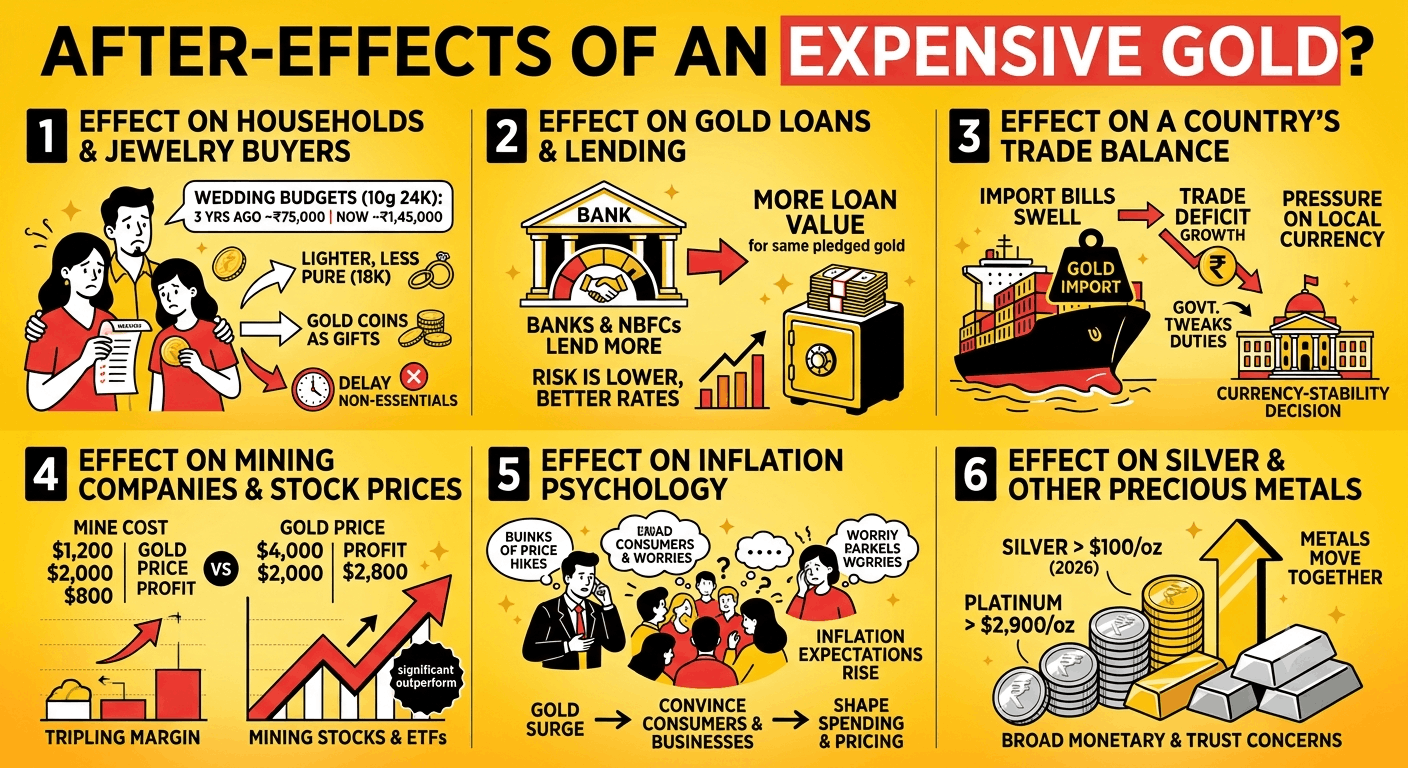
A rising gold price doesn’t just sit quietly in the background. It ripples outward into everyday life, business, and even government budgets. Here’s what actually happens.
Effect On Households And Jewelry Buyers
For countries like India, where gold is deeply tied to weddings, festivals, and family savings, a rising gold rate is a real financial event, not just market news.
Families budgeting for a wedding this year are finding that the same 10 grams of gold jewelry that cost roughly ₹75,000 three years ago now costs close to ₹1,45,000 for 24K, before making charges.
Many households are responding by buying lighter, less pure jewelry (18K instead of 22K), leaning more on gold coins as gifts instead of full sets. Or delaying non-essential purchases altogether.
Effect On Gold Loans And Lending
One underrated effect: gold loans have become significantly more attractive to lenders. Since gold’s value as collateral has jumped, banks and NBFCs (Non-Banking Financial Companies) can lend more money against the same amount of pledged gold.
Or offer better interest rates because their risk is lower. This has quietly fueled growth in India’s gold loan industry. Again, that gives households an easier way to unlock cash from jewelry they already own, without selling it.
Effect On A Country’s Trade Balance
Countries that import large amounts of gold, see their import bills swell when gold prices rise. Please note that India is the second-largest gold consumer in the world
If this goes on, even when the international and domestic gold prices are increasing equally, the trade deficit can grow and put pressure on the local currency.
This is part of why the Indian government periodically tweaks gold import duties. That explains why it’s not just a tax decision. Rather, it’s a currency-stability decision.
Effect On Mining Companies And Their Stock Prices
Gold mining company profits are highly leveraged to the gold price. To clarify, if it costs a company $1,200 to mine an ounce of gold, and gold sells for $2,000, they make $800.
If gold jumps to $4,000, they suddenly make $2,800 on that same ounce, more than tripling their profit margin even though their costs barely changed.
This is why gold mining stocks and ETFs have significantly outperformed the metal itself during this rally.
Effect On Inflation Psychology
Rising gold prices don’t cause inflation. But they often reflect and reinforce inflation expectations.
When people see gold surging, it can make consumers and businesses more convinced that price rises will continue. That can, in turn, shape spending and pricing decisions even before “official” inflation numbers catch up.
Effect On Silver And Other Precious Metals
Gold rarely rises alone. This cycle has dragged silver, platinum, and even palladium along with it. To clarify, silver crossed $100 an ounce for the first time in 2026, and platinum pushed above $2,900.
When precious metals move together like this, it’s usually a sign the underlying driver is broad monetary and trust concerns and not something specific to gold jewelry demand or gold mine supply alone.
The Opportunities This Gold Price Rally Creates
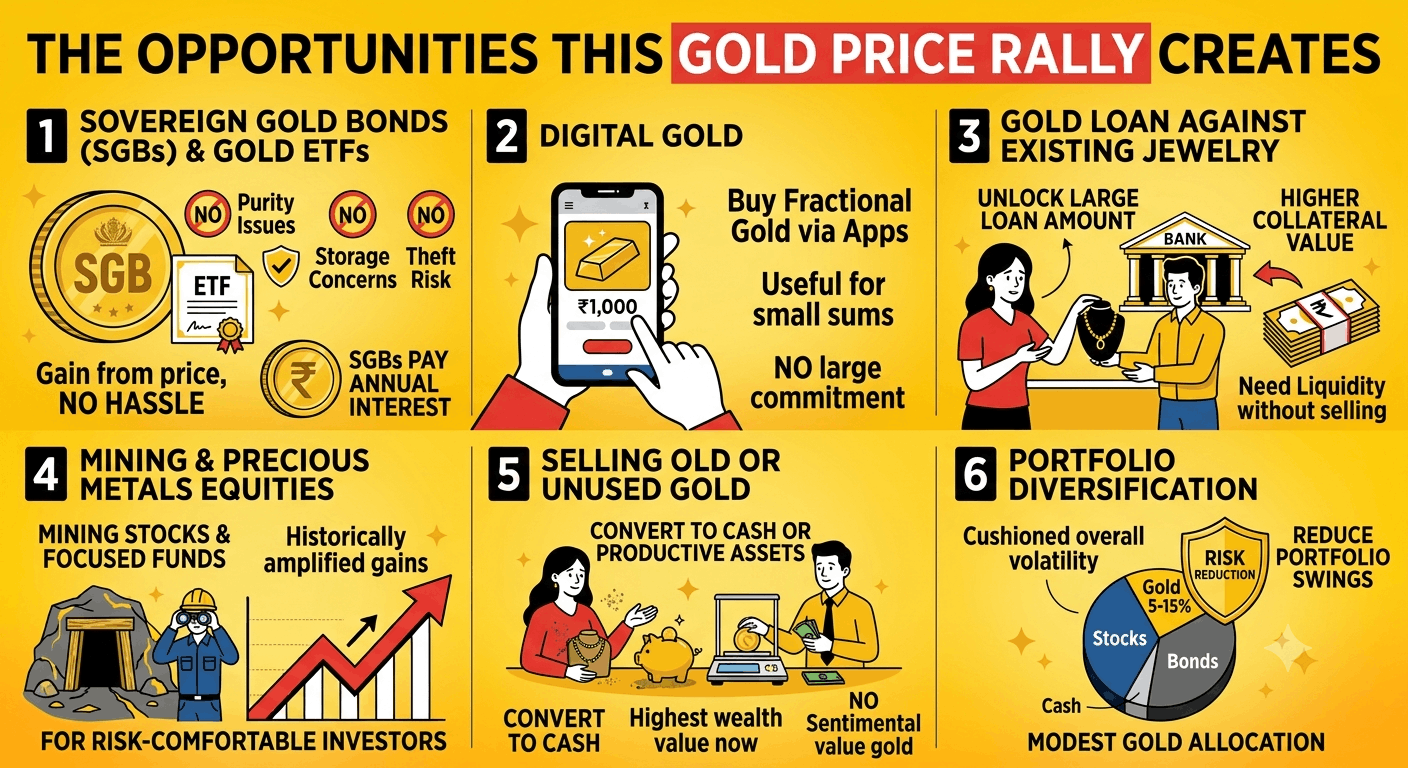
A rising gold rate isn’t only a source of stress. From my research, I firmly believe it opens up real, practical opportunities too.
-
Sovereign Gold Bonds (SGBs) And Gold ETFs:
In India, these let you gain from rising gold prices without worrying about purity, storage, or theft, and SGBs even pay a small annual interest on top of the price gain (note: new SGB issuances have been paused by the RBI at various points, so check current availability).
-
Digital Gold:
Buying gold in small fractional amounts through apps, useful for people who want gold exposure without committing large sums.
-
Gold Loan Against Existing Jewelry:
As mentioned, rising prices mean your existing gold jewelry can now unlock a larger loan amount if you need liquidity.
-
Mining And Precious Metals Equities:
For investors comfortable with more risk, mining stocks and mining-focused mutual funds/ETFs have historically amplified gold’s gains.
-
Selling Old Or Unused Gold:
Anyone holding old jewelry, coins, or inherited gold sitting unused in a locker is sitting on genuinely higher wealth right now than they were two years ago.
This can be a good time to convert unused gold into more productive assets or cash, if it doesn’t hold sentimental value.
-
Portfolio Diversification:
Even a modest gold allocation (many financial planners suggest 5-15% of a portfolio) has cushioned overall portfolio volatility during a period when both stocks and bonds have seen sharp swings.
The Warnings That Apply To Retail Gold Customers
This is something most articles would skip. After all, retail buyers contribute only a minuscule amount compared to banks buying gold. But it matters just as much as the opportunities.
You Might Be Buying At, Or Near, The Top
Gold already spiked to nearly $5,590/oz in January 2026 before falling back below $4,000 by June. In other words, that means a correction of almost 30% in five months.
That’s an enormous swing for an asset often marketed as “safe.”
Buying gold purely because the price is going up (rather than because it fits your financial plan) is a classic way to buy high and later sell low if you panic during a pullback.
Opportunity Cost Is Real
Gold pays no dividend, no interest, no rental income. Every rupee or dollar sitting in gold is a rupee or dollar not compounding in a productive, income-generating asset.
Comparing long-run averages, equities have historically outperformed gold (roughly 10.7% annual returns for US stocks vs. roughly 7.9% for gold from 1971-2024).
Gold’s job in a portfolio is usually to reduce volatility and act as insurance. It is certainly not to be the primary engine of long-term wealth growth.
Making Charges And Taxes Eat Into Jewelry “Returns”
If you’re buying gold jewelry instead of gold coins, bars, ETFs, or Sovereign Gold Bonds, remember that you’ll also pay making charges and GST.
These extra costs are usually not recovered when you sell the jewelry later. That’s why gold jewelry is a great choice for weddings, festivals, or personal use. But not the best way to invest.
A Stronger Dollar Or Resolved Conflicts Could Trigger A Sharp Correction
Several of gold’s current tailwinds are reversible.
If US-Iran tensions ease (there have been reports of mediators working toward a truce), if the Fed turns out to be more hawkish than expected, or if a resolution to current conflicts calms markets, gold could give back a meaningful chunk of its gains quickly.
Just as it already did between January and June 2026.
Household Debt Tied To Gold-Backed Loans Carries Risk
As gold loans become more popular, there’s a flip side. If gold prices later fall, loan-to-value ratios can breach regulatory limits, and lenders may ask borrowers to pledge additional gold or repay part of the loan on short notice.
Rising gold rates make borrowing look easy today, but that ease is directly tied to a price that can move against you.
Central Banks Can Slow Down
The single biggest support for this rally, which is sustained central bank buying, is a policy choice, not a law of nature.
If global tensions ease and dollar confidence stabilizes, central banks could slow their buying pace, removing one of the strongest pillars under current prices.
Mathematical Projection: Where Could Gold Rates Go Next?
Now let’s actually do the math, instead of just repeating analyst headlines.
Step 1: Establish The Historical Growth Rate (CAGR)
Using annual average gold prices:
- 2015 average: $1,160/oz
- Mid-2026 spot price (July 21, 2026): $4,083/oz
The Compound Annual Growth Rate (CAGR) formula is:
CAGR = (Ending Value ÷ Beginning Value)^(1 ÷ Number of Years) − 1
Plugging in our numbers (11 years, 2015 to 2026):
CAGR = (4,083 ÷ 1,160)^(1/11) − 1 CAGR = (3.52)^(0.0909) − 1 CAGR = 1.121 − 1 CAGR ≈ 12.1% per year
This means, on average, gold has compounded at roughly 12.1% annually over the past 11 years. Now that’s a genuinely strong long-term run for what’s often dismissed as a “boring” asset.
Step 2: Build Three Scenarios Instead Of One Guess
No single number can responsibly predict the future. So instead of pretending we know exactly where gold is headed, here’s a three-scenario model.
To clarify, the model is cross-checked against real analyst forecasts from HSBC, Standard Chartered, JPMorgan, and Deutsche Bank (as of mid-2026):
| Scenario | Assumption | Formula Applied | 2028 Projection | 2030 Projection |
| Bear case (correction/mean-reversion) | Conflicts ease, Fed stays hawkish, central bank buying slows | Price reverts toward $3,900–4,500 range and stabilizes | ~$4,100/oz | ~$4,500/oz |
| Base case (trend continuation) | Current 12.1% CAGR roughly holds | $4,083 × (1.121)^n | ~$5,036/oz | ~$6,082/oz |
| Bull case (structural de-dollarization accelerates) | ~15-16% CAGR, matching JPMorgan/Deutsche Bank’s $6,000-6,300 year-end 2026 targets extrapolated forward | $4,083 × (1.155)^n | ~$6,300/oz | ~$8,500/oz |
(n = number of years from 2026)
Step 3: What The Math Tells Us
Even in the bear case, where global tensions ease and central banks slow down, the model doesn’t project gold crashing back to pre-rally levels like $2,000-2,500/oz.
It projects a plateau around $4,000-4,500, not a collapse. That’s an important, underreported point: the structural buyers (central banks, ETF flows, de-dollarization trends) have built a much higher floor under gold than existed in previous cycles.
In the base case, simply continuing the last decade’s growth rate would put gold above $6,000/oz by 2030. Now, that’s a number that sounds shocking today but is mathematically just “more of the same trend,” not a wild leap.
Here’s the historical trend and the three projected scenarios visualized:
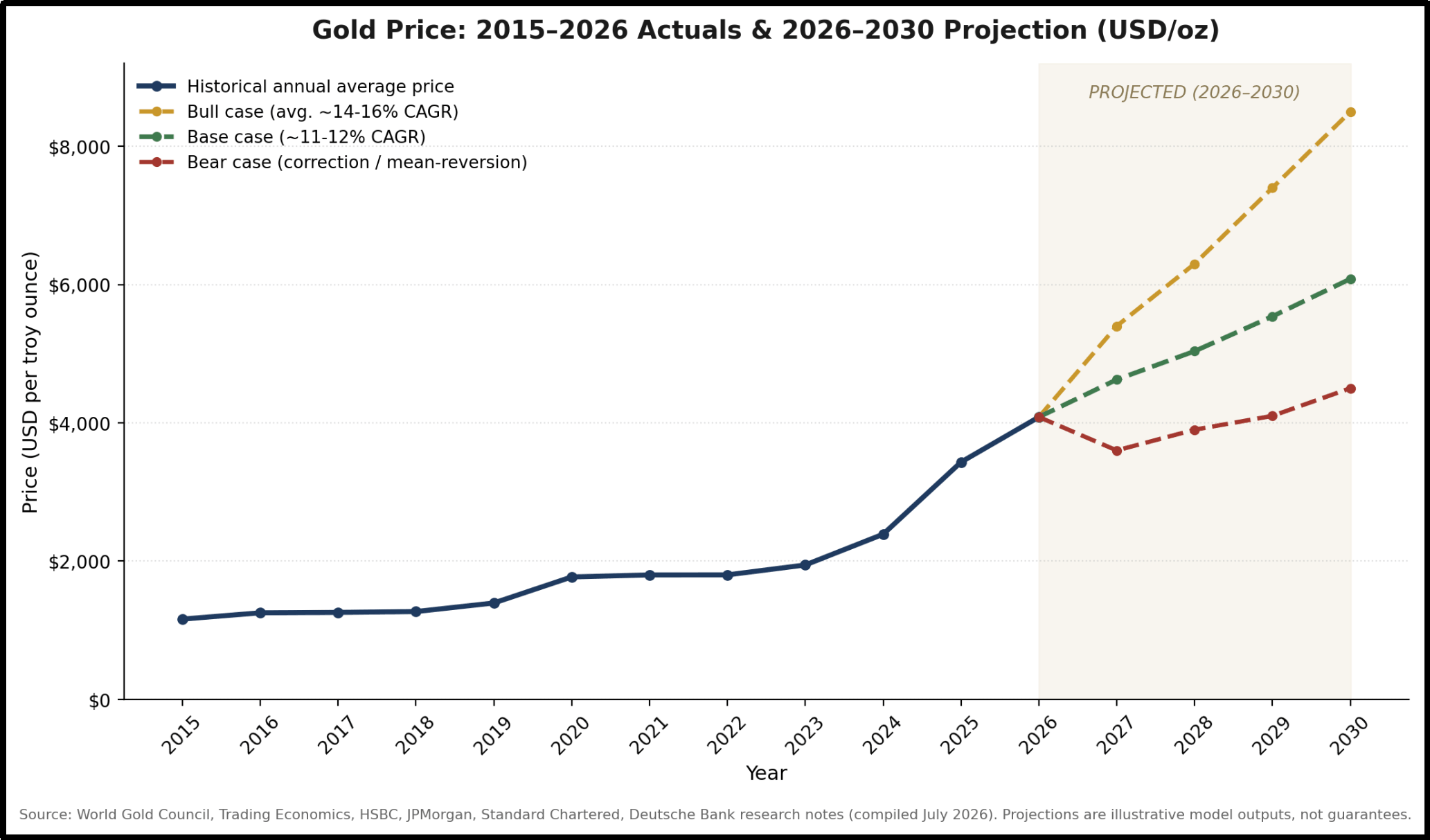
Chart: Historical annual average gold prices (2015-2026) and three projected scenarios through 2030, based on CAGR modeling cross-checked against HSBC, Standard Chartered, JPMorgan, and Deutsche Bank forecasts. These are illustrative projections built from a simplified growth model, but not guaranteed outcomes. Gold prices are volatile and can move sharply in either direction; consult a licensed financial advisor before making investment decisions.
Frequently Asked Questions
Q: Will Gold Rate Come Down Soon?
Short-term corrections are likely and have already happened once in 2026 (a nearly 30% pullback from January’s peak to June).
But the structural drivers like central bank buying, de-dollarization, and geopolitical uncertainty suggest any major, sustained crash back to pre-2024 levels is unlikely unless several of these forces reverse at once.
Q: Is Now A Bad Time To Buy Gold?
It depends entirely on your purpose. Buying gold as a small, long-term portfolio allocation (5-15%) makes sense regardless of the current price, because its job is diversification, not timing the market.
Buying gold purely because “it keeps going up,” hoping for a quick flip, is riskier. To clarify, you would be buying near a level that has already corrected sharply once this year.
Q: Why Is The Gold Rate Different In India Compared To The International Price?
India’s gold rate reflects the international USD price, converted to INR, plus import duty, GST, and local premiums or discounts based on demand.
A weaker rupee against the dollar can push India’s gold rate up even on days when the international price is flat or falling.
Q: What’s Driving Gold Prices More: Inflation Or Geopolitics?
Both matter, but in 2026 specifically, geopolitical tension (the US-Iran situation) and structural central bank buying have been the more dominant forces.
Meanwhile, inflation expectations are acting as an amplifier rather than the primary driver.
What This Means For You
So why gold rate is increasing? Gold isn’t rising because of just one reason. Several factors, including central bank buying, investor demand, inflation concerns, and global uncertainty, are all pushing prices higher at the same time.
That doesn’t mean gold prices will only go up. As we’ve already seen this year, gold can also fall sharply. That’s why it’s important to understand why prices are moving instead of buying simply because everyone else is.
Whether you’re planning to buy gold jewelry, invest through an ETF, apply for a gold loan, or wait for a better opportunity, knowing what drives gold prices can help you make a more informed decision.
Disclaimer: This article is for informational purposes only and should not be considered financial or investment advice. Gold prices can rise or fall quickly. Always do your own research or speak with a qualified financial advisor before making investment decisions.
Share this article: