- Structural Comparison In Trade Show ROI: Booth Rental vs. Asset Ownership
- Booth Rental:
- Booth Ownership:
- Operational Decision Matrix
- Formulating Your Total Event Budget For Better Trade Show ROI
- Advanced Frameworks To Measure Trade Show ROI
- Optimizing Your Return On Objectives (ROO)
- Brand Awareness:
- Competitive Intelligence:
- Strategic Partnerships:
- Customer Retention:
- Execution Strategies To Support Financial Outcomes
- Pre-Show Strategy
- On-Site Strategy
- Post-Show Strategy
- Common Risks And Operational Pitfalls To Avoid
- Follow The Steps To Boost Trade Show ROI
How Exhibitors Should Evaluate Booth Rental, Ownership, Event Budgets, And Trade Show ROI
Choosing between renting and buying a trade show booth is not simply a question of which option has the lower upfront price. The better choice depends on operational metrics:
- how often you exhibit,
- how much booth space you typically need,
- where your events are located,
- what you allocate for storage, transportation, maintenance, and structural updates.
For a company exhibiting once or twice a year, renting can provide structural flexibility without tying up capital in an asset that spends most of the year in storage.
For brands attending multiple shows with similar booth footprint requirements, purchasing a reusable exhibit may reduce the structural cost per event over time.
The right decision, therefore, comes down to your total cost of ownership – not the initial booth price alone.
This guide breaks down the financial and operational factors businesses evaluate before deciding whether to rent or buy to align with their target trade show ROI.
When launching a new regional campaign, selecting the ideal structural partner is vital. For instance, securing a premium Las Vegas trade show booth rental allows brands to test large-scale competitive markets thoroughly without committing heavy capital assets to fixed long-term storage.
Structural Comparison In Trade Show ROI: Booth Rental vs. Asset Ownership
Choosing between renting and buying a physical display impacts your balance sheet and operational workflow in distinct ways. Let us break down the direct capital trade-offs based on industry trend data from the Center for Exhibition Industry Research (CEIR).
Booth Rental:
- Lower upfront capital requirement
- No long-term booth storage obligation
- Maintenance and refurbishment are generally handled by the rental provider
- Greater flexibility to change layouts between events
- Useful when testing new markets or exhibiting infrequently
Booth Ownership:
- Higher upfront investment
- Requires storage between events
- Owner assumes maintenance and refurbishment costs
- Reusable components can reduce the effective cost per show
- Works best when booth requirements remain relatively consistent
Operational Decision Matrix
| Operational Factor | When Renting Is Indicated | When Buying Is Indicated |
| Show Frequency | You attend a few select shows each year. | You maintain a dense, active event calendar. |
| Booth Footprint | Footprint changes by venue or space availability. | Your square footage stays consistent across shows. |
| Design Flexibility | You require unique concepts or modular sizes. | Your structural design can be reused repeatedly. |
| Storage Infrastructure | You lack long-term corporate warehouse space. | You have existing, suitable storage capabilities. |
| Geography | Shows are spread across diverse regional hubs. | Shows are concentrated in a single major market. |
| Visual Identity | You frequently refresh your visual branding or messaging. | Consistent, long-term brand presentation is a priority. |
Formulating Your Total Event Budget For Better Trade Show ROI
A successful exhibition strategy relies on tracking expenses across the entire operational lifecycle.
Many corporate trade show exhibitors experience budget overruns because they primarily account for the basic raw floor space costs, overlooking localized execution fees.
According to historical spending benchmarks compiled by the Exhibitor Group, a comprehensive event budget splits into six distinct operational categories:
- Floor Space: The base cost paid directly to the event organizers for your physical footprint.
- Booth Design and Execution: Total costs for your booth structure, whether an owned asset or rental.
- Logistics and Shipping: Freight transportation to the venue, advanced warehouse storage, and handling.
- Show Services: Electrical and plumbing connections, internet, rigging labor, and daily booth cleaning.
- Travel and Staffing: Flights, lodging accommodations, meals, and daily allowances for active booth staff.
- Marketing and Promotion: Pre-show email outreach, sponsorships, and on-site promotional assets.
Failing to track localized logistics can distort your final trade show ROI calculation. Drayage – the specific fee charged by material handling contractors to move your freight from the loading dock directly to your booth space – is a critical line item that should be estimated early to avoid budget surprises.
Advanced Frameworks To Measure Trade Show ROI
To satisfy corporate governance and justify event spending to internal stakeholders, calculations must look beyond basic lead counts. Financial accountability requires calculating both quantitative Return on Investment (ROI) and qualitative objectives.
The standard formula for trade show ROI is:
Trade Show ROI = (Net Profit From Event – Total Event Expenses) / Total Event Expenses x 100
To measure this metric accurately, the sales team must track acquired leads throughout the entire B2B sales cycle, as conversion windows often span several months.
B2B Corporate Scenario Example:
To ground this framework, consider a realistic manufacturing firm scenario:
- Total Event Investment: Exactly $50,000 (inclusive of full cost stack).
- Lead Generation: The event yields 100 qualified marketing leads.
- Conversion Rate: 10 leads convert into closed enterprise contracts over the next six months.
- Contract Value: At an average contract value of $15,000, the gross revenue generated is $150,000.
- Net Margin: Assuming a 40% net profit margin on services, the net profit equals $60,000.
Using the standard analytical formula, the trade show ROI is calculated as:
Trade Show ROI = ($60,000 – $50,000) / $50,000 x 100 = 20%
This example produces a positive 20% ROI under these specific parameters. In practice, event attribution is often complex. B2B leads take time to mature, and multiple marketing touchpoints contribute to a final contract. Defining an attribution model before the event can reduce the risk of retrospective revenue misallocation.
Optimizing Your Return On Objectives (ROO)
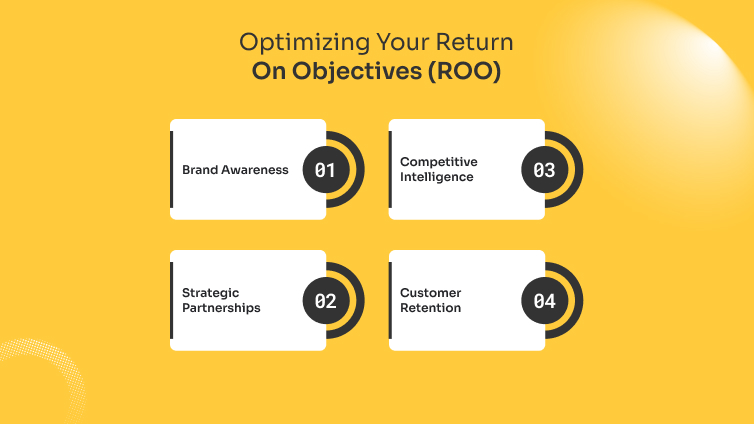
Not all good business results are accounted for immediately in a short-term financial ledger. Many companies running campaigns measure Return on Objectives (ROO) apart from ROI to keep track of non-monetary areas contributing to building long-term enterprise value and brand equity.
Brand Awareness:
First and foremost, one of the things that you can do to optimize your ROO is to keep track of your brand visibility. For example, during the exhibition days, to measure brand awareness, track:
- Social media interactions
- Media coverage
- Website traffic
Such increased brand visibility can create a sales funnel for the sales cycles that follow.
Competitive Intelligence:
Second, get to know what competitors are planning to do. For this, one of the things that you can do is observe their new product launches, pricing strategies, and their way of attracting visitors on the trade show floor. This is a great way to reinvent your own market position.
Strategic Partnerships:
Next, take networking sessions seriously. These are a great opportunity to meet and connect with manufacturers, distributors in a geographical area, and other industry players to explore working together further.
Customer Retention:
Finally, in order to maintain loyalty and retain customers, there are a few things that you can do. For example, try providing VIP clients special/exclusive experiences such as private meetings or product previews.
Execution Strategies To Support Financial Outcomes
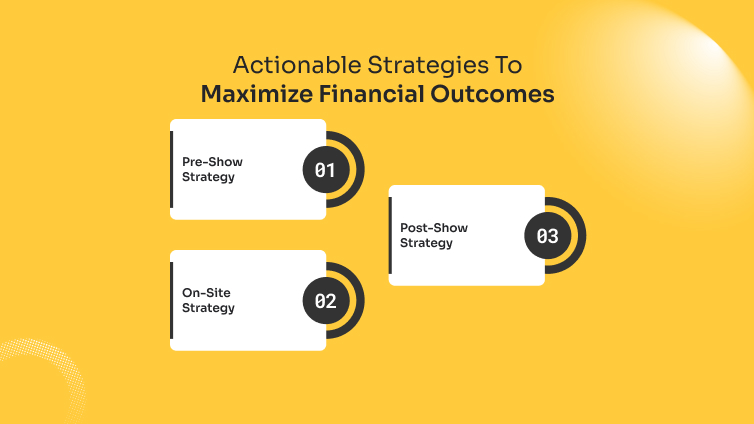
In order to maximize performance and improve your ROI, you need deliberate planning across phases. Here are a few examples that you can take a look at:
Pre-Show Strategy
- Targeted Outreach: Proactive outreach, such as booking face-to-face meetings 30 days prior or running LinkedIn campaigns targeting registered attendees, helps secure booth traffic.
- Staff Alignment: Aligning staff on brief pitches helps qualify foot traffic quickly on the busy floor.
On-Site Strategy
- Data Capture: Utilizing digital lead-retrieval scanners can reduce manual-entry errors.
- Engagement Scheduling: Conducting live product demonstrations at scheduled intervals may make crowd flow easier to manage.
- Staff Rotations: Using structured, rotating shifts keeps booth personnel energized.
Post-Show Strategy
- CRM Integration: Uploading lead data into your CRM promptly (e.g., within 24 to 48 hours) can reduce delays and missing information.
- Segmented Follow-Up: Sending personalized follow-up communication targeted to the visitor’s specific pain points may make follow-up more relevant to each lead.
- Financial Review: Conducting a formal post-mortem review compares actual expenditure against the initial trade show ROI targets.
Common Risks And Operational Pitfalls To Avoid
Here are some of the common risks that you must avoid:
- Over-Customizing Rentals: Modifying leased structures with permanent branding elements frequently incurs structural alteration fees. Utilizing interchangeable, modular graphics is often more economical.
- Logistics Delays: Missing advanced warehouse deadlines can cause logistics costs to rise due to expedited shipping and late venue handling surcharges.
- Vague Lead Scoring: Treating casual visitors the same as active decision-makers distorts post-show sales pipeline forecasting. Establishing clear qualification parameters before the show floor opens keeps data reliable.
- Delayed Outreach: Postponing prospect outreach allows momentum to fade. A structured communication plan helps teams prioritize timely contact while the interaction remains fresh.
Follow The Steps To Boost Trade Show ROI
Renting an exhibit booth is not universally cheaper than ownership.
The more suitable choice depends on show frequency, structural design consistency, and total budget limits. Renting provides agility for occasional exhibitors and brands exploring new geographic regions.
Conversely, ownership can offer long-term cost efficiencies for frequent exhibitors utilizing a consistent layout across multiple events.
Ultimately, maximizing your trade show investment requires evaluating the complete cost stack – including construction, logistics, and labor – against qualified pipeline growth to select the approach that fits your operational capacity and corporate goals.
Share this article: