- How To Implement The Order Management Process: 6 Realistic Steps
- 1. Inventory Availability
- 2. Order:
- 3. Verification
- 4. Inventory Promising
- 5. Fulfillment
- 6. Service
- What Are Some Important Factors To Consider During The Order Management Process?
- 1. Demand Generation
- 2. Internal Coordination
- 3. The Fulfillment Stage
- 4. Incorporating Feedback
- The Whole Order Management Process Explained
Clarifying The Consumer Order Journey To Improve Responsiveness

All of us understand how frustrating it is when an order is late or hasn’t shipped on time.
Additionally, this frustration is the same, regardless of whether you are a customer or a retail business owner.
However, if you belong to the latter, you must feel a certain accountability as well, right?!
Therefore, you must have a strong grasp of the order management process.
This will allow you to find all the missing links in your business that might be hindering your growth.
As I always mention in my blogs, one of the biggest assets of retail businesses is happy customers.
And the fastest way to retain them? Make sure they get what they ask for, ASAP!
I have written this blog to help you explore more about how end-to-end visibility shapes modern order management practices.
Additionally, you can also see the accompanying resource from Impact North. It is a provider of ERP software for metal fabrication.
How To Implement The Order Management Process: 6 Realistic Steps
To implement this process seamlessly, you need to take care of these sex steps. These will be enough:
1. Inventory Availability
A customer or sales team verifies that inventory is available as they review various products or services.
2. Order:
The customer places the order across a range of possible channels. They can place the order through the web and mobile.
Additionally, a call center is also a possible option these days.
In addition, they also have the options of stores, marketplaces, and others.
3. Verification
A sales team member or an automated system verifies with the customer that the order has been placed.
Additionally, they also collect or record the pertinent data for the order.
This list of data primarily includes name, address, and telephone number.
In addition, it can also include your email and promotional codes. In fact, there can be other data.
4. Inventory Promising
The system or team member matches the product or service to fulfill the order.
5. Fulfillment
The product or team is dispatched through a distribution channel such as
- Ship-From-Warehouse Or Distribution Center
- Ship-From-Store, Pickup-In-Store
- Online Download
Additionally, it can also be that a salesperson simply hands over the item.
In fact, fulfillment is verified as well. You will have the customer sign off on the completion of a service.
6. Service
The most prominent services, of course, deal with making an appointment.
Then, they schedule installation or delivery services. Also, it is the same when exchanging or returning a product.
This may be the first step in a new business process. But it can also be associated with order management.
What Are Some Important Factors To Consider During The Order Management Process?
Some factors decide the course of this process.
And even if you do everything right, your strategy will be incomplete if you don’t consider these factors.
I have listed the most important ones. If you are just starting, this is all you need for now to grasp the subject matter.
Also, if you are experienced, you might already have some idea abut their importance.
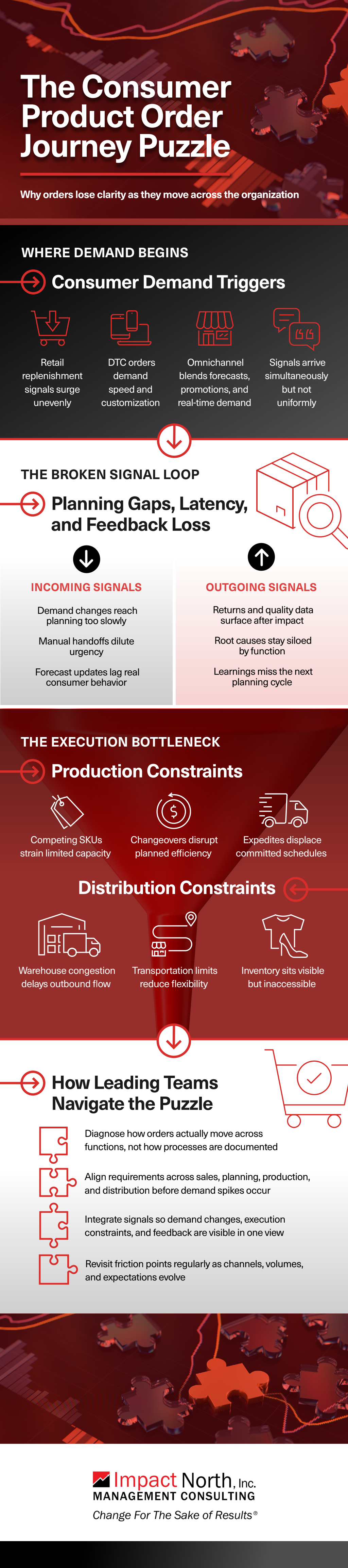
1. Demand Generation
This has become increasingly complex.
Traditional retail orders may follow more predictable patterns.
On the other hand, the direct-to-consumer channels require greater flexibility. Additionally, they ask for faster response times.
Also, all the omnichannel strategies add another layer, with pricing changes and promotions.
In fact, it also includes shifting inventory availability. Therefore, it also influences demand week by week.
Can you guess what happens when these varied signals feed into systems that are not fully aligned?
Then, your organization’s risk is relying on outdated or incomplete data.
Additionally, this limits the ability of planners and schedulers. They cannot efficiently respond to changing demand conditions.
2. Internal Coordination
This is another critical factor.
When sales, demand planning, and operations function in silos, priority updates and urgent orders often move inefficiently through:
- Emails
- Spreadsheets
- Disconnected Tools
This lack of integration increases the likelihood of errors.
Additionally, I have also heard a lot of retail business owners say that this is one of the biggest factors behind the miscommunication.
Also, this leads to delayed decision-making.
Over time, these inefficiencies can weaken accountability. Also, it can severely reduce overall performance.
3. The Fulfillment Stage
Do you know what the fulfillment stage is all about? Well, if I am to put it simply, I would say it is where planning meets execution.
Therefore, this stage is very, very important for all the manufacturing teams. They must balance competing priorities.
Additionally, they also need to manage changeovers. Also, they need to operate within resource constraints.
Guess what the most risky part is? All of which can impact output.
At the same time, warehouse and logistics teams face their own challenges. One of the biggest ones is definitely limited space.
In addition, another huge challenge is fluctuating labor availability. Also, transportation bottlenecks are a very common challenge, too.
When system visibility is limited and coordination is weak, these operational hurdles become even more difficult to manage.
4. Incorporating Feedback
Another often overlooked element is how feedback from returns, quality issues, or service failures is incorporated into future planning.
What do you think happens when feedback loops are slow or incomplete?
Then, the organizations miss opportunities to refine their processes.
Additionally, if you are dealing with delayed insights in retail businesses, it can lead to repeated mistakes.
Therefore, it will also perpetuate inefficiencies across planning cycles.
The Whole Order Management Process Explained
A proper order management process requires a broader approach than traditional forecasting tools alone.
You ned to make sure that you are aligning teams across functions. Trust me, this helps ensure that priorities are shared and understood.
Additionally, you must also evaluate the full journey from demand generation to final delivery.
This will reveal where delays and bottlenecks occur.
Integrating real-time feedback into both planning and execution systems allows organizations to respond quickly and continuously improve.
Ultimately, if you can get this process right, you will finally strengthen the consumer order journey.
This really depends on creating clear processes and connecting systems and teams.
Oh, don’t forget to maintain a unified view of key business signals!
Read Also:
Share this article: