- Inside The Gates: What Is GIFT City?
- Why Is It Called GIFT City?
- The Ultimate Power Move: India's Ambition On The Global Stage
- The Billion-Dollar Leak: Why GIFT City Had To Happen
- The Secret Sauce: Why The Big Money Actually Showed Up?
- One Regulator To Rule Them All
- Major Companies Operating In GIFT City
- Key Tax Benefits Of GIFT City
- The Glam Shift: Swapping Dry State Rules For Global Vibes
- The Policy Plot Twist
- Under the Hood: A City Built Like A Sci-Fi Movie
- The "Walk To Work" Dream: India's New Lifestyle Standard
- Can Anyone Buy Property In GIFT City?
- How Does GIFT City Compare To Singapore?
- The Reality Check: Challenges Facing GIFT City
- The Takeaway: The Blueprint For India’s Next Chapter
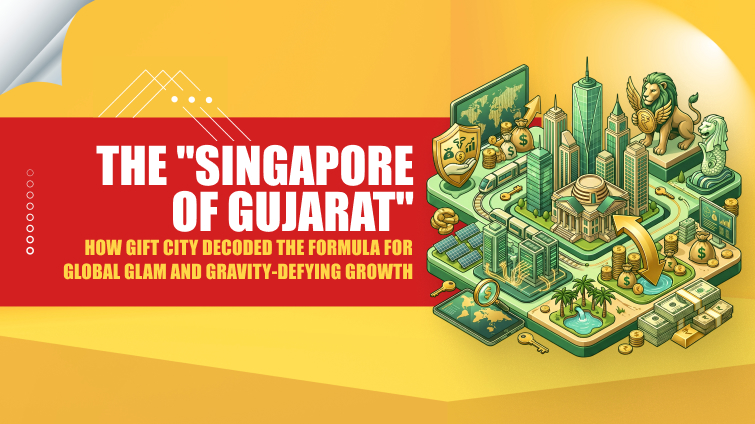
The “Singapore Of Gujarat”: How GIFT City Decoded The Formula For Global Glam And Gravity-Defying Growth
Instead of battling a soul-crushing three-hour traffic jam, you slip onto a silent, driverless metro. Within minutes, you’re sitting in a sleek, dimly lit lounge, ice clinking in your glass as you sip a cold gin and tonic.
All in the absolute heart of Gujarat!
Ten years ago, if you pitched this exact scene to anyone in Mumbai or Delhi, they’d have laughed you straight out of the room.
A dry state hosting a futuristic, high-rolling financial oasis on what was once empty, dusty scrubland? No way.
But things change fast.
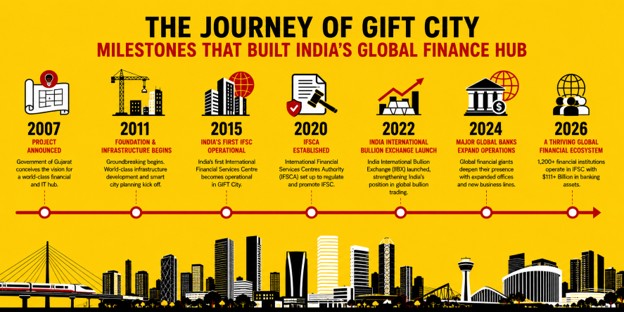
We’ve hit 2026, and GIFT City (Gujarat International Finance Tec-City) has officially stepped off the government slide decks and onto the map. It is no longer a collection of hopeful architectural mockups.
So, what is GIFT City? In reality, it is a booming, cash-fueled reality. Yet, if you actually walk its streets, the absolute first thing that hits you isn’t the towering skyline.
It is the eerie, beautiful silence. If you are used to the deafening, horn-blaring chaos of Mumbai’s BKC or Bengaluru’s Outer Ring Road, the quiet here is almost shocking.
The streets are spotless, built for actual walking, and completely stripped of the usual metropolitan roar.
Inside The Gates: What Is GIFT City?
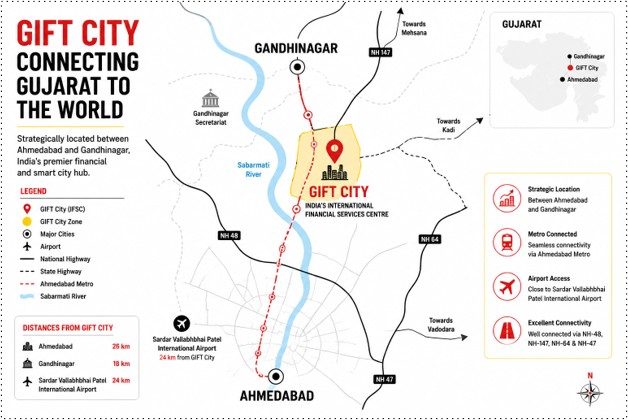
Think of it as a legal and financial loophole brought to life. GIFT City, short for Gujarat International Finance Tec-City, is a custom-built, eco-friendly smart hub straddling the Ahmedabad-Gandhinagar corridor.
It holds a unique crown as India’s sole International Financial Services Center (IFSC). In plain terms? It is an “offshore” economic zone carved directly into Indian soil, allowing global giants and local powerhouses to trade in foreign currencies under a single, radically simplified rulebook.
Why Is It Called GIFT City?
What is GIFT City? While “GIFT” sounds like a clever marketing acronym, its full form reveals the grand scope of the project: Gujarat International Finance Tec-City.
The “International Finance” part refers to its status as India’s premier tax-exempt, dollar-denominated zone.
The “Tec-City” (Technology-based Special Economic Zone) highlights the state-of-the-art digital infrastructure and smart utility networks operating beneath the surface.
Taken together, it represents India’s official playground for competing with traditional financial titans like Singapore, Dubai, and London.
The Ultimate Power Move: India’s Ambition On The Global Stage
GIFT City isn’t just a local real estate project; it is the crown jewel of India’s aspirational economic leap.
As India aggressively marches toward becoming a $5 trillion economy and beyond, the country is transitioning from a back-office outsourcing hub into a global financial superpower.
For years, India watched from the sidelines as Western capital dictated global markets. GIFT City is India’s way of taking the steering wheel.
The Billion-Dollar Leak: Why GIFT City Had To Happen
For decades, India had a massive, frustrating problem.
Whenever a booming Indian unicorn wanted to raise serious global capital, or when a massive conglomerate needed to structure an international deal, they packed their bags.
They flew to Singapore, Dubai, or London.
Consider these staggering numbers that reveal why the old system was broken:
- The Fees: India was losing an estimated $50 billion annually in financial services fees to foreign hubs.
- The Capital: Nearly 70% of India-focused private equity and venture capital was structured outside the country.
The capital was Indian, the founders were Indian, but the legal home of the money was offshore.
The Indian government realized you cannot stop money from leaving by building higher walls. You have to build a better playground.
GIFT City was designated as an IFSC (International Financial Services Centre). Essentially, the Ministry of Finance drew a virtual boundary around this patch of land.
Inside this boundary, you are technically “offshore” under FEMA (Foreign Exchange Management Act) rules.
You get to trade in foreign currencies, bypass local tax structures, and operate under global-standard regulations. All while keeping your feet firmly planted on Indian soil.
| Why Was GIFT City Created?GIFT City was created to reverse India’s “financial brain drain” and stop the multi-billion-dollar outflow of capital and advisory fees to offshore hubs like Singapore and Dubai. By establishing a domestic offshore zone (IFSC), the government created a gateway for foreign capital to flow directly into Indian markets without having to navigate onshore regulatory friction. |
The Secret Sauce: Why The Big Money Actually Showed Up?
You can build pretty buildings, but banks won’t move their money just for a nice view. GIFT City succeeded because it solved the regulatory nightmare.
Historically, setting up a financial business in India meant dealing with a multi-headed bureaucratic monster.
You had to get permissions from the Reserve Bank of India (RBI), the Securities and Exchange Board of India (SEBI), and the Insurance Regulatory and Development Authority (IRDAI).
It was a slow, exhausting process.
One Regulator To Rule Them All
GIFT City fixed this by creating the IFSCA (International Financial Services Centres Authority) under the IFSCA Act of 2019.
This single, unified regulator replaced the patchwork of SEBI, RBI, and IRDAI oversight within the zone.
Under the direction of the Ministry of Finance, business approval times dropped from agonizing months to a few brisk weeks.
Consider the sheer scale of what is happening here right now, backed by the latest official statistics from the IFSCA Annual Reports:
- $111 Billion+ in Banking Assets: According to the latest data, banking assets at GIFT City IFSC have crossed $111 billion, a massive surge from just $14 billion in 2020.
- 1,500+ Registered Entities: The ecosystem now hosts over 1,500 active financial and technology entities.
- High-Octane Exchanges: The NSE IFSC and India INX international exchanges boast cumulative debt listings exceeding $67 billion, with average daily trading volumes regularly reaching multi-billion-dollar levels.
- Aviation & Maritime Leasing: GIFT City has quickly become an alternative to Ireland and Singapore, with 35 aircraft lessors and 36 ship lessors actively leasing over 370 aviation assets and 37 ships as of 2026.
- Bullion Trading: The launch of the India International Bullion Exchange (IIBX) allows qualified Indian jewelers to import gold and silver directly, creating transparent, global pricing right inside Gujarat.
Major Companies Operating In GIFT City
GIFT City is no longer an experimental zone; it has become a “Who’s Who” of global and domestic powerhouses. If you walk through the commercial high-rises, you’ll spot some of the most influential corporate names on the planet:
| Sector | Major Global & Indian Players |
|---|---|
| Global Investment Banks | JPMorgan Chase, HSBC, MUFG, Deutsche Bank, Standard Chartered, Bank of America, Citi |
| Domestic Banking Giants | State Bank of India (SBI), HDFC Bank, ICICI Bank, Axis Bank, IDFC FIRST Bank |
| Technology & IT Services | Oracle, IBM, Tech Mahindra, TCS, Infosys, Wipro |
| Global Capability Centres (GCCs) | Capgemini, Technip Energies |
Key Tax Benefits Of GIFT City
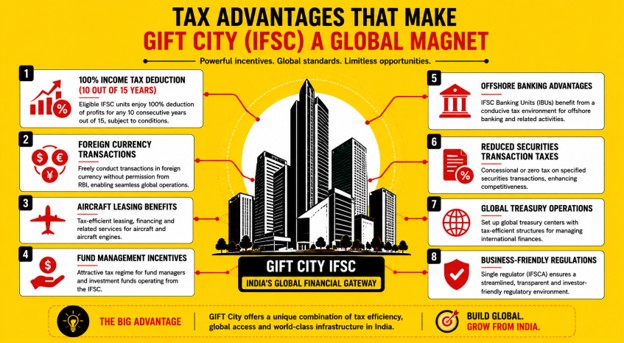
For global funds, NRI investors, and multinational corporations, GIFT City tax benefits represent one of the most competitive fiscal frameworks in the world:
- 10-Year Corporate Tax Holiday: Approved IFSC units enjoy a 100% income tax exemption for any 10 consecutive years out of a 15-year block.
- No Transaction Taxes: Complete exemption from Securities Transaction Tax (STT), Commodity Transaction Tax (CTT), and stamp duty on transactions executed on IFSC exchanges.
- Zero Capital Gains: No capital gains tax for non-resident investors on the transfer of specified securities (including derivatives and P-Notes).
- GST Exemptions: Services received by units located in the IFSC are exempt from GST.
- Withholding Tax Relief: Zero withholding tax on interest paid to non-residents on money lent to IFSC units, and a concessional 10% tax rate on dividends.
| Is GIFT City Tax-free?Yes, but with conditions. Businesses operating within the IFSC enjoy a 100% tax holiday on business profits for 10 of the 15 years, as well as zero GST, STT, and stamp duty on IFSC exchange trades. For individuals, salaries earned within GIFT City remain subject to standard Indian income tax brackets, though foreign currency accounts offer significant transactional flexibility. |
The Glam Shift: Swapping Dry State Rules For Global Vibes
Let’s be completely honest. Finance is a talent-driven game.
You can offer the best tax incentives in the world, but if high-earning fund managers, tech geniuses, and global CEOs hate living in your city, they will pack up and go back to London or Singapore.
For the longest time, the biggest elephant in the room was Gujarat’s strict dry-state policy.
How do you pitch a global lifestyle to an investment banker from New York or a tech founder from Bengaluru if they can’t grab a drink with a client after a grueling 14-hour shift?
The Policy Plot Twist
To address this head-on, the state government relaxed the liquor prohibition laws specifically for GIFT City.
Under the revised rules, the liquor permit system has been heavily simplified.
Non-resident visitors and foreign nationals no longer require complex temporary permits. They can consume alcohol at licensed establishments by simply presenting a valid government-issued photo ID.
Furthermore, licensed hotels and clubs can now serve alcohol in flexible social spaces. Including lawns, terraces, and poolside areas. Rather than being confined to secluded, dark rooms.
Today, the vibe after 6:00 PM is shifting fast. Swanky rooftop bars, premium restaurants, and elite social clubs are popping up to cater to a young, affluent, global crowd.
Under the Hood: A City Built Like A Sci-Fi Movie
If you’ve ever sat in a three-hour Mumbai traffic jam or watched a Gurgaon road flood after a brief shower, GIFT City’s infrastructure feels like science fiction.
The planners didn’t just build roads; they built a smart city from the underground up.
- The Utility Tunnel: You will never see a road being dug up in GIFT City to fix a broken pipe or lay a new cable. Every single utility, including power lines, water pipes, and high-speed fiber, runs through a massive, walkable underground tunnel.
- No Garbage Trucks: You won’t see trash cans overflowing on the street. The city uses a high-speed, automated vacuum waste management system. You throw your trash into a chute, and it gets sucked through underground pipes at 90 kilometers per hour straight to a processing plant.
- Central AC for the Entire City: Instead of every building slapping loud, dripping air conditioners on their walls, the city uses a massive District Cooling System. It pipes chilled water to every skyscraper, cutting energy bills by up to 30%.
The “Walk To Work” Dream: India’s New Lifestyle Standard
For the average Indian professional, the daily commute is a soul-crushing tax on sanity. GIFT City was designed to kill the commute entirely.
The city is built on a tight, integrated “Walk to Work” model.
Premium residential towers are positioned just minutes away from the commercial high-rises. You can live in a state-of-the-art apartment, walk through manicured green parks to your office.
After that, you can drop your kids off at a top-tier international school (like the Jamnabai Narsee School operating right in the city).
Moreover you can meet friends at a high-end cafe. All without ever needing to touch a car steering wheel.
Add in the seamless connection to the GIFT City Metro (directly linking Ahmedabad and Gandhinagar). That’s it! You now have a level of mobility that most young professionals in Bengaluru or Delhi can only dream of.
Can Anyone Buy Property In GIFT City?
For years, buying residential real estate inside GIFT City was highly restricted; only people employed within the city were permitted to own homes. However, to boost the local ecosystem, the government relaxed these residential rules, opening up the property market.
- Who can buy: Indian citizens, Non-Resident Indians (NRIs), Overseas Citizens of India (OCIs), and registered corporates are now fully eligible to purchase residential apartments inside GIFT City.
- Investment Appeal: This policy shift has triggered a massive boom in the GIFT City residential sector. Premium developers have launched luxury projects featuring modern amenities, appealing to NRIs seeking strong rental yields from the influx of high-salaried professionals.
- Commercial Leasing: Office spaces are still highly regulated. Companies must obtain the necessary registration from the SEZ authorities or the IFSCA to lease or purchase commercial office space in the IFSC zone.
| Can Foreigners Work And Live In GIFT City?Yes. Foreign nationals and NRIs can easily work in GIFT City if employed by an IFSC-registered company. The IFSCA has introduced simplified digital KYC and streamlined visa procedures to facilitate the entry of foreign talent. Anyone, including foreign entities and NRIs, can purchase or lease residential properties inside the city’s domestic and special economic zones. |
How Does GIFT City Compare To Singapore?
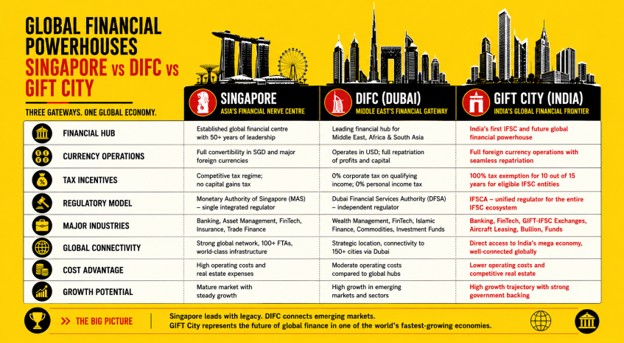
To truly understand whether GIFT City is successful, we have to look at how it compares with the heavyweight champion of Asian finance: Singapore.
| Feature | GIFT City (IFSC) | Singapore |
|---|---|---|
| Regulatory Framework | Unified, fast-track regulation via IFSCA | Multiple regulators coordinated by the Monetary Authority of Singapore (MAS) |
| Corporate Tax Holiday | 100% tax exemption for 10 out of 15 years | Concessional tax rates (usually 5% to 13.5% for financial activities) |
| Currency of Operation | Primarily USD-denominated and other global currencies | Multi-currency (SGD, USD, EUR) |
| Capital Gains Tax | Zero on specified transaction classes | Zero (no capital gains tax overall) |
| Access to Indian Assets | Direct, native access to high-growth Indian equities, bonds, and startups | Access through synthetic derivatives or FPI structures |
| Cost of Operations | Highly competitive (significantly lower real estate, labor, and compliance costs) | High (premium real estate and high cost of living) |
While Singapore remains a mature, globally trusted hub with deep-rooted legal structures, GIFT City is rapidly closing the gap. It is offering unparalleled native access to India’s domestic growth story at a fraction of Singapore’s operational costs.
The Reality Check: Challenges Facing GIFT City
No massive urban or financial experiment succeeds overnight without facing friction. For all its staggering growth, GIFT City still has several hurdles to clear:
- Talent Attraction: High-level investment bankers, legal experts, and fund managers still hesitate to relocate from established cosmopolitan hubs like Mumbai or London. Ensuring high GIFT City salary standards and continuous lifestyle development is critical to winning this talent war.
- Housing Shortages: While commercial towers are filling up with large banking operations, the development of luxury residential towers has lagged. Finding immediate, high-quality housing within walking distance of offices remains a challenge for the incoming workforce.
- Ecosystem Maturity: Though banking assets have surpassed $111 billion, the secondary debt markets, retail wealth management, and insurance ecosystems remain in their infancy compared to the massive, liquid markets of Singapore or London.
- International Competition: GIFT City must continually refine its policies to remain more attractive than emerging rivals such as Dubai’s DIFC and expanding financial centers in East Asia.
| Is GIFT City Successful?Yes, but it is a work in progress. It is highly successful as a B2B institutional gateway. It is also evidenced by over $111 billion in banking assets and 1,500 registered entities. However, its success as a vibrant, retail-friendly consumer smart city is still evolving as more residential towers, schools, and social venues open to build a mature local community. |
The Takeaway: The Blueprint For India’s Next Chapter
What is GIFT City worth to us now? GIFT City is no longer a distant dream. It is the blueprint for India’s economic sovereignty.
It proves that when India combines world-class infrastructure with flexible, unified regulation and a high-quality lifestyle, we can convert it into a global capital.
For the young Indian professional, it represents something even bigger. It is the realization that you don’t have to emigrate to Singapore or London to work on global deals, earn competitive salaries, and enjoy a world-class lifestyle.
The global stage has officially set up shop right here at home.
Share this article: