- Harshad Mehta’s Ascend In A Nutshell
- Who Was Harshad Mehta?
- How The Harshad Mehta Scam Actually Worked
- The Inner Picture
- Why Nobody Saw The Scam Coming
- But What Worked In Favor Of Mehta?
- What Is Institutional Trust?
- The Moment Everything Changed
- The Legacy Of The Scam
- Key Takeaways
- Could A Harshad Mehta Scam Happen Again?
- Lessons Every Investor Should Take Away
- Question Extraordinary Returns Before You Celebrate Them.
- Understand Where The Money Is Actually Coming From.
- Don't Blindly Trust Celebrity Investors, Then Or Now.
- Separate Hype From Fundamentals, Deliberately And Repeatedly.
- Markets Reward Discipline More Than Excitement.
- Frequently Asked Questions
- What Harshad Mehta’s Story Tells You?
Harshad Mehta Scam: The Story That Changed India’s Stock Market Forever
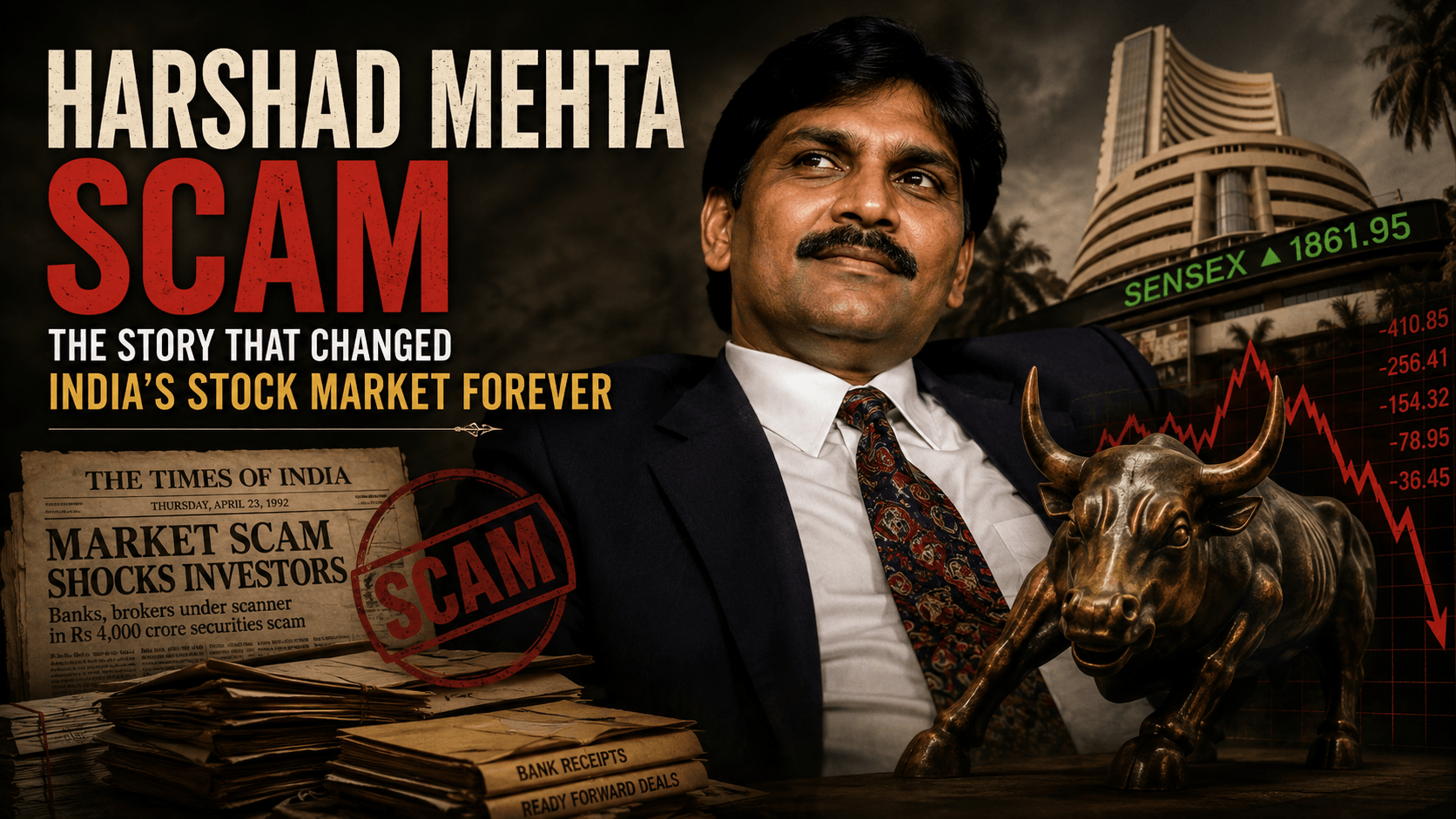
Bombay, early 1992. The Sensex is on fire. Newspaper vendors near Dalal Street can’t print copies fast enough.
Meanwhile, everyone everywhere wants to read about the man who seems to have cracked the code of the stock market. And after that, the BSE enters the daily trails of life in India.
Taxi drivers are trading tips. A three-bedroom flat in Worli, bought by a broker who used to take the bus to work, becomes a local legend.
At the center of it all is a man named Harshad Mehta. But that’s not just any name.
It’s a name that, within months, will be spoken with equal awe and disbelief. So what is the Harshad Mehta scam?
Harshad Mehta’s Ascend In A Nutshell
People call him “The Big Bull,” In 1992, Mehta seemed to have earned all of it. But why?
Stocks he touches seem to multiply in value. Notably, he drives a Toyota Lexus before most Indians have even seen one on the street. He has unwrapped every mystery in the share market.
Then, in April 1992, it all comes apart. A few newspaper columns raised questions that Harshad Mehta had no answers to.
How does a single stockbroker manage to move enough money through India’s financial system to shake it to its foundations? Meanwhile, he’s actually a big nobody.
That’s the real question this story answers. His story was never about “who is Harshad Mehta.” We rather need answers to how the system around him let it happen. Also, why so many smart, experienced people didn’t see it coming?
Who Was Harshad Mehta?
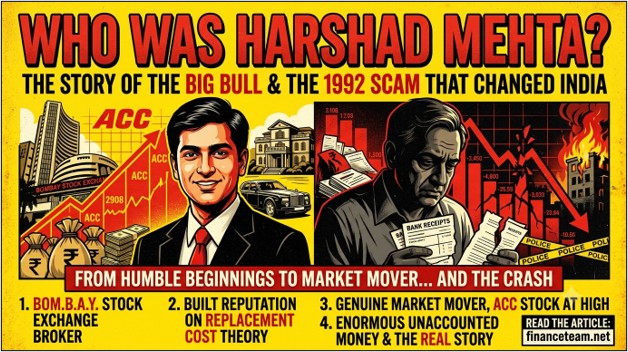
Harshad Mehta was born in 1954 into a modest Gujarati family. He was raised partly in Mumbai and partly in Raipur, where he completed his schooling.
After that, he returned to Mumbai again to pursue a B.Com degree. He tried several jobs afterward.
At one point, he sorted diamonds; at another, he worked as a cement contractor and processed insurance policies. Eventually, he landed at the Bombay Stock Exchange.
First as a jobber, then as a broker in his own right by the mid-1980s.
What set him apart wasn’t formal training in finance. It was an instinct for how India’s opaque, paperwork-heavy bond and banking markets worked, and where the gaps were.
Through his firm, Grow More Research and Asset Management, he built a reputation for aggressive stock picks and publicly championed a “replacement cost theory”.
According to the theory, certain stocks were undervalued relative to the cost of building those companies from scratch.
Retail investors loved it. As a result, his speculations became the language of logic.
By 1990-91, Mehta was a genuine market mover, capable of driving the prices of specific stocks, such as ACC, to extraordinary levels almost single-handedly.
However, that kind of influence doesn’t come from stock-picking talent alone. In fact, it comes from access to money.
Especially when you have an enormous, unaccounted-for amount of money. That’s where the real story begins.
How The Harshad Mehta Scam Actually Worked
Strip away the jargon, and the mechanism at the heart of the 1992 securities scam is surprisingly easy to follow.
Banks in India are required to hold a portion of their deposits in government securities. Essentially loans to the government. After that, they routinely trade these bonds with one another.
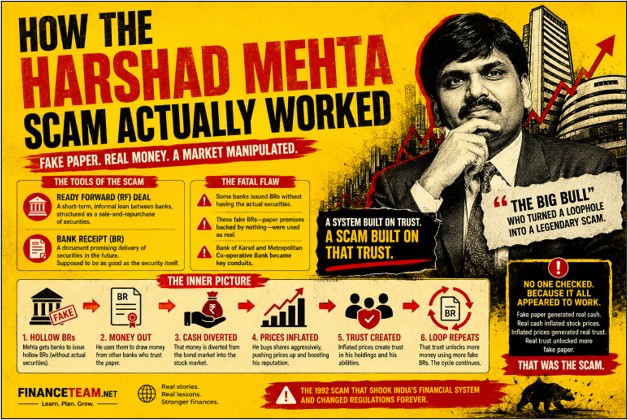
To make this easier, they use an instrument called a Ready Forward (RF) deal: a short-term, informal loan between banks, structured as a sale-and-repurchase of securities, often for periods as short as a few days.
Why did brokers get this leverage? At first, brokers weren’t supposed to be more than middlemen in these deals. They were particularly known for connecting one bank to another.
However, the system was set up so that money and securities didn’t move directly between banks. They passed through the broker’s account first.
Now add the second piece: the Bank Receipt (BR). When a bank sold securities in an RF deal, it wasn’t always practical to hand over physical bonds instantly.
Therefore, the selling bank would issue a BR. That receipt is a document promising “we hold these securities on your behalf, and will deliver them, or their equivalent, when asked.” In connection with this, the BR was supposed to be as good as the security itself.
Mehta exploited a simple but devastating weakness. Some banks, under pressure to keep pace with profits from these bond transactions, were willing to issue BRs without actually holding the underlying securities.
That’s why they allowed fake BRs, and paper promises backed by nothing. Two banks in particular, the Bank of Karad and the Metropolitan Co-operative Bank, became conduits for this practice.
The Inner Picture
Picture it like a warehouse receipt for goods that don’t exist. Mehta would get banks to issue him hollow BRs. After that, he would use them to draw money from other banks who trusted the paper at face value.
In fact, those banks believed they were lending against real government securities. That money, instead of flowing back into the bond market, was diverted into the stock market.
Again, Mehta used it to aggressively buy shares, pushing prices up. This approach made his holdings and reputation look even more impressive. Naturally, he could use this portfolio to raise even more money the same way.
It was a loop. Fake paper generated real cash. Real cash inflated stock prices. Again, inflated prices generated real trust. Finally, real trust unlocked more fake paper.
What’s worse, nobody had a reason to check whether the paper at the bottom of the pyramid was genuine. But why? The reason is simple. Everything built on top of it appeared to be working.
Why Nobody Saw The Scam Coming
This is the part of the story that many articles won’t cover. However, it is the most critical component to this scam.
It wasn’t that regulators and bankers were uniquely careless in 1992. It’s that the entire system was primed to believe the story Mehta was telling. The only reason was that Mehta could show results to validate the story.
But What Worked In Favor Of Mehta?
Success bias did a lot of the work. When a person is visibly, repeatedly successful, people stop questioning the mechanics behind that success.
They also start assuming there’s a mechanism they simply don’t understand. Bankers who bent rules for Mehta weren’t necessarily reckless.
In reality, a lot of them genuinely believed they were dealing with an unusually skilled operator, not a fraud.
Moreover, the herd mentality amplified it. Once respected institutional players were seen doing business with Mehta, smaller banks and brokers followed.
They began to reason that so many established names couldn’t all be wrong. Authority bias mattered too: in markets, track record often substitutes for scrutiny, and Mehta had one that few people looked past.
Then there was the media’s role. I feel the media was genuinely double-edged. Financial journalism in the early 1990s was still finding its footing in a newly liberalizing India.
Meanwhile, the coverage of Mehta before April 1992 was largely celebratory. That said, the media started treating him as proof that Indian entrepreneurship could conquer modern finance.
That didn’t create the fraud. But it normalized it, feeding public confidence and making the eventual unraveling feel more shocking than it should have.
And underneath it all sat institutional trust.
What Is Institutional Trust?
To clarify, the assumption is that if a document said “Bank Receipt,” it meant what it said. Nobody was auditing the auditors.
Settlement systems were manual, slow, and easy to manipulate precisely. It was mainly because they relied on paper and personal relationships rather than verified electronic records.
If the same rally had unfolded on a smartphone today, through viral trading tips instead of newspaper profiles, would the outcome really have been different? The medium would change. The psychology, arguably, would not.
The Moment Everything Changed
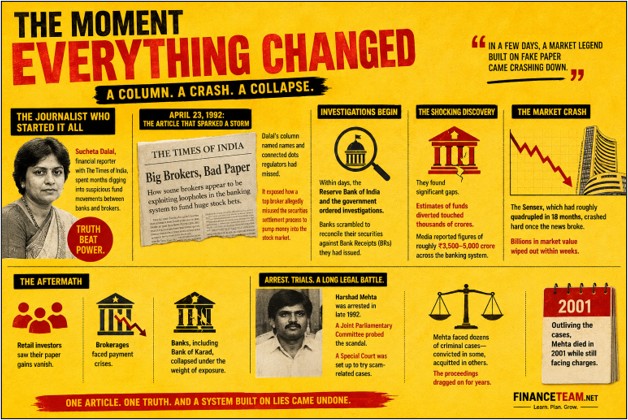
The unraveling began not with a regulator or any governing body. Instead, it was a journalist who played the key role here.
Sucheta Dalal, then a financial reporter with The Times of India, had been quietly investigating irregularities in how money was moving between banks and brokers.
On April 23, 1992, she published a column laying out how a leading broker appeared to be exploiting the banking system’s securities settlement process to fund massive stock purchases.
The article named names and connected dots regulators had missed. Within days, the Reserve Bank of India and the government ordered investigations.
Banks scrambled to reconcile their securities holdings against the BRs they had issued and found significant gaps.
Estimates of the total funds diverted eventually touched thousands of crores. The media reported figures of roughly ₹3,500–5,000 crore across the banking system.
The market’s reaction was brutal and immediate. The Sensex, which had roughly quadrupled in the eighteen months before the scam, crashed hard once the news broke.
As expected, it wiped out a significant chunk of market value within weeks.
Retail investors who had piled in during the euphoria watched paper gains disappear, brokerages faced payment crises, and some banks, including Bank of Karad, collapsed under the weight of their exposure.
Mehta was arrested in late 1992. A Joint Parliamentary Committee investigated the scandal, and a Special Court was set up to try scam-related cases.
I feel that is a rare acknowledgment of how tangled the fraud was. Mehta faced dozens of criminal cases, convicted in some and acquitted in others.
Meanwhile, the proceedings dragged on for years, outliving Mehta himself, who died in 2001 while still facing charges.
The Legacy Of The Scam
The 1992 scam didn’t just expose one broker’s fraud. It exposed how much of India’s financial infrastructure ran on trust rather than verification. Meanwhile, that realization forced structural change that outlasted the scandal itself.
SEBI’s stronger powers were perhaps the most consequential shift. The Securities and Exchange Board of India existed before 1992 but largely as a toothless watchdog.
The scam gave it statutory authority under the SEBI Act, transforming it into a genuine regulator with the power to investigate, penalize, and set binding rules for exchanges, brokers, and intermediaries. That’s a transformation that a crisis of this scale accelerated over years.
Electronic trading followed, with the National Stock Exchange, incorporated in 1992 and operational from 1994.
Interestingly, electronic trading is a fully computerized, transparent order-matching system that replaced the open-outcry trading floor, a direct rebuke to the relationship-driven culture that had enabled manipulation.
Demat accounts, introduced through the National Securities Depository Limited in 1996, eliminated physical share certificates almost entirely.
I feel that much of the old vulnerability stemmed from paper instruments such as BRs, certificates, and transfer forms. Especially, these instruments could be forged or never verified. Digitizing ownership records closed that door.
Improved settlement systems shortened the gap between a trade and the exchange of cash and securities, reducing the window during which fraudulent instruments like fake BRs could circulate undetected.
Market surveillance evolved from manual, complaint-driven oversight to systems that flag unusual trading in near real time. And banking reforms separated custody, settlement, and reporting functions that had previously been dangerously concentrated in too few hands.
Key Takeaways
None of these reforms happened because regulators anticipated the problem. They happened because the problem happened first.
That’s a pattern worth sitting with: financial systems, again and again, tend to strengthen their defenses only after those defenses have already failed someone.
Could A Harshad Mehta Scam Happen Again?
The honest answer: not in exactly the same form, but the underlying psychology hasn’t gone anywhere.
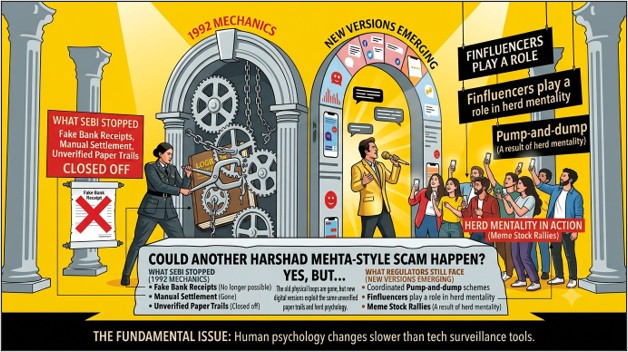
Regulators have largely closed off the specific mechanics of 1992, like fake Bank Receipts, manual settlement, and unverified paper trails.
Demat accounts, electronic settlement, and real-time surveillance by SEBI and stock exchanges make that particular playbook nearly impossible to run at scale.
But new versions of the same trust exploit have emerged elsewhere. Finfluencers now play a role. However, their role is much more critical than that of the celebratory financial press of the early 1990s, which built outsized trust in individuals based on visible short-term success.
Meme stock rallies show herd mentality is just as powerful on 2020s trading apps as it was on the physical floor of the BSE.
Meanwhile, the Pump-and-dump schemes coordinated through messaging groups echo the same loop:
- Hype generates buying
- Buying generates apparent proof
- Finally, proof generates more hype
What’s genuinely different is the defense. SEBI’s current monitoring systems use algorithmic surveillance to detect unusual volume spikes, circular trading, and coordinated pump-and-dump activity. Remember, these are tools that simply didn’t exist in 1992.
Has technology changed faster than human psychology, though? The tools for detecting fraud have improved dramatically. The tools for creating hype and our willingness to trust it may have improved just as much.
Lessons Every Investor Should Take Away
Not the generic advice you’ve read a hundred times. Specific, earned lessons from watching this exact failure unfold.
Question Extraordinary Returns Before You Celebrate Them.
Mehta’s stock picks weren’t magic. In other words, they were funded by money that shouldn’t have existed in the market.
When a return looks disconnected from anything explainable, the honest response isn’t excitement; it’s suspicion.
Understand Where The Money Is Actually Coming From.
Every asset price is, at some level, a story about capital flow.
If you can’t explain where the buying pressure behind a rally originates, you don’t understand the rally. To sum up, you’re just watching the chart.
Don’t Blindly Trust Celebrity Investors, Then Or Now.
Track records are backward-looking. Mehta had one of the most impressive track records in Bombay for about eighteen months.
It told investors nothing true about what was actually happening underneath it.
Separate Hype From Fundamentals, Deliberately And Repeatedly.
Hype and genuine value can coexist for a while. However, that’s what makes bubbles so convincing from the inside.
Markets Reward Discipline More Than Excitement.
The investors who came out of 1992 relatively unscathed weren’t the ones who avoided the market entirely.
Rather, they cultivated the habit of constantly questioning, even while everyone around them stopped doing so!
Frequently Asked Questions
A securities fraud in which broker Harshad Mehta exploited weaknesses in how Indian banks settled government securities trades, using fake Bank Receipts to divert bank funds into the stock market and inflate share prices.
Estimates vary, but the Joint Parliamentary Committee’s findings widely cite diverted funds of approximately ₹4,000–5,000 crore.
Journalist Sucheta Dalal, writing for The Times of India, exposed it in an April 1992 column detailing irregularities in bank-broker fund transfers.
Banks use this short-term arrangement to sell securities under a deal to repurchase them later. Essentially, banks collateralize this short-term loan using government securities.
A document confirming a bank holds government securities on another party’s behalf. Some banks issued them without holding any actual securities, creating fraudulent paper used to draw real money.
Police arrested him in 1992 as he faced dozens of criminal and civil cases; courts convicted him in some and acquitted him in others, but he died in 2001 with several cases still pending.
It led to a more empowered SEBI, electronic trading through the NSE, demat accounts, and far tighter settlement and surveillance systems.
That financial fraud usually results from individual ambition meeting institutional weakness. And fraudsters often exploit that investor psychology, especially when investors trust visible success without questioning its source.
What Harshad Mehta’s Story Tells You?
Go back to that image of Bombay in early 1992. The packed newspaper stands, the taxi drivers trading stock tips, the Lexus parked on a street where nobody expected to see one.
None of it was inherently irrational. People were responding reasonably to the evidence in front of them:
- rising prices
- respected institutions doing business with Mehta
- and a story that made sense
That’s what makes this scam worth returning to more than three decades later. India’s markets have changed almost beyond recognition.
To clarify, most of the market is electronic, transparent, and algorithmically surveilled in ways 1992 regulators couldn’t have imagined. But the emotions that fueled that rally stay the same.
Most importantly, problems like greed, overconfidence, fear of missing out, and unquestioning trust in visible success haven’t kept pace with the technology around them.
The Harshad Mehta scam didn’t just expose a loophole in India’s banking system. It exposed a loophole in human nature. Simply put, every new generation of investors must learn to recognize it before history repeats itself.
Share this article: