The Gst Annual Return Due Date: A Month-By-Month Roadmap For First-Time Filers
Most articles on the GST annual return due date do the same thing. They tell you the date is 31st December, list a few penalties, and move on.
If you’ve read three or four of them already, you’ve probably noticed they all say roughly the same five things.
This article takes a different approach. Instead of just stating the deadline, it walks through what actually happens in the months around that deadline. For example:
- what you should be doing in October
- what tends to go wrong in November
- and why the last week of December is the worst possible time to start.
If you’re filing your GST annual return for the first time, or you run a small business and have always left it to your accountant without really understanding it, this is written for you.
First Check Out The Date Itself

The GST annual return, filed through Form GSTR-9, is due on 31st December following the end of the financial year it covers.
So for FY 2024-25 (April 2024 to March 2025), the due date was 31st December 2025. For the current financial year, FY 2025-26, the due date is 31st December 2026.
That’s the rule in plain terms. But two things beginners consistently get wrong, so it’s worth spelling them out:
- The financial year in the name (FY 2024-25) refers to the year the transactions happened in, not the year you’re filing in.
- This date is a statutory deadline, not a guaranteed one. Extensions have happened almost every year since GST was introduced, sometimes announced with only days to spare.
- You should never plan your filing around the assumption of an extension. Treat 31st December as fixed, and if relief comes later, take it as a bonus.
| Financial Year | GSTR-9 Due Date | Note |
|---|---|---|
| FY 2022-23 | 31 Dec 2023 | No extension |
| FY 2023-24 | 31 Dec 2024 | Small businesses (turnover up to ₹2 crore) given relaxation |
| FY 2024-25 | 31 Dec 2025 | Filed under a revised, more detailed GSTR-9/9C format |
| FY 2025-26 | 31 Dec 2026 | Current cycle: this is the one most readers are preparing for now |
Do You Actually Need To File It?
This is the question that genuinely trips up first-time business owners, and it’s rarely covered clearly. Not everyone registered under GST needs to file GSTR-9.
Filing GSTR-9 is mandatory only if your aggregate annual turnover crosses ₹2 crore. Below that, it has been optional for several years running.
However, the government re-confirms this exemption each year rather than making it permanent. So it’s worth checking before assuming you’re exempt again this year.
If your turnover crosses ₹5 crore, there’s a second layer: you also need GSTR-9C, a reconciliation statement comparing your GST returns against your audited financial books.
This used to require a separate GST audit by a chartered accountant; that requirement was removed, and GSTR-9C is now self-certified by the taxpayer instead.
| Your Turnover | GSTR-9 Required? | GSTR-9C Required? |
|---|---|---|
| Up to ₹2 crore | No (optional) | No |
| ₹2 crore to ₹5 crore | Yes | No |
| Above ₹5 crore | Yes | Yes |
A quick real-world example: a small restaurant billing around ₹1.5 crore a year, charging the applicable restaurant GST rate on its food sales, would typically be exempt from GSTR-9 altogether.
But the owner still needs to keep clean monthly records, because if turnover crosses ₹2 crore even briefly during expansion, the gst annual return due date becomes mandatory for that year.
The Month-By-Month Reality (Not Just The Deadline)
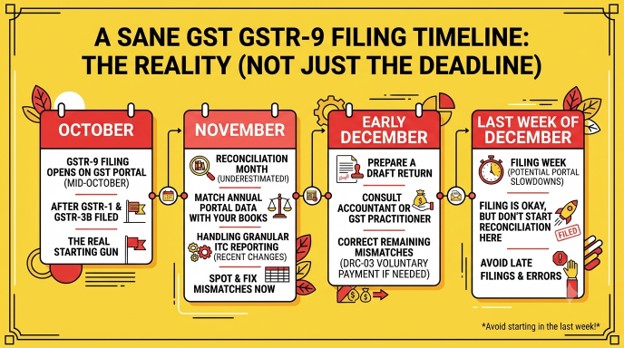
Here’s where most explainers stop short. Knowing the date doesn’t tell you when to start. In practice, the gst annual return due date falls apart for people who begin in the last week of December. Here’s what a sane timeline actually looks like.
October
The GST portal typically opens GSTR-9 filing for the year around mid-October, once your monthly and quarterly returns (GSTR-1, GSTR-3B) for the full financial year are already filed. This is your real starting gun, not December.
November
This is reconciliation month, and it’s the part beginners underestimate. GSTR-9 doesn’t ask you to enter new figures. It pulls together everything you already reported through the year and asks you to confirm it matches your books.
Recent changes to the form (notified through CBIC notifications that update the reporting tables) have made input tax credit (ITC) reporting far more granular than before.
To clarify, this is the same kind of gstr-9 tax reconciliation change that has pushed many tax practitioners to request deadline extensions in recent cycles.
If your monthly filings and your actual accounting records have drifted apart even slightly, November is when you catch it, not December.
Early December
By now you should have a draft. This is the point to involve your accountant or GST practitioner if you haven’t already.
To clarify, any mismatch found now can still be corrected before filing, through a voluntary payment form (DRC-03) if needed.
Last week of December
This is filing week, and it’s also when the GST portal slows down under heavy traffic.
Filing in this window isn’t wrong, but starting your reconciliation in this window is where almost all late filings and errors originate.
What Happens If You Miss It
Missing the date isn’t the end of the world, but it isn’t free either. A late fee of approximately INR 200 per day (₹100 each for CGST and SGST) applies. Meanwhile, that is subject to a cap based on your turnover.
On top of that, if there’s any tax shortfall discovered later, interest at 18% per annum applies from the original due date until you actually pay it.
To sum up, this is the part people underestimate. Since it compounds daily and isn’t waived just because you eventually file.
There’s also a newer, less-publicized rule worth knowing: since mid-2025, GST returns more than three years overdue can no longer be filed on the portal at all.
That’s a hard cutoff, not just a penalty. Most importantly, it is a strong reason not to let annual returns pile up unfiled across multiple years.
A note on where your money and time actually go
Here’s a connection that beginner-focused articles almost never make explicit: GST compliance and personal financial planning aren’t separate problems for a small-business owner. They draw from the same pool of time and cash flow.
Every hour spent scrambling through a rushed December reconciliation, and every rupee lost to a late fee or interest charge, is time and money that isn’t going toward actually growing your business or your personal savings.
This is exactly the kind of gap a good financial advisor helps close. However, not by filing your GST return (that’s a tax practitioner’s job). Rather, by helping you build the discipline of treating compliance deadlines as fixed calendar events.
But that’s the same way you’d plan around a loan EMI or an insurance premium due date. Are you someone who’s recently started earning or running a business and finding these deadlines stressful for the first time?
That’s usually also the point where it’s worth learning how to start investing wisely with whatever you’re setting aside after compliance costs.
Remember, the two habits, staying compliant and building savings, reinforce each other. Neither works well as an afterthought squeezed into the last week of the year.
To be clear about scope: this article is about the compliance deadline itself. If you’re a salaried individual rather than a business owner, GSTR-9 doesn’t apply to you.
You’d instead be dealing with something like the last date for regular monthly GST filings if you run a side business, which is a separate and more frequent deadline.
Common Mistakes Worth Naming Directly
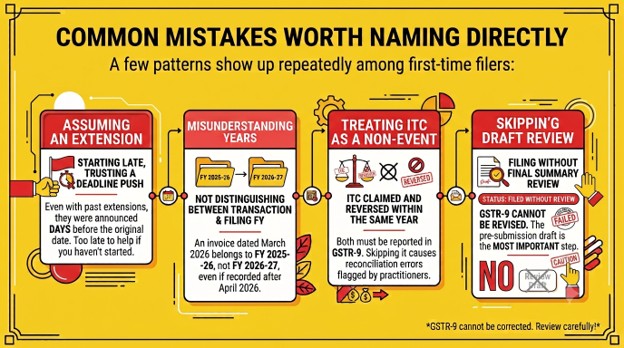
A few patterns show up repeatedly among first-time filers:
- Assuming an extension will come, and starting late anyway.
Even in years when extensions were granted, they were often announced within days of the original deadline. Too late to help anyone who hadn’t already started.
- Not distinguishing between the transaction’s financial year and the year of filing.
An invoice dated March 2026 belongs to FY 2025-26, not FY 2026-27, even if you recorded it after April 2026.
- Treating ITC claimed and reversed within the same year as a non-event.
It still needs to be reported in both places in the form, and skipping it is one of the most common reconciliation errors flagged by tax practitioners.
- Filing without a final review of the draft summary.
GSTR-9 cannot be revised once filed. There is no correction window afterwards, which makes the pre-submission draft review the single most important step in the whole process.
Where To Go From Here
If you’ve read this far, you likely already know whether you’re above or below the ₹2 crore threshold, and roughly the GST annual return due date in relative to the timeline above.
The most useful next step isn’t more reading. It’s pulling up your GSTR-1 and GSTR-3B filings for the year and checking, right now, whether they’re fully filed and whether the totals look right. Everything else in GSTR-9 builds on that.
This article reflects GST rules and notifications current as of July 2026, based on official CBIC and GSTN sources. Government notifications and extension announcements can change specific dates. So, always cross-check the live due date on the GST portal before filing.
Share this article: