- The Problem With The Standard "Semiconductor Stock" List
- The Semiconductor Revenue-Purity Framework
- Tier 1: Direct Manufacturing Exposure (fab, OSAT, ATMP)
- Tier 2: Design And Engineering IP Exposure
- Tier 3: EMS And Ancillary Assemblers With Growing Chip-Adjacent Revenue
- Tier 4: Halo And Narrative Stocks
- Why Does This Matter Practically?
- The Execution-Risk Tracker: What's Actually Been Built VS. What Was Announced?
- The Clearly Visible Trend
- Valuation Reality Check: Are You Paying For Purity Or For The Story?
- A Practical Framework
- Frequently Asked Questions
- Is There A Pure-Play, 100% Semiconductor Stock Listed In India?
- Which Semiconductor-Linked Stock Has The Least Dilution From Unrelated Business Lines?
- Why Did The Dholera Fab Timeline Slip?
- Should I Wait For The Fabs To Actually Open Before Investing?
Semiconductor Stocks India Edition: Why Every “Top 10” List Is Measuring The Wrong Thing?
The Indian semiconductor market is booming. It is projected to reach a valuation of $100 to $110 billion before 2030 ends.
But if you are hoping to invest and search for the best semiconductor stock in India online, you will see some common names reiterated in every article.
I am talking about names like HCL Technologies, Tata Elxsi, Dixon Technologies, Bharat Electronics, CG Power, Kaynes Technology, Vedanta, and L&T.
Every list ranks them by market capitalization, adds a one-paragraph company bio, and closes with the same disclaimer about consulting a financial advisor.
None of them answer the one question that actually matters before you buy semiconductor stocks india:
how much of this company’s revenue is genuinely tied to semiconductors, and how exposed are you to India’s fab-execution risk versus a story that sounds like exposure but isn’t?
Let’s address that missing link in this article.
The Problem With The Standard “Semiconductor Stock” List
Most listicles use one filter: does this semiconductor stocks india get mentioned in India Semiconductor Mission (ISM) press coverage?
I feel that filter is actually very basic. I’ve analyzed that it pulls in three very different kinds of businesses:
- Companies that physically make, assemble, test, or package chips
- Companies that design chips or license IP, earning royalty or services revenue
- Large conglomerates where “semiconductor” is one line item buried inside a much bigger, unrelated revenue base
If you are eager to learn how the Indian stock market has emerged over the years, you must know about the famous Harshad Mehta scam and its effects!
The Semiconductor Revenue-Purity Framework
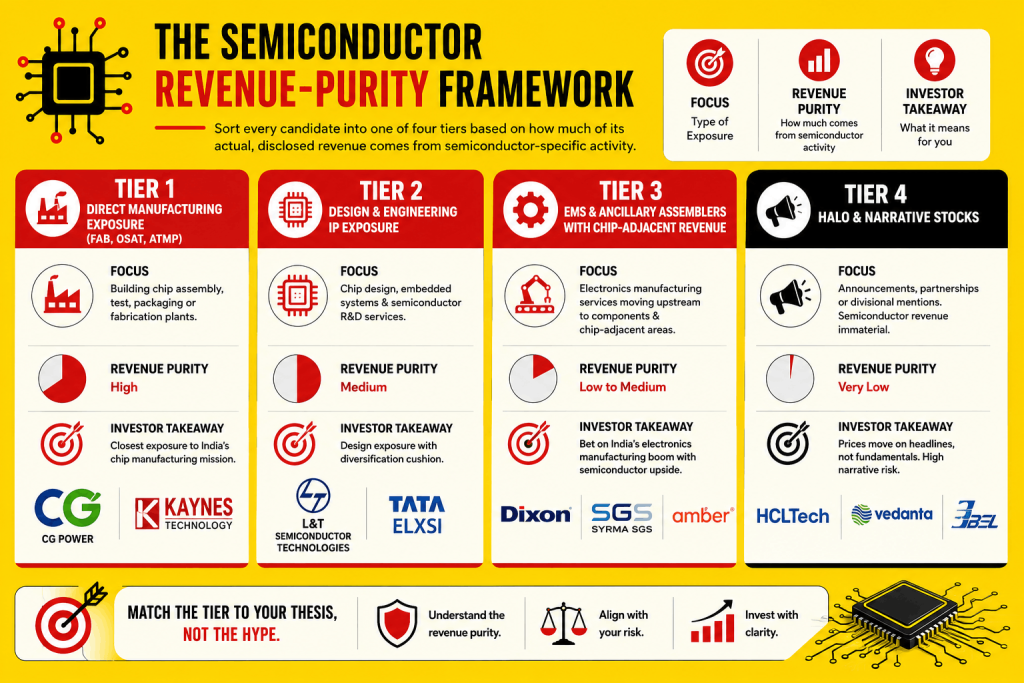
Instead of ranking by market cap, sort every candidate into one of four tiers based on how much of its actual, disclosed revenue comes from semiconductor-specific activity.
Tier 1: Direct Manufacturing Exposure (fab, OSAT, ATMP)
These are companies with stable finance and management. Again, these firms are actually going into wafer fabrication, assembly, testing, or packaging plants on Indian soil.
- CG Power And Industrial Solutions
This company is building an OSAT (outsourced semiconductor assembly and test) facility in Sanand, Gujarat.
They are partnering with Japan’s Renesas and Thailand’s Stars Microelectronics, with construction starting in April 2026. This is real capital deployment into a chip plant.
However, CG Power’s core revenue base is still transformers, motors, and railway systems. Therefore, the semiconductor unit is additive, not yet a majority of earnings, and the stock already trades at roughly 120x earnings against an industry average near 35x.
- Kaynes Technology
This company operates at a Sanand OSAT facility (inaugurated March 2026, ~₹330 crore investment, roughly 6 million chips/day capacity). Kaynes also has its core electronics manufacturing services (EMS) business.
Its FY26 revenue grew about 33% to roughly ₹3,626 crore, but the OSAT unit is still a growth bet layered on top of an EMS base, not the majority revenue driver yet.
The genuinely “purest” fabs in the country like Tata Electronics’ Dholera fab (with Taiwan’s PSMC), Micron’s Sanand ATMP plant, and Tata Semiconductor Assembly and Test in Assam are not independently listed stocks.
To clarify, they sit inside Tata Sons (private) or are subsidiaries of foreign parents. This is the single most important fact that a lot of articles miss. The country’s flagship fabs are structurally unavailable to a retail investor buying NSE/BSE shares.
What you can invest in instead are companies that support these semiconductor plants. This includes businesses like CG Power and Kaynes that assemble and test chips, as well as companies that supply equipment, materials, and services to these factories.
Tier 2: Design And Engineering IP Exposure
Companies earning genuine (if partial) revenue from chip design, embedded systems, or semiconductor R&D services, rather than physical manufacturing.
- L&T Semiconductor Technologies
This is a wholly owned subsidiary of Larsen & Toubro and is a fabless chip design house that has partnered with IBM on processor technology for automotive, energy, and industrial applications. It is not separately listed.
Its financials are folded into L&T’s much larger construction and engineering revenue base. In other words, the “purity” of your exposure through L&T shares is low even though the underlying design work is real.
- Tata Elxsi
Tata Elxsi provides design and engineering services, spanning semiconductors, automotive electronics, and embedded systems. It is a source of genuine design-stage revenue. But again, one vertical among several (media, healthcare, transportation) rather than the majority of the business.
India’s chip-design ecosystem earned a real milestone in 2026 when Qualcomm completed a 2nm chip tape-out designed entirely out of its Bengaluru, Chennai, and Hyderabad centers.
In other words, it is proof that India’s competitive edge right now is design talent, not fab capacity. But Qualcomm’s Indian design work doesn’t translate into a directly investable Indian equity; it validates the ecosystem without creating a pure-play stock.
Tier 3: EMS And Ancillary Assemblers With Growing Chip-Adjacent Revenue
These semiconductor stocks India are electronics manufacturing services (EMS) companies whose core business is assembling finished electronics (phones, TVs, appliances).
However, they are now moving upstream toward components and, in some cases, display or chip-adjacent fabrication joint ventures.
- Dixon Technologies
This is the largest example. Its FY26 segment mix shows Mobile & EMS at roughly 90% of revenue (up from 85% in FY25), Consumer Electronics & Appliances down to about 6%, and Lighting around 1%.
Dixon has announced a move into semiconductor-adjacent display manufacturing through a joint venture. However, based on current disclosed segment revenue, the company today is overwhelmingly a phone and appliance assembler, not a chip company.
It trades at roughly 19x book value with an ROE near 30.5%. It is indeed a strong EMS business. However, investors buying it as a “semiconductor stock” are really buying mobile assembly economics with a small, early-stage semiconductor option attached.
- Syrma SGS And Amber Enterprises
These companies are in a similar position. Their main business is electronics manufacturing, and while some also make a few semiconductor components, chip manufacturing is still a very small part of their business today.
Tier 4: Halo And Narrative Stocks
These are companies that appear on nearly every semiconductor list because of announcements, partnerships, or a single divisional mention. Again, for them, semiconductor-linked revenue is immaterial to the group’s overall numbers.
- HCL Technologies
HCL lists “Semiconductor” as one of roughly a dozen industry verticals it serves inside its Engineering and R&D Services segment.
Again, this domain itself sits alongside the much larger IT and Business Services segment, accounting for about 72% of group revenue. Semiconductor-vertical work is real but a small fraction of HCL’s overall $14.8 billion-plus revenue base.
- Vedanta
Vedanta’s semiconductor ambitions have been scaled back and restructured multiple times since the original Vedanta-Foxconn plan was announced. Meanwhile, the group’s core earnings still come from mining and metals, not chips.
- Bharat Electronics (BEL)
BEL, among all semiconductor stocks india deserves a more careful note than most lists give it. Specifically put, its “semiconductor angle” runs through military-grade electronics components, not commercial chip fabrication.
That’s a genuinely different risk and demand driver (defense budgets and order books) than a civilian fab or design company. Even though it’s routinely grouped with them.
Why Does This Matter Practically?
If you want to invest in India’s semiconductor industry itself, focus on Tier 1 and Tier 2 companies.
They offer the closest connection to the country’s chip-making growth, although semiconductors are only one part of their overall business.
If your goal is to benefit from the broader growth of electronics manufacturing in India, Tier 3 companies are a good option. But that’s a different investment theme.
Tier 4 companies often rise on semiconductor-related news even when they have little real involvement in the industry, which can mislead investors.
The Execution-Risk Tracker: What’s Actually Been Built VS. What Was Announced?
Every list quotes the same headline numbers: the ₹76,000 crore India Semiconductor Mission, the ₹1.64 lakh crore in approved fab projects. Almost none track whether those projects are on schedule. As of mid-2026, here is the gap between announcement and ground reality:
| Project | Original Target | Current Status (As Of July 2026) |
| Tata Electronics–PSMC Dholera fab (₹91,000 cr) | First silicon late 2026 | Reports in July 2026 indicate a shift to mature 90nm/55nm nodes first, with the original 28nm plan and full production now targeted around mid-2028. That is roughly a two-year slip from the original pitch |
| Micron ATMP, Sanand | Operational 2026 | The mission’s first genuinely completed facility, inaugurated and operational since February 28, 2026. |
| Kaynes Semicon OSAT, Sanand | Operational 2026 | Inaugurated March 31, 2026, running at roughly 6 million chips/day |
| CG Power–Renesas OSAT, Sanand | Construction 2026 | Construction began April 2026; not yet operational |
| SiCSem silicon carbide fab, Odisha | Approved Aug 2025 | Early-stage; India’s first commercial SiC compound fab, UK technology partner |
The Clearly Visible Trend
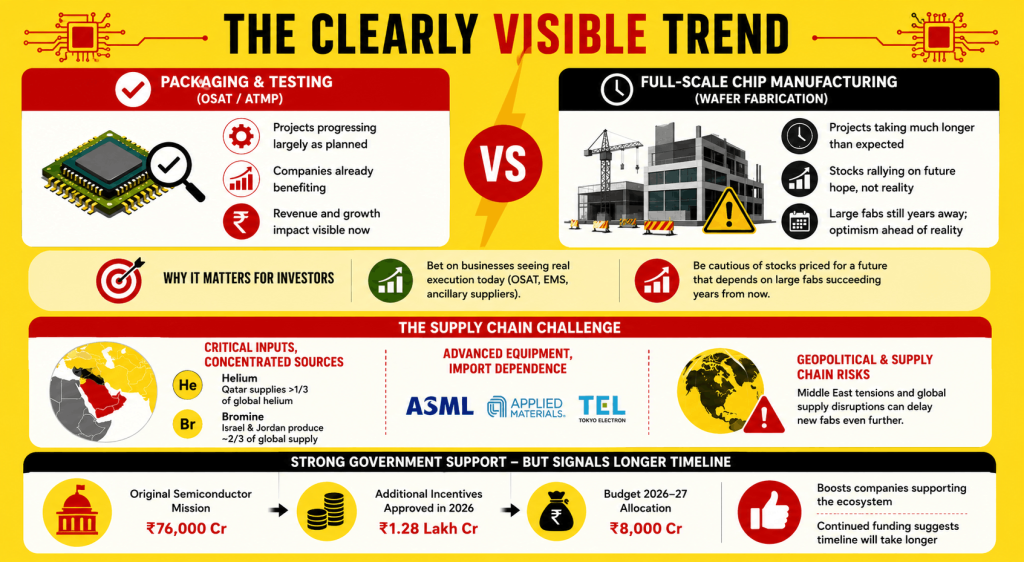
Projects that focus on chip packaging and testing (OSAT/ATMP) are progressing largely as planned. On the other hand, the full-scale chip manufacturing (wafer fabrication) is taking much longer.
This difference matters if you’re investing. Companies involved in packaging, testing, and electronics manufacturing are already benefiting as new projects begin operations.
On the other hand, many stocks have rallied simply because investors expect India to become a major chip manufacturer. Since those large chip-making plants are still years away, that optimism may be ahead of reality.
There’s another challenge that many investors overlook. Building semiconductor fabs requires specialized materials like helium and bromine, along with advanced machines imported from companies such as ASML, Applied Materials, and Tokyo Electron.
Many of these supplies come from a small number of countries. Ongoing geopolitical tensions in the Middle East and global supply chain disruptions could delay new chip factories even further.
The government continues to support the sector despite these challenges. In 2026, it approved ₹1.28 lakh crore in additional incentives, on top of the original ₹76,000 crore semiconductor mission, and allocated another ₹8,000 crore in the 2026–27 Budget.
This is positive news for companies that are already supplying or supporting India’s semiconductor industry. At the same time, the continued increase in government funding suggests officials expect the overall semiconductor program to take longer than originally planned.
Valuation Reality Check: Are You Paying For Purity Or For The Story?
Counterintuitively, purity of exposure does not currently correlate with valuation discipline; if anything, the opposite. Recent data points:
- Kaynes Technology trades near 59 to 62x earnings against an industry average closer to 30x
- CG Power trades near 120x earnings against an industry average closer to 31 to 32x
- Dixon Technologies trades at roughly 19x book value with strong ROE,
- But a meaningful share of recent profit growth has come from non-recurring items (fair-value gains on investments) rather than core operations,
- which inflates headline PAT growth relative to operating performance
In plain terms: the market is already pricing in years of successful execution for the names with the most direct semiconductor narrative. However, the delay data above suggests execution is running behind, not ahead, of plan.
That gap of rich valuation and slipping timeline is the single most important thing a 2026 buyer of “pure” semiconductor names needs to underwrite.
Again, it’s the mirror image of what most retail-facing content implies (that being early and “pure” is automatically the safer, smarter bet).
A Practical Framework
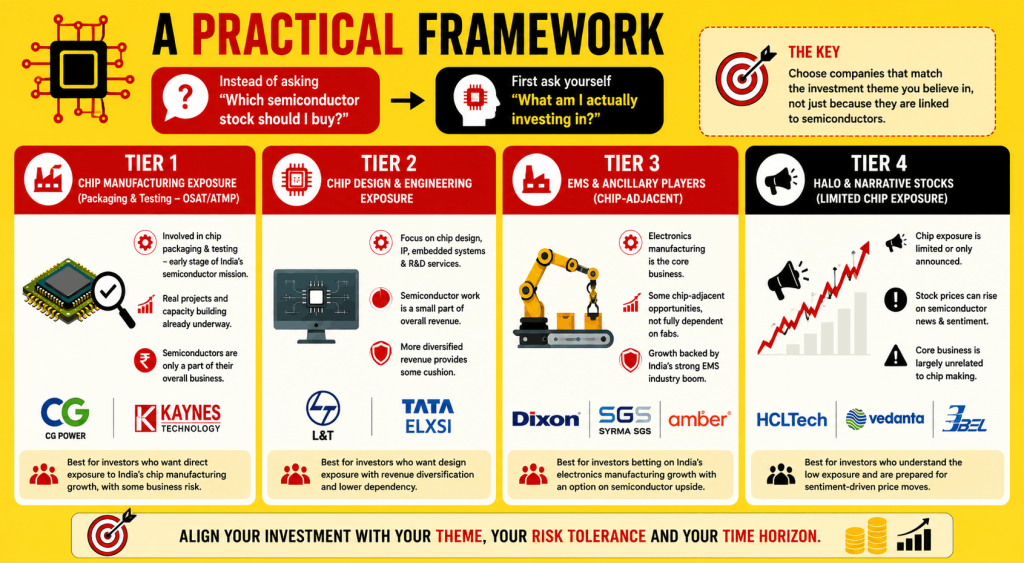
Instead of asking “Which semiconductor stock should I buy?”, first ask yourself “What am I actually investing in semiconductor stocks india?”
- If you want to invest in India’s chip manufacturing growth, look at Tier 1 companies like CG Power and Kaynes.
They are involved in chip packaging and testing, which is one of the first stages of India’s semiconductor mission. Keep in mind that semiconductors are only one part of their overall business.
- If you prefer companies that design chips rather than manufacture them, Tier 2 companies such as L&T and Tata Elxsi are worth considering.
However, semiconductor-related work still makes up only a small share of their overall revenue.
- If you’re betting on India’s growing electronics manufacturing industry, Tier 3 companies like Dixon Technologies, Syrma SGS, and Amber Enterprises may be a better fit.
Their growth does not depend entirely on India’s semiconductor factories being completed on time.
- If you’re looking at large companies with only limited exposure to semiconductors, such as HCLTech or Vedanta, be cautious.
Their share prices may rise whenever semiconductor news creates excitement, even if their core business is largely unrelated to chip manufacturing.
The key is to choose companies that match the investment theme you believe in, rather than buying a stock simply because it is linked to semiconductors.
Frequently Asked Questions
Is There A Pure-Play, 100% Semiconductor Stock Listed In India?
Not currently. India’s flagship fabs (Tata-PSMC Dholera, Micron ATMP, Tata Semiconductor Assembly & Test) are private subsidiaries or JVs, not independently listed companies.
Every listed “semiconductor stock” today carries some dilution. That is either from a larger non-chip core business or from being one node in a bigger conglomerate.
Which Semiconductor-Linked Stock Has The Least Dilution From Unrelated Business Lines?
Among listed names, OSAT-focused units at Kaynes and CG Power currently have the most direct linkage.
Both companies still generate meaningful revenue from other segments (EMS assembly and power/industrial equipment, respectively).
Why Did The Dholera Fab Timeline Slip?
Recent reports indicate that India is likely to start by manufacturing simpler chips before moving on to more advanced ones.
Since the country is still developing the skills and infrastructure needed for large-scale chip production, full commercial manufacturing is now expected around 2028, rather than the original late-2026 target.
Should I Wait For The Fabs To Actually Open Before Investing?
It depends on what you’re expecting. If you think these stocks have already priced in the success of India’s semiconductor plans, it may be better to wait until companies achieve important milestones, such as starting production or completing projects.
This can reduce the risk of paying a high price today for growth that takes longer than expected.
Disclaimer: This article is for informational and educational purposes only and does not constitute investment advice or a recommendation to buy or sell any security. Semiconductor stocks carry sector-specific execution, geopolitical, and valuation risks. Please consult a SEBI-registered financial advisor and read all offer documents before investing.
Share this article: