- What Happens If You Start Margin Trading Without Understanding It?
- What Exactly Is Margin Trading?
- Margin Trading Example: How It Works In Practice
- Margin Account VS Cash Account At A Glance
- What Is a Margin Call And Why Does It Matter?
- Who Uses Margin Trading (and Who Should Avoid It)?
- Margin Trading Risks: What Most Beginners Miss
- What the Data Actually Shows About Margin Trading
- Common Margin Trading Mistakes Beginners Make
- Real-World Example: When Margin Trading Goes Wrong
- Pros And Cons Of Margin Trading
- What Can Work in Your Favor?
- What Can Work Against You?
- When Does Margin Trading Actually Make Sense?
- Is Margin Trading Right For You Right Now?
- Should Beginners Even Try Margin Trading?
- An Ideal Roadmap For Beginners Into Investment Before Margin
- Quick Summary On Margin Trading
- Frequently Asked Questions
- Is margin trading legal?
- Can I lose more money than I invested?
- How is margin trading different from a regular investment account?
- Do all brokers offer margin accounts?
- What is a good starting point if I am new to investing?
- When does margin trading actually make sense?
- So, When Can You Finally Start Margin Trading?
Margin Trading Is Powerful. That’s Exactly the Problem
A Quick Summary: What is margin trading?
Margin trading is a method of buying stocks using money borrowed from your broker. It lets you invest more than what you actually have in your account. The potential gains are larger. But so are the losses. It is one of the most misunderstood concepts for new investors.
In Simple Terms: Margin trading means:
- Borrowing money from your broker
- Buying more stock than you can afford
- Amplifying both gains and losses
What Happens If You Start Margin Trading Without Understanding It?
My cousin Priya had been investing for about eight months. She had put aside a small amount each month, done her research, and picked a few solid companies.
Then a friend told her about margin trading. What is margin trading? The idea sounded exciting: use the broker’s money to buy more shares and multiply her returns.
She did not fully understand the risks. A few weeks later, the stock she bought on margin dropped sharply. Not only had she lost her own money, but she now owed the broker as well.
What happened to her can happen to any of us. It plays out every year among people who discover margin trading too soon and too fast.
This article is for people like Priya. Many people with her mindset are curious and cautious, trying to figure out whether margin trading makes sense at all. Let us start from the beginning.
What Exactly Is Margin Trading?
When you open a regular investment account, you can only invest the money you deposit. If you have ten thousand dollars, that is the most you can put into any stock. Simple enough.
A margin account works differently. Your broker agrees to lend you additional money, usually up to a fixed ratio of your deposits. This deposited money is called your margin.
You use the combination of your own funds and the broker’s loan to buy more shares than you could afford on your own.
Think of it like buying a flat. You put down a part of the cost yourself. A bank covers the rest. You get full ownership of the flat, but you owe the bank.
If the flat’s value goes up, you profit more than you would have if you had paid the full amount yourself. But if the value drops, you still owe the bank.
In other words, you could end up in a difficult spot. Margin trading works on this simple logic.
Margin Trading Example: How It Works In Practice
Suppose you have $5,000 in your margin account. Your broker offers 2:1 leverage. This means for every dollar you put in, the broker lends you one more. So your total buying power is $10,000.
You decide to buy $10,000 worth of shares in a company. The stock goes up 20%. Your position is now worth $12,000.
You repay the $5,000 you borrowed, leaving you with $7,000. That is a $2,000 profit on an original investment of $5,000. In other words, a 40% return instead of just 20%.
Now flip the scenario. The stock drops 20%. Your $10,000 position falls to $8,000. You repay the $5,000 loan. You are left with $3,000.
That is a $2,000 loss on $5,000 of your own money. In other words, a 40% loss from a 20% dip. And that does not include the interest you owe on the borrowed amount.
This amplification of both gains and losses is the core of what makes margin trading powerful and dangerous at the same time.
Margin Account VS Cash Account At A Glance
| Feature | Cash Account | Margin Account |
|---|---|---|
| Capital needed | Only your own money | Yours + borrowed funds |
| Potential gain | Limited to your stake | Amplified by leverage |
| Potential loss | Only what you put in | Can exceed your deposit |
| Margin call risk | None | Yes, a broker can sell assets |
| Interest cost | None | Yes, on the borrowed amount |
| Best suited for | Long-term investors | Experienced active traders |
What Is a Margin Call And Why Does It Matter?
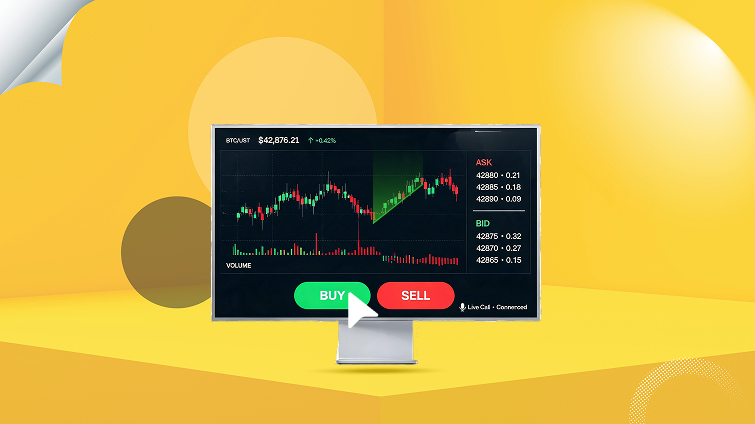
Here is one term every beginner must understand before thinking about margin trading. It is called a margin call.
If the value of your investments drops below a certain level, your broker will contact you. He will demand that you either add more funds or sell some of your holdings to reduce the loan.
This is the margin call. It does not ask for your opinion. In fact, it is a requirement.
Imagine being forced to sell stocks at the worst possible time, i.e., when the market is down. That is exactly what happens to many traders who ignore the risk of margin calls.
If you are a beginner, first learn what is a stock, before you spend even $1 on investments!
The broker does not wait. If you cannot meet the call quickly, they will sell your assets automatically, often at a loss.
Regulators like the SEC and FINRA set strict rules around margin requirements. But these only define minimum thresholds. In other words, the actual risk still lies with the investor. The SEC in the United States documents:
- How much brokers can lend and
- What minimum margin levels must be maintained?
Even so, the rules only set a floor. That is to say, the actual risk is still yours to manage.
Who Uses Margin Trading (and Who Should Avoid It)?
Not everyone who uses margin is reckless. Many experienced traders use it as a calculated tool. Here is what the two groups tend to look like.
Day traders and short-term active investors sometimes use margin to take larger positions in moves they expect to unfold within hours or days.
They:
- Manage risk tightly
- Set strict stop-loss points, and
- Understand that interest on the borrowed amount adds up fast if they hold positions for a long time.
Long-term investors, on the other hand, rarely need margin. If you are investing in index funds or buying shares in strong companies for the next ten years, margin adds unnecessary complexity and cost.
Most financial advisors recommend that beginners stick with regular cash accounts until they have at least two to three years of experience and a clear understanding of their own risk tolerance.
Margin Trading Risks: What Most Beginners Miss
The math is one thing. The emotional side is another. When you invest only your own money, a 15% drop in a stock is painful but survivable. You can wait it out.
When you invest on margin, that same 15% drop might wipe out half your capital and trigger a margin call on top of it. That is to say, the psychological pressure is completely different.
There is also the issue of interest. Borrowed funds are not free. Your broker charges interest on the loan, sometimes daily.
If your trade takes longer to play out than expected, the interest keeps building. A trade that looked profitable on paper can turn into a loss simply because of the time it took.
And then there is the leverage trap. When things go well, leverage feels like a superpower. When they go wrong, it feels like quicksand.
Most people who have been through a painful margin experience say the same thing. They did not truly understand the downside until they lived it.
Pro Tip: Most financial advisors caution that margin trading is suitable only for experienced investors who can manage high volatility and potential losses.
What the Data Actually Shows About Margin Trading

Most beginners assume margin trading is risky, but still manageable. The data tells a different story. Risk is not optional in margin trading. Instead, it is built into the structure.
In practice, a large percentage of retail traders lose money, especially when leverage is involved. Across multiple markets, studies consistently show that roughly 70% to 90% of active retail traders end up in losses over time.
The number goes even higher in high-leverage environments. Some research tracking short-term and derivatives trading has found that over 85% of leveraged accounts are wiped out within a year, largely due to amplified losses and poor risk control.
This isn’t just about bad strategy. It’s structural.
When you use borrowed money, even a small market move works against a much larger position. That’s why a 2%–5% price drop can translate into a 40%–100% loss of your capital, depending on the level of leverage used.
Regulators like the SEC explicitly warn that margin accounts can:
· Lead to losses beyond your initial investment
· Trigger forced asset sales during market drops
· Require immediate additional funds to cover losses
That combination of math, market volatility, and human behavior makes margin trading far riskier than it first appears.
Common Margin Trading Mistakes Beginners Make
- Using maximum leverage without understanding risk
- Ignoring margin call requirements
- Holding positions too long and accumulating interest
- Trading volatile or illiquid stocks
- Entering trades without a stop-loss plan
Real-World Example: When Margin Trading Goes Wrong
To understand how quickly margin trading can turn against you, you don’t need a hypothetical example. Real markets have shown this again and again.
During periods of high volatility, leveraged positions are often forced to close automatically. This process is called forced liquidation, in which a broker or exchange sells your assets without your approval once your account falls below the required levels.
And it happens faster than most people expect.
In the stock market, forced liquidation is not optional. If your account drops below the maintenance margin, your broker has the legal right to sell your holdings immediately to recover the borrowed money. Even without notifying you first.
What makes this dangerous is the timing.
These forced sales usually occur when the market is already falling, locking in losses rather than giving you a chance to recover later. In fact, large-scale forced selling can push prices even lower, triggering a chain reaction across other leveraged positions.
This is not just theory; it has played out at scale.
For example, in leveraged crypto markets, over 264,000 traders were liquidated in a single day, with more than $1.28 billion wiped out as falling prices triggered cascading margin calls. [blockonomi.com]
In even more extreme cases, liquidation events have erased over $19 billion in leveraged positions within 24 hours, affecting more than 1.6 million traders.
What’s important to understand here is the pattern:
- Prices fall slightly
- Margin requirements are breached
- Forced selling begins
- That selling pushes prices even lower
- More positions get liquidated
This creates a liquidation cascade in which losses accelerate far beyond the initial market move.
Pros And Cons Of Margin Trading
You now know what margin trading is. But if you are serious about starting margin trading, take a look at the pros and cons before that.
What Can Work in Your Favor?
• You can take larger positions with a smaller base amount
• Short-term opportunities that require quick capital can be acted on
• In rising markets, returns can be significantly amplified
• Experienced traders can hedge existing positions more efficiently
What Can Work Against You?
• Losses are amplified just as much as gains
• Interest costs reduce overall profitability over time
• Margin calls can force you to sell at the worst moments
• Emotional pressure is far higher than in regular investing
• Beginners often underestimate how fast things can go wrong
When Does Margin Trading Actually Make Sense?
- Short-term, high-conviction trades
- Experienced traders with strict risk management
- Hedging an existing portfolio
Is Margin Trading Right For You Right Now?
Before anything else, be honest with where you stand. This simple framework may help.
| You Might Consider It If… | Avoid It For Now If… |
|---|---|
| You have 1+ years of investing experience | You just opened your first brokerage account |
| You understand how to read a balance sheet | You rely on investing for daily expenses |
| You have set a clear stop-loss strategy | You have not built an emergency fund yet |
| You can absorb a loss without panic | You feel nervous when a stock dips 5% |
| You trade in liquid, well-known stocks | You plan to use margin on penny stocks |
If you are still figuring out the basics, like how to pick stocks, what a P/E ratio means, and how to read a company’s earnings report, margin trading is not the next step.
Build that foundation first. Learn how to start investing.
Platforms that offer access to discount brokers make it easy to start with a cash account and learn at your own pace before ever touching margin.
Should Beginners Even Try Margin Trading?
Most financial advisors recommend that beginners avoid margin trading until they understand leverage, risk management, and market volatility. In other words, margin trading is not a beginner’s tool.
It rewards discipline, experience, and the ability to stay calm under pressure. Those qualities take time to build.
If you are new to investing, the goal right now is simple: learn to invest wisely with your own money. Understand how markets move. Get comfortable with the feeling of watching your portfolio go up and down.
Once you have done that for a couple of years, you will be in a far better position to decide if margin trading fits your style and risk appetite.
The investors who have done well with margin are rarely the ones who jumped in early. They are the ones who waited until they had a clear plan, a proven track record, and the emotional resilience to handle the bad days without panic.
An Ideal Roadmap For Beginners Into Investment Before Margin
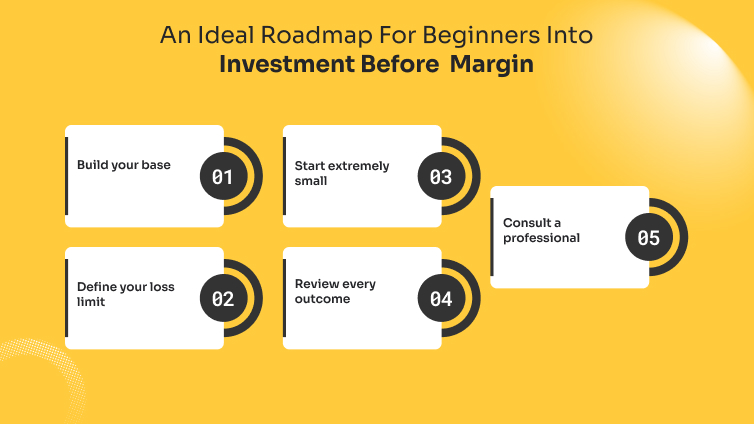
If you are curious about margin trading but want to approach it responsibly, here is a step-by-step path that makes sense.
1. Build your base: spend the first year or two investing with your own money only. No borrowed funds, which means no pressure.
2. Define your loss limit: before you borrow a single dollar, decide exactly how much you are willing to lose. Write it down.
3. Start extremely small: if and when you try a margin, begin with the smallest possible position. Treat it as an experiment, not a strategy.
4. Review every outcome: whether the trade wins or loses, study what happened. Build a written record. Patterns will emerge over time.
5. Consult a professional: speaking with a qualified financial advisor before opening a margin account is one of the most underrated moves a new investor can make.
Quick Summary On Margin Trading
- Margin trading means buying stocks using borrowed money from your broker
- Gains and losses are both amplified. Again, risk is not optional; it is built in
- A margin call can force you to sell at exactly the wrong time
- Interest on borrowed funds eats into returns if trades take longer than expected
- Beginners should focus on learning with their own capital before considering margin
- Always have a loss limit in mind before entering any leveraged position
Frequently Asked Questions
Beginners in margin trading rely heavily on search engines. Here’s answering what most beginners ask, in simple language and avoiding jargon:
Is margin trading legal?
Margin trading is certainly vouched by law. The legal governance framework of most countries has clear rules for margin trading. In the US, governing bodies such as the SEC, FINRA, and others set the rules for margin trading.
Can I lose more money than I invested?
Yes. You can also lose all your money. Here’s an equation. You borrow $ 2,000, but the investment’s value drops sharply. In the end, you will incur a net loss after repaying borrowed capital.
How is margin trading different from a regular investment account?
A regular cash A/C allows you to investment from your own money. However, a margin account allows you to borrow funds and invest directly. Therefore, you have to bear interest on borrowed capital and pay back the principal, even if your investment fails.
Do all brokers offer margin accounts?
In the US, many online brokers and some full-service brokers offer margin trading. Even discount brokers offer margin trading. But their terms are different.
What is a good starting point if I am new to investing?
Do not go after margin trading if you are new to investing. Begin with what is a stock and how a market order works. Then learn how to diversify your investments to reduce risks.
Open a cash account first. After that, start investing small amounts every day. See if your portfolio grows. That signals you are on the right track.
When does margin trading actually make sense?
If you have just started investing, do not do margin trading. Yes, it’s lucrative and gives you hopes of huge earnings. But what nobody tells you is that you can incur huge losses too. Again, the chance of losing is higher.
So, When Can You Finally Start Margin Trading?
Once you develop strong risk management habits and have the necessary financial cushion, you can start reading the market. But not before that.
Personally, I have been researching finance and investing for the last 7 years. But I still avoid margin trading!
Share this article: