- Quick Answer: What Is The Restaurant GST Rate In India?
- What Is Restaurant GST, Exactly?
- Restaurant GST Rates At A Glance
- Why You Paid 5% Yesterday But 18% Today
- GST On Standalone Restaurants
- GST On Hotel Restaurants
- GST On Takeaway Orders
- GST On Swiggy And Zomato Orders
- GST On Cloud Kitchens
- GST On Alcohol
- Can Restaurants Claim Input Tax Credit (ITC)?
- GST Registration Rules For Restaurant Owners
- Common Mistakes Customers Make
- Common Myths VS Facts
- Timeline Of Restaurant GST Changes
- How To Read A Restaurant Bill
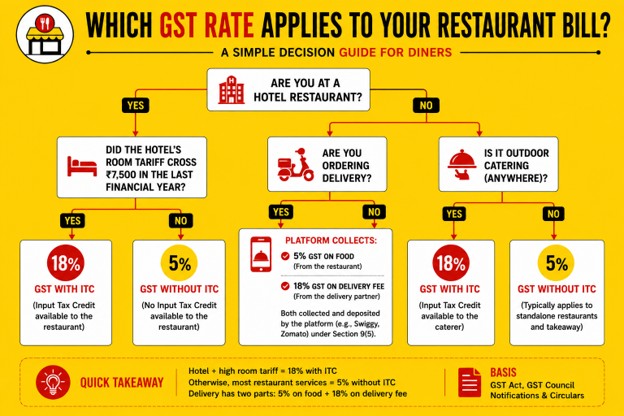
- Decision Tree: Is GST Applicable To You?
- Frequently Asked Questions (FAQs)
- Bringing It All Back To Your Dinner
Restaurant GST Rate in India (2026): Why Your Bill Changes From One Restaurant To Another
Imagine you’ve just finished dinner with your colleague after a long day at work. It’s a small, cozy standalone restaurant near your office. Nothing fancy!
The bill arrives: ₹2,380!! Right below the food total, you spot GST at 5%. Fair enough, you think, and pay up.
A week later, you’re at a wedding reception held at a luxury hotel’s banqueting hall. Same kind of food, arguably less delicious than what you had earlier.
But this time, the GST line reads 18%. You do a double-take. Did the waiter make a mistake?
A few days later, you order the exact same dish from your favorite restaurant. But this time through Swiggy.
The GST shows up again, slightly differently structured, with a separate charge for delivery.
By now, you’re not annoyed. You’re just confused. Is restaurant GST rate on food some kind of moving target? Does every restaurant just charge whatever it wants?
It isn’t random at all. There’s a clear, logical system behind every one of these numbers. However, once you understand it, you’ll never squint at a restaurant bill in confusion again.
Quick Answer: What Is The Restaurant GST Rate In India?
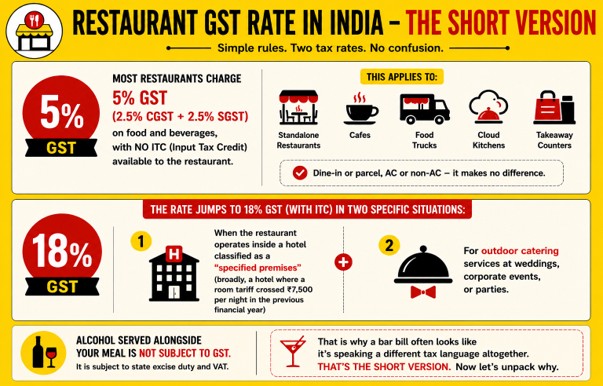
Most restaurants in India charge 5% GST (2.5% CGST + 2.5% SGST) on food and beverages, with no Input Tax Credit (ITC) available to the restaurant.
This applies to standalone restaurants, cafes, food trucks, cloud kitchens, and takeaway counters. Meanwhile, dine-in or parcel, AC or non-AC, it makes no difference.
The rate jumps to 18% GST (with ITC) in two specific situations:
- When the restaurant operates inside a hotel classified as a “specified premises” (broadly, a hotel where a room tariff crossed ₹7,500 per night in the previous financial year)
- For outdoor catering services at weddings, corporate events, or parties.
Alcohol served alongside your meal is not subject to GST. In contrast, it is subject to state excise duty and VAT.
Again, that is why a bar bill often looks like it’s speaking a different tax language altogether. That’s the short version. Now let’s unpack why.
What Is Restaurant GST, Exactly?
Restaurant GST is the Goods and Services Tax charged on the “service” of preparing and serving food. But not on the raw ingredients themselves.
When you eat at a restaurant, you’re not just buying a plate of biryani. Rather, you’re paying for:
- The cooking
- Seating comfort and ambience
- The service staff and service quality
- And the electricity bill that keeps the kitchen running
GST law classifies this bundle as a “restaurant service” under SAC (Services Accounting Code) 9963, and it’s taxed differently from buying the same rice and spices off a grocery shelf.
Before GST arrived in July 2017, restaurant bills were a mess of VAT, Service Tax, and sometimes Luxury Tax.
In addition, each state created its own version, leaving diners with absolutely no idea what they were paying for.
GST replaced this patchwork with one nationwide framework. That might sound simpler in theory.
However, it remains confusing in practice because the rate isn’t fixed. In reality, it depends on where you’re eating and how the food reaches you.
Restaurant GST Rates At A Glance
Here’s the comparison table that answers almost every question you’re about to ask.
| Type of Establishment | GST Rate | Input Tax Credit (ITC) |
|---|---|---|
| Standalone restaurant (AC or non-AC) | 5% | Not available |
| Restaurant in a hotel (room tariff ≤ ₹7,500/night, “non-specified premises”) | 5% | Not available |
| Restaurant in a hotel (room tariff crossed ₹7,500/night in the previous FY, “specified premises”) | 18% | Available |
| Takeaway / parcel orders | 5% | Not available |
| Food delivery via Swiggy/Zomato | 5% (collected by the platform) | Not applicable to restaurant |
| Cloud kitchen (delivery-only) | 5% | Not available |
| Outdoor catering (weddings, events) | 18% | Available |
| Alcohol served with food | Outside GST: state excise/VAT applies | Not applicable |
Keep this table in your back pocket. Nearly everything else in this article is really just explaining the “why” behind each row.
Why You Paid 5% Yesterday But 18% Today
Back to your evening out with your colleague. That restaurant was a standalone establishment. To clarify, there were no hotel rooms attached.
Just a kitchen and a dining hall. Under GST rules, that automatically puts it in the 5% bracket, no exceptions for air conditioning, seating style, or how fancy the menu sounds.
The wedding reception, though, was held inside a hotel. And not just any hotel. Simply put, it was one in which the room tariff exceeded ₹7,500 per night at some point during the relevant financial year.
That single fact reclassifies the entire food and beverage operation on that property as a “specified premises.”
The government slaps an 18% tax on every single rupee you spend on food there, whether you’re booking a room or just crashing a wedding.
Notice something important: the higher rate has nothing to do with your dinner being fancier. The hotel’s room-tariff history dictates the entire tax rate, completely ignoring what actually ends up on your plate.
That’s the piece most people miss. Again, that’s exactly why the same paneer tikka can be taxed at two completely different rates depending on which building it’s served in.
GST On Standalone Restaurants
A standalone restaurant is any eatery that isn’t attached to hotel accommodation. For instance:
- Your neighbourhood dhaba
- A mid-range family restaurant
- A fine-dining spot in a standalone building
- Most QSR chain outlets
- A sweet shop with a seating area.
All of these fall under the same umbrella: 5% GST, no ITC.
A common misconception here is that air-conditioned restaurants are taxed higher than non-AC ones.
That distinction existed briefly in the early days of GST but was scrapped years ago. Whether you’re eating under a ceiling fan or full air conditioning, the restaurant GST rate is identical.
Another myth: that fine-dining automatically means 18%. It doesn’t. Unless the restaurant is located in a specified-premises hotel, the rate remains 5%, regardless of how many courses are on the tasting menu.
GST On Hotel Restaurants
This is where most of the confusion in our running example comes from. Hotels aren’t simple.
To clarify, they run rooms, restaurants, banquet halls, spas, and sometimes all of it under one roof. The best part is that each is taxed according to its own logic.
If the hotel’s rooms are priced at ₹7,500 or below per night, it’s treated as a “non-specified premises,” and its in-house restaurant charges the same 5% GST as any standalone eatery.
But if even one room category in that hotel crossed the ₹7,500 threshold during the previous financial year, the entire property gets tagged as a “specified premises”.
And its restaurant, room service, and banquet food and beverage services move to 18% GST, with the benefit of Input Tax Credit.
Here’s the nuance that trips people up. This classification is decided at the start of the year (or at registration) based on actual or declared tariffs.
In addition, it applies uniformly. For example, a walk-in customer who never books a room still pays the 18% rate if they eat at that hotel’s restaurant.
The tax follows the property, not the guest.
GST On Takeaway Orders
Say you skip the sit-down experience entirely and just walk up to the counter for a parcel. Does GST change? No.
Whether you eat in or take your biryani home in a foil box, GST law treats it identically as a “restaurant service”: 5%, no ITC.
There’s no separate “takeaway GST rate” carved out anywhere in the law. In other words, the distinction people imagine simply doesn’t exist for regular restaurant food.
The only exception worth noting: if you’re buying pre-packaged, branded items off a shelf (a sealed bottle of sauce, a branded snack packet) rather than freshly prepared food, that item may carry its own separate GST rate under packaged-goods rules. But that’s a different transaction entirely, not a restaurant service.
GST On Swiggy And Zomato Orders
Now to the part of your story that confused you the most. It’s nothing but the delivery app order.
When you order through Swiggy or Zomato, something structurally different happens compared to walking into the restaurant yourself.
Under Section 9(5) of the GST Act, food delivery platforms are treated as the entity responsible for collecting and depositing the 5% GST on the food portion of your order. Not the restaurant.
This is called the “e-commerce operator” mechanism.
To clarify, it exists because the government wanted a single, trackable point of tax collection across thousands of small restaurants that partner with these apps.
Separately, the delivery fee itself is typically taxed at 18%. But why?
It’s treated as a distinct service (transportation/logistics) rather than a restaurant service. This is exactly why your Swiggy bill can look like it’s splitting hairs.
To clarify, one GST line for the food at 5%. Another for delivery at 18%.
It isn’t the app double-charging you. It’s two different services being taxed under two different rules, bundled into one invoice for convenience.
A quick myth-buster: no, Swiggy and Zomato don’t “add their own GST on top.”
They’re simply the designated collection point for food GST that would otherwise be collected directly by the restaurant.
GST On Cloud Kitchens
Cloud kitchens are the delivery-only operations with no dine-in seating. Again, they often just a kitchen unit and a stack of delivery bags.
They are taxed exactly like standalone restaurants: 5% GST, no ITC. The absence of a dining hall doesn’t change anything from a tax perspective.
Rather, what matters is that they’re preparing and serving food, not manufacturing packaged goods.
This is good news for the fast-growing cloud kitchen sector in Indian cities. To clarify, it keeps compliance simple and predictable, even without a physical storefront.
GST On Alcohol
Here’s a genuinely important distinction. Remember that getting it wrong can lead to real confusion on a bill.
Alcohol for human consumption was deliberately kept outside the scope of GST when the law was drafted.
That is to say it remains under the older system of state excise duty and state VAT, which varies from state to state.
So if you order a bottle of wine with your hotel dinner, your bill will likely show two separate tax treatments:
- GST on the food portion (5% or 18%, depending on the premises), and
- A separate state-level tax on the alcohol, calculated under that state’s own excise rules.
This is why restaurants serving liquor often issue slightly more complex bills. It’s not an error, it’s two different tax regimes operating side by side on the same table.
Can Restaurants Claim Input Tax Credit (ITC)?
Input Tax Credit is one of GST’s core ideas:
- A business can offset the GST it pays on its purchases (raw materials, rent, equipment, professional services) against the GST it collects from customers.
- So tax isn’t charged on tax at every stage of the supply chain.
Here’s the catch for most restaurants. If you’re charging the concessional 5% rate, you give up the right to claim ITC. That 5% is a trade-off.
In reality, there is a lower headline rate in exchange for simpler compliance.
But it also means every rupee of GST a restaurant pays on cooking oil, vegetables, kitchen equipment, or rent becomes a sunk cost that can’t be recovered.
It just gets consumed into the overall cost of running the business.
Only restaurants charging 18% get to claim ITC. Usually, hotel restaurants on the premises and outdoor caterers do that.
For a large hotel chain buying supplies in bulk, that ITC benefit can genuinely offset a chunk of their operating costs.
Again, that is part of why the 18% rate isn’t purely a “penalty”. It comes bundled with a real financial upside for that category of business.
GST Registration Rules For Restaurant Owners
If you’re running a restaurant, even a small one, GST registration isn’t optional once you reach a certain size. Restaurant services generally follow the standard services threshold:
Businesses with an aggregate annual turnover above ₹20 lakh (₹10 lakh in special category states) must register for GST and start charging it on sales.
Once registered, restaurant owners typically have two broad paths:
- Normal Scheme: Charge 5% (or 18%, if applicable) on every bill, file regular monthly or quarterly GST returns, and maintain detailed input/output records.
- Composition Scheme: Available to restaurants with turnover up to ₹1.5 crore, this lets smaller operators pay a flat, simplified GST rate on their total turnover, with far lighter compliance requirements for quarterly payments and a simpler annual return. Though they can’t collect GST separately from customers on the bill or claim ITC.
Choosing between these isn’t just a compliance checkbox. To sum up, it genuinely changes how a small restaurant prices its menu and manages cash flow. Meanwhile, that’s why many first-time restaurant owners consult a tax professional before registering.
Common Mistakes Customers Make
A surprising number of disputes over restaurant bills come down to a few recurring misunderstandings:
- Thinking GST is optional or negotiable. Whereas it isn’t. If a restaurant is GST-registered, charging it is a legal requirement, not a service add-on you can decline.
- Confusing service charge with GST. A service charge is a separate, discretionary amount that some restaurants add to reward staff. To clarify, it is not a government tax. Also, you are technically entitled to ask for it to be waived. GST, on the other hand, is mandatory once applicable.
- Assuming every restaurant charges the same rate. As we’ve walked through, the rate depends heavily on the type of premises, not the price of the meal.
- Believing takeaway is GST-free. It isn’t. The rate is identical to dine-in.
- Thinking a higher GST automatically means a “premium” or better restaurant. It only reflects the hotel’s room-tariff classification, nothing about food quality.
Common Myths VS Facts
| Myth | Fact |
|---|---|
| AC restaurants are taxed higher than non-AC ones | Both are taxed at the same 5% rate |
| Service charge is a government tax | Service charge is discretionary and separate from GST |
| Takeaway food has no GST | Takeaway is taxed exactly like dine-in, at 5% |
| Swiggy/Zomato add extra GST on top of the restaurant’s tax | The platform simply collects the same 5% food GST on the restaurant’s behalf, plus 18% on delivery fees |
| All hotel restaurants charge 18% | Only “specified premises” hotels charge 18%; others charge 5%, same as standalone restaurants |
| Restaurants can choose whichever GST rate suits them | The rate is determined by classification rules, not restaurant preference |
Timeline Of Restaurant GST Changes
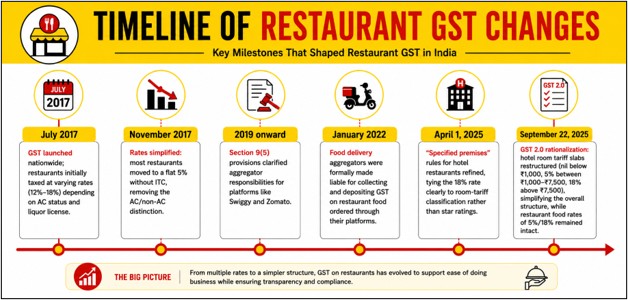
- July 2017: GST launched nationwide; restaurants initially taxed at varying rates (12%–18%) depending on AC status and liquor license.
- November 2017: Rates simplified: most restaurants moved to a flat 5% without ITC, removing the AC/non-AC distinction.
- 2019 onward: Section 9(5) clarified the aggregator’s responsibilities for platforms like Swiggy and Zomato.
- January 2022: Food delivery aggregators were formally made liable for collecting and depositing GST on restaurant food ordered through their platforms.
- April 1, 2025: “Specified premises” rules for hotel restaurants refined, tying the 18% rate clearly to room-tariff classification rather than star ratings.
- September 22, 2025: GST 2.0 rationalization: hotel room tariff slabs restructured (nil below ₹1,000, 5% between ₹1,000–₹7,500, 18% above ₹7,500), simplifying the overall structure, while restaurant food rates of 5% and 18% remained unchanged.
How To Read A Restaurant Bill
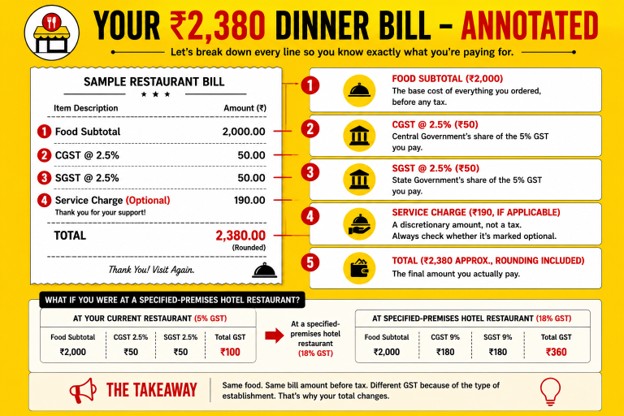
Let’s go back to your ₹2,380 dinner and actually annotate it, line by line:
- Food subtotal (₹2,000): The base cost of everything you ordered, before any tax.
- CGST @ 2.5% (₹50): Central government’s share of the 5% GST.
- SGST @ 2.5% (₹50): State government’s share of the 5% GST.
- Service charge (₹190, if applicable): A discretionary amount, not a tax (check whether it’s marked optional)
- Total (₹2,380 approx., rounding included): What you actually pay.
If instead you’d been at that specified-premises hotel restaurant, the same ₹2,000 food subtotal would show CGST @ 9% and SGST @ 9%, taking the tax portion to ₹360 instead of ₹100.
To clarify, that’s a very real difference that has nothing to do with portion size or ingredients, and everything to do with which building you’re sitting in.
Decision Tree: Is GST Applicable To You?
Frequently Asked Questions (FAQs)
Most restaurants charge 5% GST without ITC; hotel restaurants in specified premises and outdoor caterers charge 18% with ITC.
Because the rate depends on the type of premises (standalone vs. hotel-based) and on the hotel’s room-tariff classification, not on the restaurant’s menu or pricing.
It happens when the restaurant is inside a hotel classified as a “specified premises” (room tariff crossed ₹7,500/night in the previous financial year), or when the service is outdoor catering.
Because the government set a concessional rate for standard dine-in/takeaway food services to keep everyday dining affordable, in exchange for restaurants giving up ITC.
The same 5% rate as dine-in. There’s no separate takeaway rate.
Swiggy collects the 5% GST on food on behalf of restaurants (under Section 9(5) of the GST Act) and typically charges 18% GST on the delivery fee separately.
Yes, in the same manner as Swiggy. It collects food GST as the designated e-commerce operator and applies 18% on delivery charges.
Only if they’re charging 18% GST. It happens typically in hotel restaurants in specified premises or outdoor caterers. Restaurants on the 5% rate cannot claim ITC.
It’s a deliberate trade-off in the law: a lower, simpler tax rate in exchange for giving up credit on input purchases.
5% if the hotel is a “non-specified premises” (room tariffs at or below ₹7,500/night); 18% with ITC if it’s a “specified premises.”
5%, without ITC. It’s the the same as standalone restaurants, since the tax treats delivery-only kitchens identically to a regular restaurant.
It’s applied to the food/beverage subtotal before tax, split as CGST + SGST (for intra-state sales) at either 2.5%+2.5% (5% total) or 9%+9% (18% total).
Once a restaurant hits the registration thresholGenerally ₹20 lakh in annual turnover, or ₹10 lakh in special category states. The law forces them to charge GST. They don’t get a choice.
No. A service charge is a discretionary amount that some restaurants add for staff, separate from any government tax. GST is a mandatory tax once applicable.
Yes! While both legally distinct charges can share the same bill, the government levies GST only on your food and drinks. Better yet, since the service charge isn’t compulsory, you can simply ask the restaurant to remove it.
Bringing It All Back To Your Dinner
Remember that ₹2,380 bill with your colleague? By now, you know exactly why it showed 5% GST: a standalone restaurant, nothing more complicated than that.
You know why the wedding at the luxury hotel jumped to 18%. It was not because the food was better, but because that property’s room tariffs had crossed a specific threshold.
And you know why your Swiggy order looked different again. To clarify, a platform collects food GST on the restaurant’s behalf, with delivery taxed separately.
Understanding restaurant GST was never really about memorizing percentages.
Ultimately, the kitchen that cooks your meal, the hands that serve it, and the authority that collects the cash rewrite the entire tax story of the exact same plate. Once you see the pattern, the confusion disappears. Meanwhile, the next time a bill looks “off,” you’ll know exactly where to look before assuming it’s a mistake.
Share this article: