- Key Takeaways
- What Is FII And DII Data?
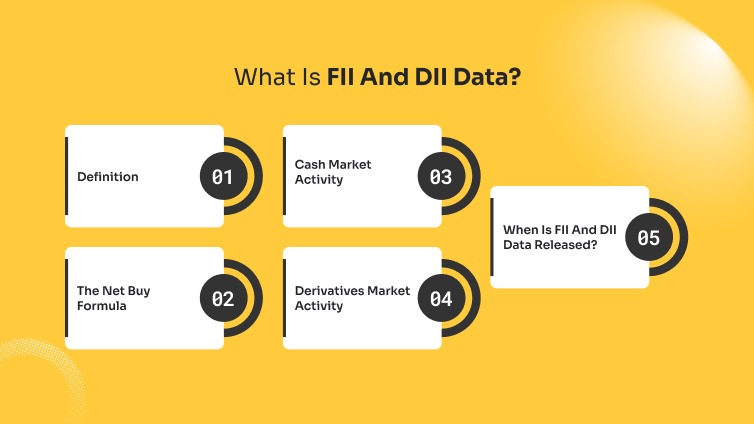
- Definition
- The Net Buy Formula
- Cash Market Activity
- Derivatives Market Activity
- When Is FII And DII Data Released?
- How To Check FII And DII Data
- 1. NSE Website
- 2. BSE Website
- 3. NSDL
- 4. Financial News Platforms
- A Better Way to Use the Data
- Why FII And DII Data Suddenly Matters More In 2026
- FII VS DII: Key Differences
- How To Actually Read The Daily FII And DII Data?
- A Real Scenario: The 25-Year-Old Who Checks FII Data Every Morning
- Common Beginner Misconceptions
- Research FII And DII Data With The Other Basics
- Should Beginners Track FII/DII Data Daily?
- Where To Check FII And DII Data Daily
- NSE (National Stock Exchange)
- BSE (Bombay Stock Exchange)
- NSDL (National Securities Depository Limited)
- Financial News Websites And Brokerage Apps
- A Simple Rule
- A Simple Framework To Use This Data Well
- What Changed Recently
- Frequently Asked Questions (FAQs)
- Disclaimer:
FII VS DII Data Explained: Why Domestic Investors Now Drive Indian Markets

FII and DII data is the daily record of how much foreign and domestic institutions bought or sold in Indian stocks. It involves tracking net purchases across the cash and derivatives markets on NSE and BSE.
It offers a quick read on institutional mood, but carries the risk of being overinterpreted as a trading signal on its own.
For years, that single line “FIIs sold ₹X crore, DIIs bought ₹Y crore” was treated almost like a scoreboard. Foreign money was the star player.
Meanwhile, domestic money was the substitute that came in when things got shaky. In 2026, that script flipped.
After tracking institutional flow data across multiple market cycles, one recurring pattern stands out: a single day of FII selling rarely matters. What matters is whether domestic institutions continue absorbing the selling pressure over several weeks.
For the first time in over a decade, foreign investors own a smaller slice of Indian listed companies than domestic institutions do. Nobody saw that coming three years ago, and it changes how a beginner should actually use this data.
Key Takeaways
- FII and DII data show net institutional buying or selling in Indian equities, published daily by the NSE and the BSE.
- According to Prime Database and market analysis cited by major financial publications, FPI ownership fell to roughly 16.13% by March 2026 while DII ownership rose to about 19.24%.
- A single day’s number rarely matters. What matters is whether DIIs are absorbing FII selling, and for how long.
- Beginners should treat this data as background context, not as a buy or sell trigger.
- Your own portfolio discipline (how you invest, not what institutions do) decides your long-term return.
What Is FII And DII Data?
If you’ve spent even a few weeks following the Indian stock market, you’ve probably seen headlines like “FIIs sold ₹3,000 crore today” or “DIIs remained net buyers.”
These figures come from FII and DII data, which are among the most closely watched indicators of institutional activity in the market.
At its core, FII and DII data show whether large investors were net buyers or net sellers of Indian equities on a given trading day. Since institutions deploy far larger sums than individual investors, their activity often provides clues about broader market sentiment.
Definition
FII (Foreign Institutional Investor) data tracks the buying and selling activity of overseas investors in Indian markets. Under current SEBI regulations, these investors are officially classified as Foreign Portfolio Investors (FPIs).
Examples include foreign mutual funds, pension funds, sovereign wealth funds, hedge funds, and global asset managers.
DII (Domestic Institutional Investor) data tracks the activity of Indian institutions such as mutual funds, insurance companies, pension funds, provident funds, and banks.
Every trading day, exchanges publish how much these institutions bought and sold. The difference between the two is the market’s net inflow or outflow.
For example:
- FIIs bought ₹12,000 crore worth of shares.
- FIIs sold ₹10,500 crore worth of shares.
The result is:
Net FII Buying = ₹1,500 crore
A positive number indicates net buying. Meanwhile, a negative number indicates net selling.
The Net Buy Formula
The headline number reported by financial news portals is usually the net figure.
Net Buying (or Net Selling) = Total Purchases – Total Sales
For example:
- Total FII purchases: ₹8,000 crore
- Total FII sales: ₹9,200 crore
Net FII activity:
₹8,000 crore – ₹9,200 crore = -₹1,200 crore
This means FIIs were net sellers of ₹1,200 crore that day. Meanwhile, the same calculation applies to DIIs.
A common mistake among beginners is focusing on raw buying numbers. What matters is the net figure because it reveals whether institutions added to or withdrew from the market.
Cash Market Activity
When most people discuss FII and DII data, they’re referring to activity in the cash market, also known as the equity market.
This is where investors buy and sell shares of actual companies, such as Reliance Industries, HDFC Bank, Infosys, or TCS.
For instance, if a mutual fund purchases ₹500 crore worth of HDFC Bank shares, that transaction counts as DII cash market buying.
Cash-market data is especially useful because it reflects institutions taking direct ownership positions in companies rather than placing short-term derivative bets.
Derivatives Market Activity
Institutions also participate heavily in the derivatives segment, which includes:
- Futures contracts
- Options contracts
- Index derivatives
- Stock derivatives
The derivatives market often reveals how institutions are positioning themselves for future market movements.
For example, an institution may sell shares in the cash market while simultaneously holding bullish index futures. Looking at only one segment can therefore create an incomplete picture.
That’s why experienced market participants often analyze cash-market flows alongside derivative positioning before drawing conclusions about institutional sentiment.
When Is FII And DII Data Released?
The National Stock Exchange (NSE) and Bombay Stock Exchange (BSE) publish provisional institutional activity data after market hours each trading day.
In most cases, investors can access the figures during the evening, usually a few hours after the market closes.
Since the initial numbers are provisional, minor revisions may occur later based on custodial confirmations and settlement adjustments.
For long-term investors, checking the data once or twice a week is generally enough. Daily monitoring often creates unnecessary noise without improving investment outcomes.
How To Check FII And DII Data
If you’d like to track institutional activity yourself, these are the most reliable sources:
1. NSE Website
The NSE publishes daily FII/FPI and DII trading activity, including buy value, sell value, and net value.
2. BSE Website
The BSE also publishes institutional trading figures after market hours.
3. NSDL
NSDL provides official Foreign Portfolio Investor (FPI) flow data and longer-term investment statistics, making it useful for understanding broader trends rather than single-day moves.
4. Financial News Platforms
Most major financial websites and market apps display FII and DII numbers in an easier-to-read format, often alongside Nifty and Sensex performance.
A Better Way to Use the Data
The most useful question isn’t:
“Did FIIs buy or sell today?”
Instead, ask:
“Are domestic institutions consistently absorbing foreign selling over several weeks?”
A single day’s number is often noise. Multi-week trends reveal far more about market strength, investor confidence, and the balance of power between foreign and domestic capital.
That’s why professional investors tend to focus on patterns, not headlines.
Why FII And DII Data Suddenly Matters More In 2026
Something structural happened in Indian markets this year. And most explainer articles haven’t caught up to it yet.
Between January and April 2026, foreign institutional investors pulled out close to ₹2 lakh crore from Indian equities. To clarify, that is one of the steepest sustained sell-offs on record.
Rising US bond yields, a stronger dollar, and geopolitical tension in West Asia made emerging markets like India less attractive to global money for a while. On paper, that sounds alarming.
Except the market didn’t fall the way it did during past foreign-selling phases. Domestic institutions, mainly mutual funds, insurance companies, and pension funds, bought aggressively enough to absorb close to 90% of that foreign selling.
By the first half of 2026, DIIs had pumped in a record ₹4.3 lakh crore, largely funded by ordinary Indians investing through SIPs every month. The result: FII ownership of Indian stocks dropped to around 14-15%, while DII ownership climbed past 18-19%.
For the first time since India opened up to foreign investment in the early 1990s, domestic institutions own more of the market than foreign ones do.
That’s not a small footnote. It means the old assumption “if FIIs are selling, be scared” is a lot weaker than it used to be. Understanding FII and DII data today is really about understanding this tug-of-war, not about memorizing a single number.
FII VS DII: Key Differences
Both groups move large amounts of money, but their motivations are almost opposite.
| Factor | FII (Foreign Institutional Investors) | DII (Domestic Institutional Investors) |
|---|---|---|
| Who they are | Overseas funds, for instance sovereign wealth funds, foreign pension funds, hedge funds, global asset managers | Indian mutual funds, insurance companies (like LIC), banks, provident and pension funds |
| Official term | Now called FPIs (Foreign Portfolio Investors) under SEBI rules | Stays domestic-only; no separate reclassification |
| What drives their decisions | Global interest rates, dollar strength, currency risk, relative returns across countries | Local SIP flows, insurance premiums, retirement contributions, India’s growth outlook |
| Behavior pattern | Can enter or exit quickly, sometimes called “hot money” | Tends to invest steadily every month: sometimes called “patient capital” |
| Where you can check them | NSE/BSE daily reports, NSDL monthly FPI data | Same NSE/BSE reports, plus AMFI’s monthly SIP data |
Notice the last row. DII money isn’t just “less foreign”. In other words, a large chunk of it is your own SIP installment, pooled with millions of others’, flowing back into the market every month.
When you read that DIIs bought ₹4,000 crore in a day, part of that is, quite literally, retail investors like you and me. People like us are buying in small, regular amounts through mutual funds.
How To Actually Read The Daily FII And DII Data?
Most explainers stop at “positive means buying, negative means selling.” That’s true, but it’s only half the picture. Here’s what actually matters:
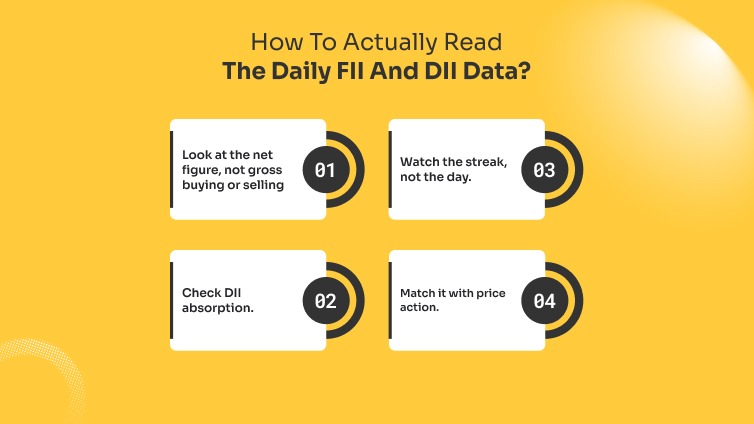
- Look at the net figure, not gross buying or selling. A fund can buy ₹10,000 crore and sell ₹9,000 crore on the same day. However, the net figure (₹1,000 crore buying) is what moves the market.
- Check DII absorption. If FIIs sell ₹5,000 crore and DIIs buy ₹5,500 crore, domestic buying has more than covered the foreign selling. As a result, the market can stay flat or even rise on a day of heavy FII selling.
- Watch the streak, not the day. One day of FII selling means very little. Three or four weeks of consistent selling, paired with weakening DII absorption, is worth paying attention to.
- Match it with price action. If FIIs are net sellers, but Nifty barely moves, domestic buying is doing the heavy lifting. If FIIs sell and the index falls hard, absorption is weak.
A Real Scenario: The 25-Year-Old Who Checks FII Data Every Morning
Ananya, my cousin, is 25, based in Pune, is earning ₹30,000 a month. She started a small SIP six months ago.
Again, like many new investors, she picked up the habit of checking FII/DII numbers on her phone before checking her own portfolio.
Every red FII number made her anxious. On the other hand, every green DII number gave her false confidence to invest more than she’d planned.
After a few months, she realized she was reacting to a number that had nothing to do with her actual goal. And what was her goal? It was building a long-term corpus on a modest, steady income.
Her fix was simple:
- She now checks FII/DII data once a week, purely for context
- Spends far more time thinking about how to start investing wisely with the money she actually has.
For someone in her position, a fixed monthly income, a long time horizon, and no urgent need for the money are some ideal conditions. Anyone with such a persona will definitely grow the discipline of investing regularly
Again, that discipline matters far more than reacting to what institutions did yesterday. This is a common starting point for many first-time earners trying to figure out how to start investing for long-term growth on a modest salary.
And it’s a much steadier approach than tracking daily flows.
Common Beginner Misconceptions
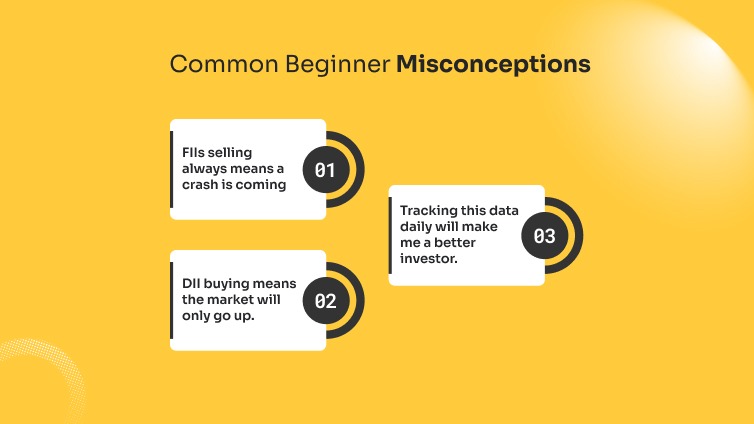
“FIIs selling always means a crash is coming.” Not necessarily. FII selling is often about global factors. For instance, US bond yields, a stronger dollar, and currency risk.
That said, they have nothing to do with the health of Indian companies. In 2026, heavy FII selling coincided with strong corporate earnings in several sectors.
“DII buying means the market will only go up.” Not always true either. DIIs buy steadily due to structural inflows such as SIPs. However, not because they’re calling short-term tops or bottoms. Their buying cushions fall; it doesn’t guarantee gains.
“Tracking this data daily will make me a better investor.” For most beginners, it does the opposite. Daily tracking nudges people toward reactive, short-term decisions.
Again, that’s closer to a speculative investment mindset than genuine investing. On the other hand, the bigger lever for long-term wealth is consistency and asset allocation.
Read Here: What is a speculative investment? And find out how to restrict yourself from making such investments later in this article.
Research FII And DII Data With The Other Basics
If you’re new to markets, FII and DII data are one small piece of a much bigger puzzle. Before it, get these three things right:
- Learn how to diversify your investment portfolio. So, no single stock, sector, or country’s money flow can hurt you too badly.
- Understand what a speculative investment actually is. So you can tell the difference between investing and betting on tomorrow’s institutional flow.
- Pick a reliable, well-regulated platform. I recommend choosing one of the best trading app for beginners. As a result, execution and costs won’t quietly reduce your returns.
Institutional flow data is a layer you add once these fundamentals are in place, not a replacement for them.
Should Beginners Track FII/DII Data Daily?
Short answer: no, not daily. Weekly context is enough for most long-term investors.
- Yes, glance at it if you already hold direct equity or trade derivatives like Bank Nifty options, where institutional positioning around Bank Nifty expiry day can genuinely move prices within a session.
- No, skip the daily habit if you invest in mutual funds through SIPs with a 5+ year horizon. Your outcome depends on your own consistency, not on any single day’s institutional mood.
- Wait and watch if you’re deciding whether to invest a large lump sum. In that case, a multi-week trend (heavy, sustained FII selling with weak DII absorption) is more useful than jumping in or out based on one day’s print.
Where To Check FII And DII Data Daily
If you want to follow institutional money flows, it’s best to use official data sources rather than relying solely on social media posts or market rumors. The daily figures are publicly available and usually updated shortly after market hours.
NSE (National Stock Exchange)
The NSE publishes daily FII/FPI and DII trading activity, including:
- Total buy value
- Total sell value
- Net buy or sell value
- Combined exchange data
Most investors use NSE’s report as their primary source when tracking institutional participation in the equity market.
BSE (Bombay Stock Exchange)
The BSE also publishes institutional trading data after market close.
While the numbers are often viewed alongside NSE data, checking both exchanges gives a more complete picture of overall market activity.
NSDL (National Securities Depository Limited)
For investors who want to look beyond daily figures, NSDL provides detailed FPI flow reports, including:
- Monthly foreign investment trends
- Historical inflow and outflow data
- Equity and debt market participation
- Long-term foreign ownership patterns
This is particularly useful for identifying whether foreign investors are building or reducing exposure over several weeks or months.
Financial News Websites And Brokerage Apps
Most market platforms display FII and DII figures in an easy-to-read format alongside:
- Nifty 50 performance
- Sensex performance
- Market breadth
- Sector-wise movements
These platforms are convenient for quick checks, but serious investors should occasionally verify major trends using official exchange or NSDL data.
A Simple Rule
Don’t focus on whether FIIs or DIIs bought or sold on a single day. Instead, track the trend over one to four weeks.
Institutional flow data becomes far more useful when viewed as a pattern rather than a daily headline.
A Simple Framework To Use This Data Well
- Step 1: Build your base first. Emergency fund, clear goals, and a diversified portfolio before you even look at institutional flow data.
- Step 2: Check weekly, not daily. Look at the 7-day and 30-day trend on NSE or a reliable aggregator, not the single-day print.
- Step 3: Read it alongside other signals. Combine it with Nifty’s price action and broader news. Never treat it as a standalone signal.
- Step 4: Track your own numbers too. Your XIRR: a measure of your actual annualized return across irregular investments like SIPs, tells you far more about your progress than any institutional flow number ever will.
What Changed Recently
| Period (2026) | FII Activity | DII Activity | Notable Shift |
|---|---|---|---|
| January | Net outflow of ~₹25,000 crore | Net inflow of ~₹40,000 crore | DII buying comfortably exceeded FII selling |
| March | Net outflow of ~₹1,17,775 crore | Net inflow of ~₹1,16,000 crore | One of the sharpest single-month FII exits on record |
| April | Net outflow of ~₹60,847 crore | Strong offsetting inflow | FII ownership fell toward a 14-year low |
| May | Net outflow of ~₹55,963 crore | Net inflow of ~₹82,668 crore | Monthly SIP inflows hit a record of roughly ₹32,000 crore |
| H1 (Jan–Jun) | Net outflow of ~₹2.8 lakh crore (NSDL) | Net inflow of ~₹4.3 lakh crore | DII ownership overtakes FII ownership for the first time in decades |
Figures are rounded, based on NSE, BSE, and NSDL provisional data reported through mid-2026.
Again, the figures are meant to show the trend rather than serve as exact, unchanging numbers. Therefore, you must always check the exchange’s live report for the latest figures.
Two regulatory and structural points are worth knowing too. First, FIIs technically operate under SEBI’s Foreign Portfolio Investor (FPI) framework, and their holding in a single listed company is generally capped at 24% of paid-up capital unless shareholders vote to raise it.
Second, the surge in DII strength isn’t a one-off. It’s built on consistent monthly SIP contributions from retail investors, which is the part beginners can actually influence through their own habits.
Frequently Asked Questions (FAQs)
Not by itself. A negative FII number paired with strong DII buying often results in a flat or even positive market day. Context matters more than the raw figure.
NSE and BSE publish provisional data daily after market close, usually by around 6 PM IST. NSDL releases the final FPI figures on the next working day, and SEBI’s monthly bulletin provides a broader, aggregated view.
Both indices are affected, but the Bank Nifty tends to be more sensitive to FII activity, as foreign investors hold meaningful stakes in large private banks. This is one reason institutional flow data gets extra attention around Bank Nifty expiry day.
Yes. What are hedge funds, in this context? They’re one category of foreign institutional investor registered under SEBI’s FPI framework, alongside sovereign wealth funds and foreign mutual funds.
Generally, no. SIPs are designed to work through market ups and downs over years. Stopping or restarting a SIP based on daily institutional flow usually hurts long-term returns more than it helps.
Because DIIs now own a larger share of Indian equities than FIIs do: a first in India’s market history. That means domestic money, not foreign money, increasingly sets the floor under the market.
No. Much of the 2026 FII selling was driven by global factors such as US bond yields, dollar strength, and oil prices, rather than by deteriorating fundamentals among Indian companies.
Disclaimer:
FII and DII data is a useful weather report for the market, not a compass for your own financial decisions. Read it for context once a week, keep your own investing plan simple and consistent, and let your goals, not the institutions, decide what you do next.
Share this article: