- Quick Summary: AMC SIP vs. Normal SIP (Broker SIP)
- How Does An AMC SIP Actually Work?
- The Regulatory Safety Net Behind Your Money
- What You Need Before Starting An AMC SIP?
- AMC SIP VS. Third-Party Platforms: The Real Breakdown
- The Comparison At A Glance
- Understanding the Three Investment Routes
- 1. The AMC Direct Route
- 2. The Third-Party Direct Route
- 3. The Traditional Regular Route
- Making Sense Of TER And NAV: A Simple Breakdown
- 1. What Is The Total Expense Ratio (TER)?
- 2. What Is Net Asset Value (NAV)?
- 3. How TER Affects NAV
- Direct Plan (Low TER: 0.5%)
- Regular Plan (High TER: 1.5%)
- 4. A Simple Comparison Over Time
- 5. The “More Units” Confusion Explained
- But here’s the catch:
- 6. What Actually Matters: Future Growth
- Quick Read:
- The Math Behind The Savings: Total Expense Ratio (TER) & NAV
- Who Actually Uses AMC SIPs? (3 Common Patterns)
- Pros And Cons Of AMC SIP
- Pros
- Cons
- The Workaround: How To Track Multiple AMC SIPs In One Place
- 1. MF Central (The Official Unified Portal)
- 2. Consolidated Account Statement (CAS)
- Should Beginners Choose AMC SIP?
- A Simple Framework To Decide
- The Real Cost Of A 1% Expense Ratio Over Time
- Frequently Asked Questions
- Regulatory Disclosure & Disclaimer:
What Is AMC SIP? The Low-Cost Investing Route With a Hidden Catch

Key Takeaways
- AMC SIP means investing directly through the fund house’s app or website, rather than through a broker.
- It’s a cost difference, not a risk difference. In other words, the underlying fund and its risk stay exactly the same.
- It suits people who already know which one or two funds they want.
- It gets harder to manage once you’re spread across several fund houses.
- A SIP calculator can show you the actual rupee gap between a direct plan and a regular plan before you decide.
Quick Summary: AMC SIP vs. Normal SIP (Broker SIP)
What is AMC SIP?
It is a Direct Plan SIP executed directly through the asset management company’s (mutual fund house) portal. You pay zero distributor commissions, resulting in a lower Total Expense Ratio (TER) and higher long-term returns.
What is a Normal/Regular SIP?
It is an investment routed through a bank, broker, or distributor. The fund house pays these intermediaries an ongoing commission, which is deducted from your investment, resulting in a higher TER and slightly lower returns.
Are there Direct Broker SIPs?
Yes. Platforms like Zerodha Coin, Groww, and Kuvera offer Direct Plans, meaning you don’t pay distributor fees even while using an aggregator app.
How Does An AMC SIP Actually Work?

You pick a fund, choose the “direct plan” option, and set up an auto-debit mandate straight from the AMC’s own portal. That means no broker app in between.
Every month, on your chosen date, the amount is deducted and converted into fund units at that day’s NAV. The mechanics are identical to a regular SIP. The only things that change are who’s handling the paperwork and what fee structure you end up paying.
The Regulatory Safety Net Behind Your Money
When you invest through an AMC SIP, your money doesn’t actually sit with the fund house’s corporate office.
By order of the Securities and Exchange Board of India (SEBI), all mutual fund assets are held by an independent third-party Custodian (typically a major banking institution such as SBI or HDFC Bank).
Even if the AMC faces financial distress or closes down, your underlying units are safe and ring-fenced by law.
Furthermore, every AMC operates under the strict oversight of a Board of Trustees, who are legally bound to protect the interests of retail unit holders under the SEBI (Mutual Funds) Regulations, 1996.
What You Need Before Starting An AMC SIP?
The paperwork is lighter than most beginners expect, but it’s worth knowing upfront so there are no surprises mid-setup.
- A completed KYC (most investors already have this from any earlier mutual fund or Demat account)
- A PAN card
- A bank account that supports auto-debit mandates (NACH)
- The specific fund’s direct plan growth or IDCW option, since the direct and regular versions are listed separately on the AMC’s site
- A nominee added at setup, which most platforms now ask for by default
None of this differs much from setting up a regular SIP. The extra step is simply repeating it for each AMC, since there’s no shared registration across fund houses, the way a broker app gives you.
AMC SIP VS. Third-Party Platforms: The Real Breakdown
To make the right choice, we have to clear up a massive misconception. Many investors think the choice is simply between an AMC website (Direct) and a broker app (Regular). That is outdated.
Today, third-party apps are split into two completely different categories: Third-Party Direct Platforms (like Zerodha Coin, Groww, or Kuvera), which sell Direct Plans with zero distributor commissions, and Traditional Distributors (like traditional banks, national distribution networks, or local brokers), which sell Regular Plans and collect an ongoing commission.
The real comparison comes down to where you want to manage your Direct Plans, or whether you are mistakenly buying a Regular Plan.
The Comparison At A Glance
| Feature | AMC SIP (Direct) | Third-Party App (Direct) | Traditional Distributor (Regular) |
|---|---|---|---|
| Examples | HDFC MF, SBI MF portals | Groww, Zerodha Coin, Kuvera | Bank RMs, Local Brokers, NJ Wealth |
| Plan Type | Direct Plan | Direct Plan | Regular Plan |
| Expense Ratio | Lowest (No commission) | Lowest (No commission) | Highest (Includes distributor commission) |
| Portfolio View | Separate dashboard per fund house | One consolidated dashboard | One consolidated dashboard |
| Best Suited For | Investors committed to 1–2 specific fund houses | Multi-fund investors wanting a single dashboard | Investors who want human advice and don’t mind the cost |
Understanding the Three Investment Routes
Check out these routes if you’re deciding how to invest in mutual funds.
1. The AMC Direct Route
You bypass all middlemen and go straight to the source. You get a direct, unmediated relationship with the fund house.
The cost is at the absolute statutory minimum, but you trade off convenience if you invest across multiple fund families, as your portfolio will be fragmented across different logins.
2. The Third-Party Direct Route
Platforms like Zerodha Coin or Groww act as a single, unified window. They do not charge a distributor commission, meaning you get the exact same low-cost Direct Plan and identical underlying fund as you would on the AMC website.
The major advantage here is convenience. In other words, you get a single dashboard to track and manage everything across dozens of different AMCs.
3. The Traditional Regular Route
This is where the “hidden cost” actually lives. When you invest through a bank relationship manager or an old-school broker, they place your money into a Regular Plan.
The fund house quietly deducts a trail commission (0.5% to 1.5% per year) out of your mutual fund assets and pays it to the distributor. You get a single dashboard and human assistance, but it comes at a massive compounding cost to your long-term wealth.
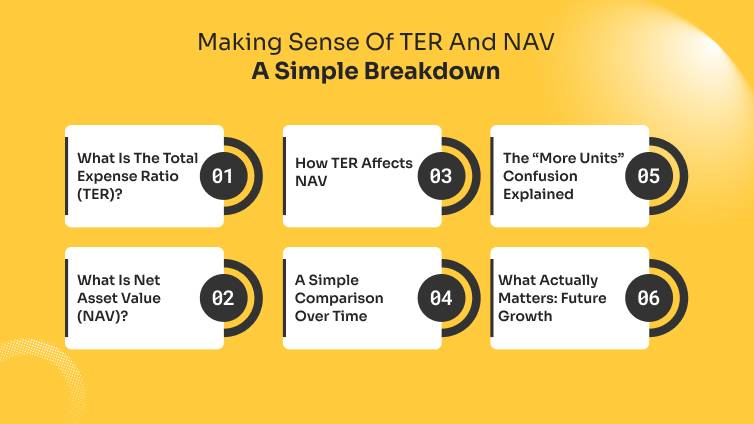
Making Sense Of TER And NAV: A Simple Breakdown
To understand how mutual fund fees affect your money, forget complex charts for a moment. Think of it like a baker managing a large cookie jar for you and your friends.
1. What Is The Total Expense Ratio (TER)?
The Total Expense Ratio (TER) is the baker’s annual fee for managing the jar. Instead of sending you a bill, the baker quietly takes a tiny bite out of the jar every day.
- In an AMC SIP (Direct Plan):
There is no middleman. The baker takes a very small bite, around 0.5% per year.
- In a Regular SIP (via a broker):
You are paying both the baker and the broker. So the baker has to take a bigger bite, around 1.5% per year.
2. What Is Net Asset Value (NAV)?
The Net Asset Value (NAV) is simply the price of one “slice” of the cookie jar.
When you invest, you are buying slices (units).
Formula:
Slices (Units) = Amount Invested ÷ NAV
Example:
- NAV = ₹ 10
- Investment = ₹ 100
- Units received = 100 ÷ 10 = 10 units
3. How TER Affects NAV
This is the important part.
Because the fee (TER) is deducted daily from the total jar:
- A higher fee = more taken out daily
- A lower fee = less taken out daily
Direct Plan (Low TER: 0.5%)
- Smaller daily deduction
- The fund grows faster
- NAV rises more over time
Regular Plan (High TER: 1.5%)
- Larger daily deduction
- Growth slows down
- NAV increases at a slower pace
4. A Simple Comparison Over Time
Let’s assume both plans start with the same NAV:
- Starting NAV: ₹ 10
After a few years:
- Direct Plan NAV: ₹ 20
- Regular Plan NAV: ₹ 18
The difference comes solely from the higher fees in the Regular Plan.
5. The “More Units” Confusion Explained
At first glance, a lower NAV might seem better.
If you invest ₹ 100:
- At ₹ 20 NAV → 100 ÷ 20 = 5 units
- At ₹ 18 NAV → 100 ÷ 18 = 5.55 units
So yes, the Regular Plan gives you more units.
But here’s the catch:
- Direct Plan value = 5 × 20 = ₹ 100
- Regular Plan value = 5.55 × 18 = ₹ 100
Both are equal initially.
6. What Actually Matters: Future Growth
Going forward:
- The Direct Plan grows faster because it loses less to fees daily
- The Regular Plan grows more slowly because more is continuously deducted
Over long periods (10–20 years), this small difference compounds into a significantly larger final portfolio in the Direct Plan.
Quick Read:
- TER eats into your returns every single day
- Lower TER = faster compounding
- Higher TER = slow leakage of gains
Even a 1% difference in fees can create a massive gap over time.
The Math Behind The Savings: Total Expense Ratio (TER) & NAV
Net Return = Gross Portfolio Return – Total Expense Ratio (TER)
To understand why AMC SIPs yield more money over time, you need to understand how two fundamental financial metrics interact on a daily basis: Total Expense Ratio (TER) and Net Asset Value (NAV). Here is the breakdown of what they mean and exactly how they impact your pocket:
- Total Expense Ratio (TER):
This is the annual management fee charged by the mutual fund house to cover administrative, operational, and fund management expenses. For a Direct Plan (like an AMC SIP), the TER might be low, around 0.5%.
For a Regular Plan, the distributor’s or broker’s ongoing trail commission is added directly to this fee, pushing the total TER up to 1.5% or higher.
- Net Asset Value (NAV) Impact:
The NAV represents the per-unit market value of the mutual fund. Because these asset management fees are deducted daily from the fund’s total assets under management, a higher TER directly pulls down the fund’s NAV growth every single day.
Over an extended investment horizon, the Direct Plan version of the exact same mutual fund will naturally compound to a higher NAV than its Regular counterpart. As a result, your money buys you more units for every single rupee invested.
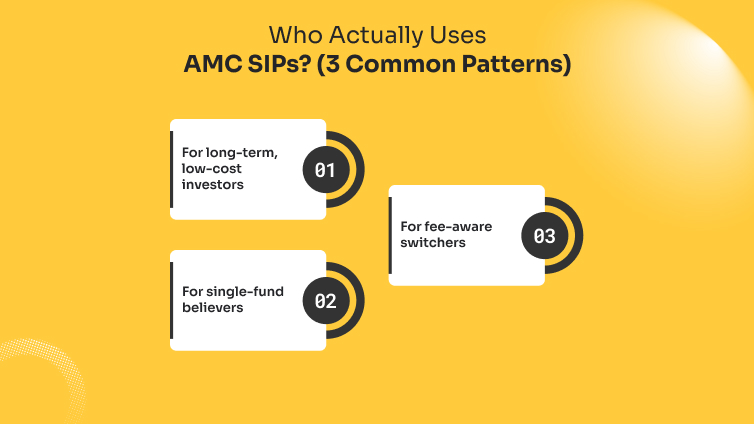
Who Actually Uses AMC SIPs? (3 Common Patterns)
- For long-term, low-cost investors:
Consider someone investing for 15 to 20 years in one or two flexi-cap funds. The 0.5–1% saved on expense ratio each year, compounded over two decades, adds up to a meaningfully bigger corpus. Again, that is enough to justify managing one extra app.
- For single-fund believers:
Some investors settle on a single fund early and don’t plan to diversify across multiple fund houses any time soon. For them, the “too many logins” downside simply doesn’t apply yet.
- For fee-aware switchers:
Investors who started through a broker app noticed the regular plan was quietly costing them more, and moved future installments to a direct AMC SIP.
Switching existing units can trigger capital gains or exit load depending on the fund and holding period, so it’s worth checking with the AMC before moving older units.
Pros And Cons Of AMC SIP
You must introspect on the pros and cons of any investment plan before investing your hard-earned money as a beginner. Now, you know what is amc sip. Therefore, it’s crucial that you understand the pros and cons before investing in it.
Pros
- Lower ongoing cost through the direct plan
- Slightly higher long-term returns purely from that cost saving
- A direct relationship with the fund house, with no distributor steering you toward higher-commission funds
Cons
- A separate account registration and login process for every AMC you invest with
- No consolidated dashboard across fund houses
- More admin if you ever want to pause, switch, or redeem across several AMCs at once
The Hidden Catch Beginners Miss
Most explainers stop at “direct plans are cheaper.” What they skip is what happens a year or two in, once you’ve opened SIPs with three or four different AMCs to chase the best-performing funds. Each one has its own app, its own password, its own mandate renewal date.
There’s no single email or SMS that tells you all your SIPs together. Investors often forget a small SIP entirely, only noticing it during tax season or when a mandate quietly lapses.
The saving is real, but so is the tracking effort. And that trade-off rarely gets mentioned along with the cost comparison.
The Workaround: How To Track Multiple AMC SIPs In One Place

While the admin effort of managing multiple AMC logins is real, the Indian mutual fund ecosystem has introduced two powerful tools to solve this exact problem.
You do not necessarily have to sacrifice the lower cost of direct plans for the convenience of a single dashboard.
1. MF Central (The Official Unified Portal)
Co-created by India’s primary registrar and transfer agents (RTAs), CAMS and **KFintech**, under SEBI’s guidance, MF Central allows you to view, track, and transact across all your mutual fund holdings in one place.
Whether you started your direct SIP on HDFC’s website or ICICI Prudential’s app, they will automatically consolidate here under your PAN.
2. Consolidated Account Statement (CAS)
Every month, the National Securities Depository Limited (NSDL) or Central Depository Services Limited (CDSL) sends a single, comprehensive CAS to your registered email.
This document pools your holdings across all AMCs, stock portfolios, and Demat accounts into a single PDF, ensuring no forgotten SIP goes unnoticed.
Should Beginners Choose AMC SIP?
For a first-time investor with one or two funds in mind, yes. I did invest in the AMC SIP.
What I believe, after investing for 7 years, is that the cost savings are real and the extra admin is minor. If you’re planning to build a portfolio across four or five different fund houses right away, a single broker platform may be easier to start with.
Meanwhile, you can move to direct plans later once your fund choices settle down.
A Simple Framework To Decide
- Step 1: List the specific funds you’re considering, not just the AMCs.
- Step 2: Check the expense ratio gap between the direct and regular plan for each fund. It’s usually published on the fund’s factsheet.
- Step 3: Run the numbers through a SIP calculator to see the actual rupee difference over your investment horizon, not just the percentage.
- Step 4: Be honest about how many separate AMC logins you’re willing to track.
- Step 5: Start with one AMC SIP, review it after 6–12 months, and add more only once the habit feels manageable.
Mutual Fund Cost Calculator
The Real Cost Of A 1% Expense Ratio Over Time
This is the number that actually helped me to make the decision to invest in AMC SIP. I know what is amc sip. However, I needed to be sure about all the speculative benefits.
Below is an illustrative example. However, let me tell you it is not a promise of returns. Here we are comparing a ₹5,000 monthly SIP over 20 years at two different net return assumptions, reflecting roughly a 1% cost difference between a direct and a regular plan.
| Monthly SIP | Tenure | Assumed Net Return | Total Invested | Illustrative Final Corpus |
|---|---|---|---|---|
| ₹5,000 | 20 years | 12% (direct plan) | ₹12,00,000 | ≈ ₹49.9 lakh |
| ₹5,000 | 20 years | 11% (regular plan) | ₹12,00,000 | ≈ ₹43.7 lakh |
On the same ₹12 lakh invested, a 1-percentage-point fee difference amounts to roughly ₹6 lakh less over 20 years. Here, money is lost not to the market but to costs. Now you know what is amc sip and how it works!
Mutual fund returns aren’t guaranteed and may differ from those in this example. But one thing stays true: costs grow over time just like returns do, no matter when you start.
Frequently Asked Questions
Yes. The fund, its risk profile, and the regulatory oversight (SEBI) stay exactly the same. Only the route you use to invest changes, not the safety of the underlying investment.
No. Most fund houses let you invest directly using your KYC details, PAN, and bank account, without needing a Demat account.
Yes, but you’ll need to register separately with each AMC, since there’s no shared dashboard linking your investments across different fund houses.
Yes, though switching existing units can count as a fresh purchase for tax purposes, and an exit load may apply depending on the fund and how long you’ve held it. Check with the specific AMC first.
Most fund houses won’t penalize a single missed installment, but a SIP may be canceled automatically after several consecutive misses. Policies vary by AMC, so it’s worth checking the specific fund’s terms.
It depends on how many funds you hold and how comfortable you are managing multiple logins. Cheaper isn’t automatically simpler, so the better choice depends on your situation rather than a universal rule.
Yes. Starting with a single fund and a single AMC SIP is one of the simplest ways for a first-time investor to learn the process before expanding to more funds or platforms.
Regulatory Disclosure & Disclaimer:
The information provided in this article is strictly for educational and informational purposes only. It should not be construed as investment, legal, or tax advice. Mutual fund investments are subject to market risks; please read all scheme-related documents carefully before investing. Past performance is not indicative of future returns. The compounding calculations presented above are illustrative models and do not guarantee actual terminal wealth. The author is not a SEBI-registered investment advisor (RIA).
Share this article: