- So What Exactly Is A Hedge Fund?
- Who Actually Runs Hedge Funds?
- Can Regular People Even Invest in Them?
- Hedge Funds vs. Mutual Funds: A Side-by-Side Look
- How Do Hedge Funds Actually Make Money?
- Group 1: Betting That Prices Will Move (Either Way)
- Group 2: Using Borrowed Money To Amplify Returns
- Group 3: Alternative Asset Strategies
- A Real-World Example Worth Knowing
- Pros And Cons: What The Numbers Do Not Always Tell You
- Should Beginners Even Think About Hedge Funds?
- A Simple Framework For Beginners Starting Their Journey
- Key Takeaways
What Are Hedge Funds? The Gap Between the Hype and Reality

A hedge fund is a private investment pool. Usually, wealthy individuals or institutions stock their capital in hedge funds. Meanwhile, the funds are managed by professional fund managers who use aggressive strategies to seek returns.
Unlike regular mutual funds, hedge funds face fewer regulations, charge high fees, and can use tactics such as short selling and heavy borrowing. To sum up, you can expect high-risk but potentially high reward from hedge funds.
My friend Marcus was 28, working a decent job in Austin, and had just saved up $5,000. He wanted to start investing wisely. However, he would always face the same roadblock.
Every time he searched for investing tips, he came across hedge funds, leverage, and short positions. But why?
In reality, he was searching for options that are highly rewarding and mostly short-term investments. He had no idea what these meant. That’s why he did not get the solutions he wanted.
Here is the thing. Maybe you have learned that hedge funds are highly rewarding from a Reddit thread. But almost no one explains what they actually are in plain english. That is exactly why you need to read about what are hedge funds before you begin!
So What Exactly Is A Hedge Fund?
Let me tell you a simple story to explain to you what are hedge funds. Imagine ten of your richest friends pool their savings and hire a financial expert to grow that money.
Now the financial expert is not just buying stocks and waiting. They can bet that a stock will fall. Moreover, they can borrow money to invest more.
They can invest in real estate, currencies, and commodities. To sum up, they can use the fund money for almost anything that could generate a profit.
The name actually comes from “hedging”. It means reducing risk by making counter-moves. If you bet on stocks going up, you hedge by also betting on some stocks going down.
The goal originally was to protect money. Over time, though, hedge funds became more focused on chasing big gains, even if that meant taking on serious risk. Some compare it to a speculative investment approach taken to an extreme level.
Who Actually Runs Hedge Funds?

Hedge fund managers are usually seasoned professionals. To clarify, they represent investment banks, trading firms, or top financial institutions.
They charge investors in two ways. At first, they will typically ask for a management fee (typically around 2% of the total funds annually). Next, they demand a performance fee (usually 20% of any profits made).
This is known in the industry as “2 and 20.” Let me explain why it is called that.
You give your money to someone, and if they earn $100,000 in profit, they walk away with $20,000 of it. That is why hedge funds are not designed for everyday investors.
Can Regular People Even Invest in Them?
The SEC draws a hard line on who can invest in a hedge fund. You need a net worth of at least $1 million. And your house does not count toward that number. Or you need to be pulling in at least $200,000 a year, consistently, not just one good year.
Why such a high bar? Bluntly, regulators figure that if you have that kind of money, you can afford to lose some of it without it ruining your life. It is not the most generous reasoning, but that is the logic behind it.
On top of that, minimum investment amounts are usually very high. To clarify, the amount is often $100,000 to $1 million just to get started.
The SEC puts these rules in place because hedge funds use complex, high-risk strategies, and the assumption is that wealthy investors can better absorb potential losses.
So if you are just starting and eager to learn about how to start investing wisely, hedge funds are not where you begin. You can explore them later.
Hedge Funds vs. Mutual Funds: A Side-by-Side Look
People often confuse hedge funds with mutual funds since both involve pooled money. Here is a quick comparison that clears things up:
| Feature | Hedge Fund | Mutual Fund |
|---|---|---|
| Who can invest? | Accredited (wealthy) investors only | Anyone |
| Minimum investment | $100K–$1M+ | $500–$3,000 typically |
| Regulation | Light (SEC oversight but fewer rules) | Heavily regulated |
| Strategies used | Short-selling, leverage, derivatives | Mostly long-term stock/bond holdings |
| Fees | 2% management + 20% profits | 0.5%–1.5% expense ratio |
| Liquidity | Often locked in for months or years | Can usually withdraw anytime |
How Do Hedge Funds Actually Make Money?
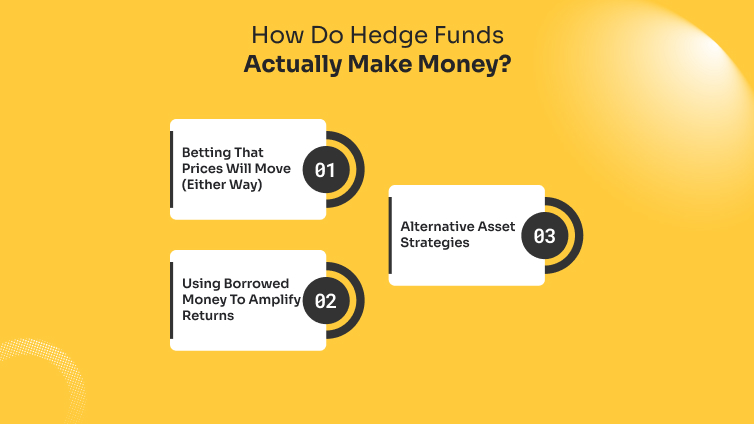
This is where it gets interesting. Hedge funds do not just buy stocks and wait. They use a mix of strategies, and sometimes they are not easy to follow, even for experienced investors. Let us break down the main ones in plain language.
Group 1: Betting That Prices Will Move (Either Way)
- Short-selling: The fund borrows shares of a company it expects to decline in value. It sells those shares now, waits for the price to fall, then buys them back at a lower price and pockets the difference. This is the opposite of what most investors do.
- Long/short equity: The fund holds stocks it expects to rise (long) and simultaneously bets against stocks it expects to fall (short). This is the classic hedge strategy.
- Global macro: Managers bet on major economic trends, such as interest rate changes, currency shifts, or inflation, across multiple countries.
Group 2: Using Borrowed Money To Amplify Returns
Hedge funds often use margin trading. In simpler words, that is borrowing money from their broker to invest more than they actually have.
If you invest $1 million but borrow another $2 million, you now control $3 million worth of assets. When it works, returns are huge. When it goes wrong, losses can exceed what you originally put in.
Group 3: Alternative Asset Strategies
Some funds go after things most investors would never touch. Dying companies, for instance, buy up a business’s debt when it is nearly bankrupt and bet that it will survive. Or private startups before they ever hit a public exchange, which is closer to what happens in the world of venture capital.
Then there is arbitrage. The idea is simple, even if the execution is not. In other words, the same asset trades at slightly different prices on two different markets at the same moment, and the fund jumps on that gap before it closes. It sounds small. At scale, with borrowed money, it is not.
A Real-World Example Worth Knowing
In 2008, while most investors were panicking as the housing market collapsed. Meanwhile, hedge fund manager John Paulson made roughly $15 billion for his fund by betting against mortgage-backed securities.
He saw the collapse coming and positioned accordingly. It was one of the most famous trades in history and showed the enormous upside hedge funds can deliver.
But here is the other side. Long-Term Capital Management (LTCM), a legendary hedge fund managed by Nobel Prize-winning economists, collapsed in 1998. Their extremely leveraged bets went wrong, and the U.S. government had to step in to prevent broader financial damage. Billions were lost in weeks.
These two stories are not meant to scare you. They are meant to show the real range. Hedge funds can be genius-level plays or spectacular failures. Sometimes by the same types of people.
Pros And Cons: What The Numbers Do Not Always Tell You
| What Can Go Right | What Can Go Wrong |
|---|---|
| Returns can far exceed regular stock market gains | You can lose your entire investment |
| Expert management by seasoned professionals | Fees eat into profits even when returns are modest |
| Access to strategies not available to regular investors | Low transparency, i.e., you may not know what they are doing with your money |
| Can profit even when markets fall | Funds are often illiquid. That means your money is locked up |
| Portfolio diversification at a high level | Performance varies wildly across fund managers |
Should Beginners Even Think About Hedge Funds?

Honest answer: No. Not yet, and if you ask me, maybe not ever. I lost good money by investing in hedge funds at the beginning. That’s why, personally, I am against them.
If you are just starting to invest, hedge funds are not your entry point. They are not designed for you. The minimum investment alone rules out 99% of new investors.
Even if you somehow had the money, the lack of liquidity, high fees, and complex risk profiles make them a poor fit for someone still learning the basics.
What actually helps beginners is building good habits. Learning index funds. Using discount brokers with low fees and consulting a financial advisor before making major moves. These are the tools that build long-term wealth for most people.
The right time to think about hedge fund exposure is after you have a strong financial base, a diversified portfolio, and have already navigated a few market cycles. And even then, most financial advisors would tell you to skip it unless you are an institutional investor or genuinely wealthy.
A Simple Framework For Beginners Starting Their Journey
If hedge funds are not the answer right now, what is? Here is a practical starting path:
- Step 1: Build an emergency fund first. Three to six months of expenses. No investment decisions until this exists.
- Step 2: Open a brokerage account with a reputable discount broker. Start with index funds or ETFs.
- Step 3: Set a risk limit. Decide the maximum percentage of your portfolio you are willing to lose before it keeps you up at night.
- Step 4: Invest consistently. Even $50 a month builds meaningful wealth over a decade.
- Step 5: Revisit your strategy every year and adjust based on your life situation.
Hedge funds are a world away from this. Understanding what they are is useful. To clarify, it makes you a more informed investor who can follow financial news intelligently.
But chasing them as a beginner is like wanting to race in Formula 1 before you have passed your driving test. So just limit yourself to learning what are hedge funds.
Key Takeaways
If you take nothing else from this, here is what actually matters:
- Not open to you, unless you have a $1M net worth or earn $200K+ a year, hedge funds are legally off the table
- Getting in costs a lot. To clarify, most funds want $100,000 minimum, many want $1 million or more just to start
- The manager gets paid regardless. Usually, he gets 2% of your money every year, win or lose, plus 20% of any gains.
- The methods are aggressive. For instance, short-selling, borrowed money, and bets on currencies and commodities, sometimes all at once
- Results are all over the place. In other words, a few funds are legendary, plenty have quietly folded and taken investor money with them.
For most people? Index funds are the solution they need. The results are consistent, and you get assured wins. Most importantly, index funds perform fairly in the long run.
Share this article: