- What Should You Focus On Instead As A Beginner?
- 1. Start With Creating Your Emergency Fund
- 2. Begin With Simple, Low-Cost Investments
- 3. Learn How Risk Actually Feels
- 4. Build Consistency Before Complexity
- Pro Tip For New Investors:
- What Is Venture Capital In Reality?
- But Why Venture Capital And Not Bank Loan?
- A Real Story That Makes This Click
- Who Actually Does Venture Capital Investing?
- VC Firms
- Angel investors
- Corporate Venture Arms
- How Venture Capital Compares to Other Investment Types?
- The Stages Of VC Funding: Simplifying The Terms
- How Regular Investors Can Still Access Venture-Style Investments?
- 1. Buy Shares After A Company Goes Public
- 2. Invest Through Special Funds (ETFs)
- Why this helps:
- 3. Try Equity Crowdfunding (Small Tickets)
- 4. Explore Other Non-Traditional Investments
- This Story Should Inspire You
- The Major Risks Of Venture Capital
- Your Money Can Be Locked For Years
- You May Never Get A Chance To Sell
- Most Startups Do Not Make It
- Wins Are Rare, But They Drive All Returns
- It Tests Your Patience And Belief
- Pro Tip:
- What Does A VC Investor Actually Do Day To Day?
- Final Takeaway: Should You Care About Venture Capital? `
Chasing Unicorns? Read This Before You Touch Venture Capital

If you are young, energetic, and money-minded, there is no way you haven’t come across the term: venture capital. Last year’s Shark Tank introduced a lot of people to this term.
Anyway, we see a lot of finance videos on YouTube where someone talks about venture capital, funding start-ups, and building your own business.
Such content can easily hook you. However, most of the content doesn’t break down the venture capital in simple terms. If economic or business studies were not part of my major, how would I understand the jargon?
Let me tell you a truth, plain and simple. For most people just beginning to invest, venture capital is not where to start.
But you need to understand these basics of investing. Such niche knowledge changes how you see the whole investment world.
This guide is for beginners who are just starting to invest and want to understand what is venture capital without getting lost.
What Should You Focus On Instead As A Beginner?

Once you know what is venture capital, it may sound exciting. But if you are just starting out, it is not your first step.
You need a strong base before you take big risks. Here is a simple path to follow.
1. Start With Creating Your Emergency Fund
Before investing, keep some money for safety. This fund should cover at least 3 to 6 months of your expenses. Why this matters:
- You won’t need to sell investments in a panic
- You stay calm during market ups and downs
Think of this as your financial cushion.
2. Begin With Simple, Low-Cost Investments
Start with options that are easy to understand. Good beginner choices:
- Index funds
- ETFs (Exchange Traded Funds)
These:
- Spread your money across many companies
- Reduce the risk of one bad decision
- Help you learn how markets behave
You don’t need to pick winners. Instead, you grow with the market. If you know what are hedge funds, you can start investing in this risk-free option.
3. Learn How Risk Actually Feels
Reading about risk is easy. Living through it is different. Start small and observe:
- How do you react when prices fall?
- Do you panic or stay calm?
This matters because:
- All investing involves risk
- Bigger returns always come with bigger uncertainty
Understanding your own behavior is more important than chasing profits.
4. Build Consistency Before Complexity
Focus on small, regular investments.
- Invest every month
- Stay patient
- Track your progress
Wealth is not built in one big move. It grows through discipline over time.
Pro Tip For New Investors:
You don’t need to rush into high-risk areas like venture capital.
First, build stability. Then, improve your investing knowledge. Only after that, explore complex ideas.
That is how smart investing begins. Alternatively, you can also take from discount brokers.
What Is Venture Capital In Reality?
What is venture capital? Simply put, it is the financial assistance that investors provide to a startup.
In return, a company gives investors a share of its ownership in the company. But why would an investor invest in your company?
Simply put, you get the money when the investor believes that your business can actually grow big.
When the company is worth much more later, the money earned against the same percentage of ownership would be substantial.
But Why Venture Capital And Not Bank Loan?
Often, VCs approve funding that traditional banks or NBFCs don’t. They consider the idea, market size, and the founder’s drive before approving a loan.
However, they are not keen to earn interest. On the contrary, they invest in businesses they believe have a high chance of growing. That’s why they claim a certain equity in the company they invest in. For example, an investor says:
“We’ll give you $500,000 for 20% of your company.”
Once the company grows and its valuation grows, the investor can earn more against that 20%. For instance, if the business grows to a net worth of $100 million, the 20% stake would be worth $20 million. That’s just the earnings from investing $500,000 in one company.
Simply put, the risks outweigh the stakes. Again, most of the ventures fail, too. From what I’ve seen, most beginners overestimate how easy it is to spot a winning startup. However, even if 1 out of 15 ventures meets success, the VCs earn a lot.
A Real Story That Makes This Click
Back in 2005, a venture capital firm, Sequoia Capital, lent $12.5 million to a little-known brand with a unique business model called YouTube.
In November 2006, Google bought YouTube for $1.65 billion. Meanwhile, the investor Sequoia received $495 million in proportion to its investment in YouTube.
That’s a popular example that we all probably know. So now let me share a small-scale story.
Ritesh Agarwal, an Indian entrepreneur from a small town in Odisha, founded a unique hotel aggregator platform called Oyo Rooms.
The small-scale investors invested very small amounts at the start of Oyo’s journey. However, in a few years, Oyo became one of the world’s largest hotel aggregators. As a result, the early investors made a large profit.
Therefore, the culture of VC lending is widespread. Most fail. But the ones that click make themselves and the VCs rich.
Who Actually Does Venture Capital Investing?
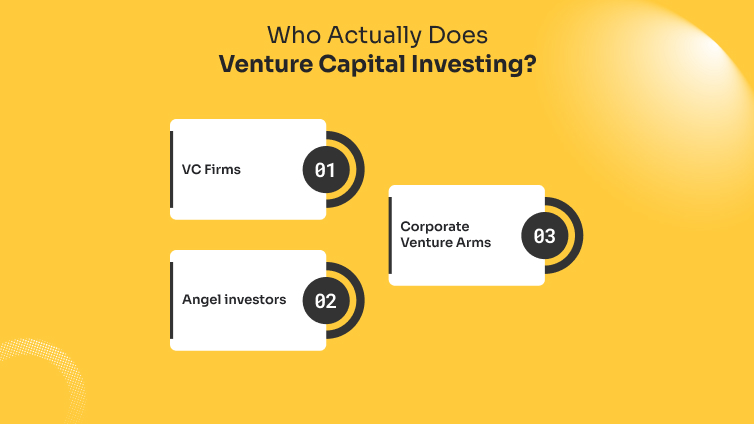
This is important to understand because it shapes how you should think about it personally. Venture capital is primarily done by:
VC Firms
VCs are professional investment firms that raise large pools of money from wealthy individuals and institutions. They have analysts, partners, and due diligence processes. For example: Sequoia, Andreessen Horowitz, Accel.
Angel investors
The angels are wealthy individuals who invest their own money in early startups. Often, they are former entrepreneurs themselves. Angels typically come in before a VC firm does.
Corporate Venture Arms
Big companies like Google, Intel, and Salesforce have their own VC wings. They invest in startups that might one day complement their core business.
To participate directly in most VC deals, you typically need to qualify as an accredited investor. In the US, this generally means having a net worth of over $1 million (excluding your home) or an annual income of over $200,000.
This threshold exists because regulators consider VC investing too risky for the average person. If you are early in your investing journey and do not yet qualify, do not worry.
We will come back to how you can still get exposure to this world.
How Venture Capital Compares to Other Investment Types?
People often mix up venture capital with other types of investing. Here is a simple breakdown:
| Investment Type | Who Invests | Typical Return Timeline | Risk Level |
|---|---|---|---|
| Venture Capital | Accredited investors, VC firms | 7–10 years | Very High |
| Index Fund / ETF | Anyone | Ongoing (liquid) | Low–Medium |
| Angel Investing | High-net-worth individuals | 5–8 years | Very High |
| Stocks (public) | Anyone | Ongoing (liquid) | Medium |
Notice how different VC is from simply buying an index fund or an ETF. Those are liquid, accessible, and diversified.
On the other hand, VC is none of those things. In addition, the potential upside is dramatically higher.
The Stages Of VC Funding: Simplifying The Terms
If you read business news, you will see terms like “Series A” or “seed round” tossed. Here is what they actually mean in practice:
| Stage | Typical Funding Amount | What It’s For | Example |
|---|---|---|---|
| Pre-Seed | $50K–$500K | Idea + early prototype | Two founders, a rough app, a pitch deck |
| Seed | $500K–$3M | Build product, hire first team | Beta users, basic revenue coming in |
| Series A | $3M–$15M | Prove the business model | Growing fast, needs to scale |
| Series B+ | $15M–$100M+ | Expand to new markets | Household names like Airbnb once were here |
Source: https://www.openvc.app/blog/funding-stages-pre-seed-series-a
Each stage represents a different level of maturity and proof. The earlier you invest, the higher the risk. Again, theoretically, it means a higher potential reward.
A seed investor who got in early on Uber or Stripe made returns that are almost impossible to explain in normal financial terms.
How Regular Investors Can Still Access Venture-Style Investments?
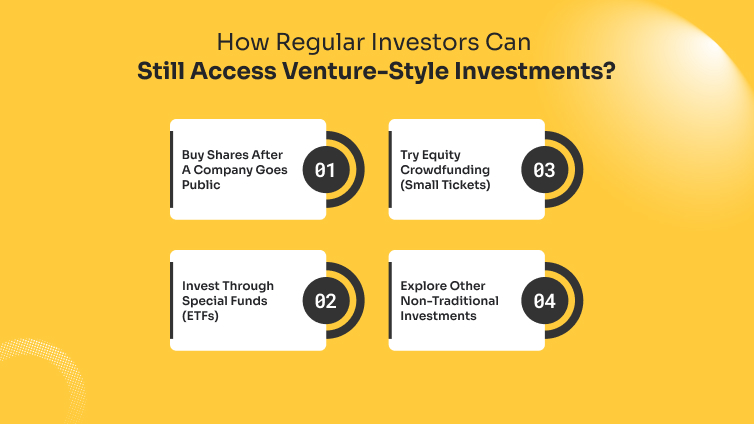
The world of investing has changed. Earlier, only very rich people could invest in startups early. Now, there are a few ways for regular investors to take part, too.
Let’s go step by step.
1. Buy Shares After A Company Goes Public
Some startups grow large and go public. This is called an IPO. At this stage:
- The company is no longer “early stage.”
- Anyone can buy its shares
Yes, the biggest jump in value may have already happened. But the company can still grow further.
2. Invest Through Special Funds (ETFs)
There are funds that invest in companies linked to innovation. These funds:
- Hold shares of many companies
- Often include firms that were once startups
You don’t pick one company. You get a mix.
Why this helps:
- Lower risk than betting on one startup
- An easy way to learn and start
It also helps you spread your money across ideas, not just one bet.
3. Try Equity Crowdfunding (Small Tickets)
Some online platforms let you invest small amounts in startups. You can sometimes start with as little as $50–$100. But be careful:
- Most startups fail
- You may lose all your money
- Returns take many years, if they come at all
Still, it gives you a real taste of startup investing.
4. Explore Other Non-Traditional Investments
As you gain experience, you may hear about other options. These include:
- Private businesses
- Real assets (like property, infrastructure)
- Funds that invest in early-stage ideas
These are not basic investments. They need more understanding.
This Story Should Inspire You
Not every big startup begins in a fancy office. Take Zepto as an example. It started in 2021.
Above all, the founders were just 19 years old. Aadit Palicha and Kaivalya Vohra left college to build it. After that, in only 18 months, the company crossed a value of $1 billion.
That kind of growth is rare. But the story helps us understand how investors think.
Now the key question is, why did investors trust them? Firstly, it was not because of polished presentations. It was not about big talk. They got funding for three simple reasons.
First, they solved a real problem. To clarify, Grocery delivery was slow, and people were frustrated.
Second, they acted fast. Meanwhile, their promise was clear: deliver in 10 minutes. This made them stand out.
Third, the market was huge. Almost everyone needs groceries. That means room to grow.
Early investors gave them money when the company was still small. As the business grew, its value increased quickly. On paper, those early investors saw big gains.
But here is the real lesson. You are not expected to find the next Zepto. Even experienced investors cannot do that easily.
What you can do is understand the pattern. Investors look for:
- A clear problem
- A founder who is serious and driven
- A market that can grow big
That’s it. The businesses that thrive on simple ideas and strong execution mostly make it big. So that’s a large opportunity. That is what attracts money.
The Major Risks Of Venture Capital
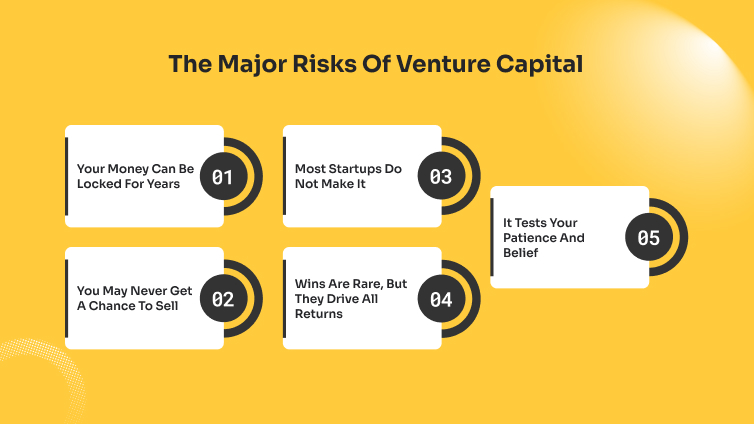
Venture capital sounds exciting when you hear success stories. It is completely different from short-term speculative investment. What is a speculative investment?
It is a risky investment based on short-term price variations. But in investment, the reality is much harder. Let’s slow down and look at the actual risks you must be aware of.
Your Money Can Be Locked For Years
When you invest in startups, you cannot just exit when you want.
- Your money can be stuck for 7 to 10 years
- There is no easy “sell” button like in stocks
- You have to wait for an IPO or acquisition
That means no quick access to your money, even if you need it.
You May Never Get A Chance To Sell
Even after waiting, there is no guarantee of an exit.
- The startup may shut down
- It may never go public
- No buyer may come forward
In many cases, investors don’t get any return at all.
Most Startups Do Not Make It
This is the hardest truth.
- Many startups run out of money
- Some fail due to poor timing
- Others struggle with competition or scaling
Even good ideas fail. Not because they were bad, but because the market was not ready or execution fell short.
Wins Are Rare, But They Drive All Returns
In venture investing:
- A few companies create most of the returns
- The rest either give small gains or fail
This creates a strange outcome: You can be “right” about many ideas and still not make money.
It Tests Your Patience And Belief
Unlike regular investing:
- There are no daily price updates
- You won’t know what your investment is worth often
- You have to trust the process for years
This can feel uncomfortable, especially for beginners.
Pro Tip:
Venture capital is not just risky. It is uncertain in ways most people are not used to.
- You wait longer.
- You control less.
- And you may lose everything.
That is why it looks exciting from the outside. But feels very different when your own money is involved. So, read about investment options first. Lean What is SEC and how it operates.
What Does A VC Investor Actually Do Day To Day?
The role of a venture capitalist is actually very significant. He is not just signing cheques and lending money at random. The crucial roles of a VC include:
Sourcing deals: Finding startups worth looking at. This happens through networks, university events, LinkedIn, referrals, and just staying close to what is happening in technology and business.
Due diligence: Deeply analyzing a startup’s product, team, market, financials (if any), and competition. This can take weeks.
Post-investment involvement: Good VC firms do not disappear after wiring the money. They sit on boards, make introductions, help with hiring, and advise on strategy.
Exits: The end goal is a liquidity event. Again, that is typically an IPO or an acquisition, in which the VC can sell its stake and return capital to its investors.
It is genuinely a full-time, relationship-heavy, expertise-driven profession. This is another reason it is not a space most beginners should try to replicate without serious preparation.
Final Takeaway: Should You Care About Venture Capital? `
Venture capital is exciting. It sits at the center of big ideas, fast growth, and life-changing returns. But here is the honest truth.
For most beginners, venture capital is not something you should rush into. It is something you should understand first.
Your key concern should be how to start investing wisely. So, begin with what is venture capital.
Use it to learn how the investing world works. See how risk, patience, and scale play out at the highest level. But do not confuse understanding with participation.
Your early investing journey should be simple. It should be steady. It should help you build confidence, not test your limits.
You don’t build wealth by chasing rare wins. In contrast, you build it by staying consistent over time. Check out what is a financial advisor? And how a financial advisor can make your investment journey easier.
So, yes, venture capital is worth knowing about. Just don’t treat it as your starting point.
Share this article: