- Why Bank Nifty Expiry Day Matters
- When Does Bank Nifty Expire? (Date And Time)
- What Happens To Options On Expiry Day
- Characteristics Of Expiry-Day Price Action, In Short:
- How a Typical Bank Nifty Expiry Day Unfolds
- Why Expiry Day Feels "Random" (It Isn't)
- A Simple Hypothetical Example
- Common Beginner Mistakes on Expiry Day
- Pros and Cons of Trading Around Expiry Day
- Myth vs. Reality
- Should Beginners Trade Bank Nifty on Expiry Day?
- A Simple Framework If You Do Want to Learn Expiry Mechanics
- Where Expiry Day Fits Into The Bigger Investing Picture
- Further Insights
- Frequently Asked Questions
- How This Guide Was Prepared
Bank Nifty Expiry Day Explained: Navigating The New Tuesday Settlement
Every Bank Nifty options contract has a built-in shelf life. It is created, trades for a while, and then expires. In other words, it stops trading and is settled by the exchange, either for a profit, a loss, or nothing at all. Expiry day is simply the last day that the contract is alive.
This matters more than it sounds because much of the published content still describes an older system. For years, the Bank Nifty had both a weekly expiry (every Wednesday) and a monthly expiry. That changed.
In November 2024, following a SEBI directive aimed at reducing risk concentration in short-tenor options, the exchange discontinued Bank Nifty’s weekly contracts entirely.
Today, Bank Nifty has only monthly and quarterly options, and both expire on the last Tuesday of their respective cycle. If that Tuesday falls on a market holiday, expiry shifts to the previous trading day.
This is a useful thing to know before you read older articles, YouTube videos, or even some broker help pages. A fair number of them still say “every Wednesday,” which is no longer accurate.
Expiry schedules are set by the exchange and can be revised. So the safest practice is to check the current NSE circular or your broker’s contract notes rather than relying on any single article, including this one.
Why Bank Nifty Expiry Day Matters

For a regular investor who just holds mutual funds or a handful of stocks, expiry day means nothing. It only matters if you hold or are considering holding Bank Nifty options or futures.
It matters for three practical reasons:
- Positions get settled automatically. You don’t place an “exit order” for expiry. The exchange handles it whether you’re ready or not.
- Prices behave differently. Institutional players adjust large positions, and that shows up as sharper, faster moves than a normal trading day.
- Time decay is at its most aggressive. An option that looked cheap in the morning can be worth almost nothing by 2 PM, even if the index barely moved.
When Does Bank Nifty Expire? (Date And Time)
Bank Nifty’s monthly and quarterly contracts expire on the last Tuesday of the relevant month or quarter. If that Tuesday is a trading holiday, expiry moves to the previous working day.
Trading in expiring contracts closes at the normal market close. That time is around 3:30 PM IST.
Meanwhile, many brokers auto-square off leveraged intraday positions a little earlier. Often between 3:15 and 3:20 PM, to give themselves a buffer.
It’s worth checking your own broker’s specific cut-off time rather than assuming it matches the exchange’s.
Because expiry dates shift around holidays and exchange rule changes. To clarify that’s the only fully reliable way to confirm an exact upcoming date is the NSE website or your broker’s contract calendar.
What Happens To Options On Expiry Day
Every option you hold at expiry falls into one of three categories, based on where the index closes relative to your strike price:
- In-the-money (ITM): The option has real value. It is automatically cash-settled — the difference between the settlement price and your strike is credited or debited from your account. You don’t need to take any action.
- At-the-money (ATM): The strike is right around the closing price. These are the most sensitive positions on expiry day — a move of even 20–30 points in the last few minutes can flip an ATM option from having value to expiring worthless.
- Out-of-the-money (OTM): The option has no intrinsic value. It simply expires worthless, and the buyer loses the entire premium paid.
Because Bank Nifty is an index, there’s no physical delivery involved. Everything is cash-settled.
That’s different from stock options, where an in-the-money position can result in actual shares being bought or sold from your demat account.
Characteristics Of Expiry-Day Price Action, In Short:
- Rapid, accelerating time decay (theta) as the clock runs down
- Wider bid-ask spreads on far OTM strikes, especially after 2:30 PM
- Sharp, short bursts of volatility tied to institutional position adjustments
- Settlement that is automatic with no manual “exit” required for either outcome
How a Typical Bank Nifty Expiry Day Unfolds
No two expiry days play out identically, but the general rhythm is consistent enough to describe.
| Time of Day | What Typically Happens |
|---|---|
| Morning (9:15 AM – 12:00 PM) | Premiums are still relatively rich. Time value hasn’t eroded much yet. Direction is often unclear. |
| Midday (12:00 PM – 2:00 PM) | Theta decay noticeably accelerates. Options that looked reasonably priced in the morning start losing value even if the index is flat. |
| Afternoon (2:00 PM – 3:00 PM) | Gamma effects become more visible — smaller index moves start producing larger, faster swings in option premiums. |
| Final hour (3:00 PM – 3:30 PM) | Institutional hedging and position-unwinding intensify. Liquidity in far OTM strikes can dry up. This is when most of the sharpest, least predictable moves happen. |
Why Expiry Day Feels “Random” (It Isn’t)
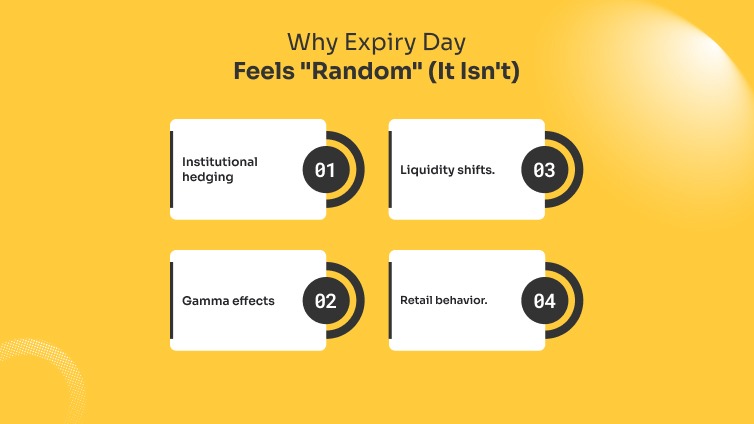
Ask any beginner what expiry day feels like, and you’ll hear some version of: unpredictable, chaotic, random. It isn’t actually random. It just has more moving parts than a normal session, and most of them aren’t visible on a basic price chart.
A few things are usually happening at once:
- Institutional hedging.
Large funds and market makers holding option positions constantly adjust their own hedges as the index moves and time runs out. Those adjustments themselves create buying or selling pressure.
- Gamma effects.
As strikes move closer to being at-the-money near the close, small index moves start producing outsized changes in option deltas. Again, that triggers more hedging, which can further amplify the move.
- Liquidity shifts.
Some strikes that were actively traded all week can suddenly see thin order books in the final hour, making prices jump more easily.
- Retail behavior.
A lot of retail traders are watching the same charts and reacting to the same headlines at the same time, which can briefly push prices further than the “fundamentals” of the move would suggest.
None of this is a conspiracy or a rigged game. It’s what happens when thousands of contracts with hard deadlines are all resolved within the same 30-minute window.
A Simple Hypothetical Example
To make time decay concrete, here’s an illustrative example. Not a real trade, just numbers chosen to show the mechanics clearly.
Say Bank Nifty is trading at 58,000. A call option at the 58,000 strike is priced at ₹180 in the morning.
An hour later, the underlying index has moved only 50 points. So, that’s a small, unremarkable move. Yet the same option is now priced at ₹92.
What happened isn’t mysterious once you separate the two components of an option’s price:
- Intrinsic value: the value the option would have if exercised right now. A 50-point move changes this only slightly.
- Time value: the extra amount buyers pay for the chance the option becomes more valuable before expiry.
On expiry day, time value erodes fast, because there’s very little time left for anything to change. Combine that with a small drop in implied volatility (traders pricing in less uncertainty as the close approaches), and you get a premium that nearly halves even though the index barely moved.
This is the single most common thing that surprises beginners when they first watch an expiry session closely.
Common Beginner Mistakes on Expiry Day
These patterns recur and tend to cluster into a few groups.
Mistakes about cost and pricing
- Buying far out-of-the-money options purely because they look “cheap”
- Not accounting for how fast theta eats into a premium during the final hours
- Ignoring the bid-ask spread widening on thin strikes late in the day
Mistakes about risk control
- Trading without any predefined stop-loss or exit plan
- Using excessive leverage on a day that is already more volatile than usual
- Holding a position into the final minutes “to see what happens”
Mistakes about expectations
- Assuming expiry day always brings a big move (many expiry sessions are actually fairly calm)
- Treating expiry day trading as a shortcut to quick profits rather than a specialized, higher-risk skill
- Not checking whether the current expiry is monthly or quarterly, and assuming the old weekly Wednesday pattern still applies
Pros and Cons of Trading Around Expiry Day
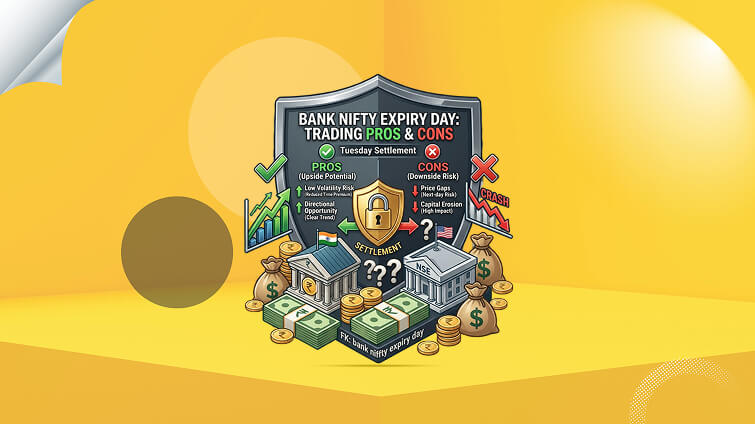
Potential advantages:
- Options can be available at relatively low absolute prices, since most of the time value has already decayed
- Clear, well-defined event (a fixed settlement time) that some traders use to structure short, defined-risk strategies
- High liquidity in near-the-money strikes for major contracts, at least earlier in the session
Real drawbacks:
- High probability of losing the entire premium on OTM positions
- Sharp, fast price swings that can move against a position before you can react
- Emotional decision-making is easy to fall into when prices are moving quickly
- Even experienced sellers of options can face large, sudden losses if the index makes an unexpected late move
Myth vs. Reality
| Myth | Reality |
|---|---|
| Expiry day guarantees profits | Price movement on expiry day is genuinely unpredictable |
| Premiums always keep rising as expiry nears | Time decay usually accelerates, so most premiums fall unless the index moves strongly in your favor |
| Option buyers always lose on expiry day | Outcomes depend on direction, timing, volatility, and how the position was managed. There’s no universal winner |
| Option sellers always win on expiry day | A sharp, sudden move can create large losses for sellers too, especially on undefined-risk positions |
| Expiry day trading is easy money | It typically demands real experience, fast decision-making, and disciplined risk management |
Should Beginners Trade Bank Nifty on Expiry Day?
Short answer: most beginners should not, at least not with real capital, until they’ve watched several expiry sessions closely first.
This isn’t about being overly cautious for its own sake. Expiry day compresses a lot of the hardest parts of options trading into a single, short window. For instance, fast time decay, sudden volatility, thin liquidity in some strikes.
That’s a difficult environment to learn in. A more sensible path is to first understand how a normal options contract behaves over its full life, build a basic sense of how premiums move with implied volatility and time, and only then look closely at expiry-day behavior, ideally by observing it before risking money on it.
A Simple Framework If You Do Want to Learn Expiry Mechanics

- Build the foundation first. Understand what an option is, what a strike price and premium mean, and how intrinsic and time value work, before looking at expiry specifically.
- Watch before you trade. Follow two or three full expiry sessions on a paper-trading or demo basis, noting how premiums move through the day.
- Define your risk before you start. Decide the maximum amount you’re willing to lose on any single position, in rupees, before you place it, not after.
- Start small and specific. If and when you do trade, use small position sizes and simple, defined-risk structures rather than large naked positions.
- Review afterward. Write down what actually happened versus what you expected. This single habit does more for learning than most paid courses.
Where Expiry Day Fits Into The Bigger Investing Picture
It’s worth stepping back here, because Bank Nifty expiry day trading is a narrow, high-risk corner of a much larger world of investing. And it’s easy for a beginner to stumble into it before understanding the basics.
If you’re new to markets altogether, it usually makes more sense to first get comfortable with how to start investing wisely and the difference between building wealth steadily and taking short-term bets.
Bank Nifty options trading sits firmly on the speculative investment end of that spectrum. It’s a bet on short-term price movement, not an ownership stake compounding over years. That doesn’t make it wrong to explore.
But it’s a very different activity from the kind of investing most people should be doing with the bulk of their savings, which usually focuses on ideas like diversifying your investment portfolio rather than concentrating risk in a single index on a single day.
It’s also worth knowing what you’re up against. A meaningful share of Bank Nifty options volume on any given expiry comes from institutional desks, proprietary trading firms, and funds operating out of GIFT City.
In the same vein, GIFT City is India’s international financial services hub. It has become an active venue for derivatives trading. These are professional players with far more data, faster execution, and dedicated risk teams.
Retail traders are not competing on equal footing. And that’s not a reason to avoid learning the mechanics. To clarify, it’s a reason to size positions conservatively while you’re doing so.
Further Insights
If you follow the broader market, FII and DII data can offer useful context for the kind of positioning that shows up in index behavior around expiry. Even though it won’t predict any single day’s move.
But what are these data? In simple words, they are the daily buying and selling activity of foreign and domestic institutional investors
Similarly, if you’re tracking your own returns across different types of investments, learning what XIRR is is far more useful for judging your actual investing performance over time than any single expiry-day outcome ever will be.
None of this replaces professional guidance. A registered financial advisor’s real value isn’t predicting where Bank Nifty settles on Tuesday.
Rather, it’s translating a complex, fast-moving topic like derivatives into a plan that actually fits your income, goals, and risk tolerance. And being someone you can ask “does this make sense for me?” before you act, not after.
If options trading is something you’re genuinely interested in, that conversation is worth having before you fund an account, not after a rough first expiry.
For readers specifically looking to get set up, understanding Bank Nifty lot size and comparing best trading app for your needs are sensible next steps. But they come after the basics above, not before them.
Frequently Asked Questions
If Bank Nifty expiry day is still a mystery to you, this section offers direct and clear answers to what most people query:
It’s the day when Bank Nifty options and futures contracts stop trading and are settled by the exchange.
Since November 2024, this happens only monthly or quarterly, on the last Tuesday of the cycle. That is to say, the Bank Nifty no longer has a weekly expiry.
Trading closes at the normal market close, around 3:30 PM IST, though many brokers auto-square-off leveraged intraday positions slightly earlier. Always confirm your broker’s specific cut-off.
Because institutional hedging adjustments, accelerating time decay, and thinning liquidity in certain strikes all occur within the same short window, this tends to produce sharper price swings than on a typical trading day.
Technically, yes, but it’s generally not advisable without first understanding the basics of options and observing a few expiry sessions. It’s one of the more difficult environments in which to learn, given how quickly conditions change.
No. Only out-of-the-money options expire worthless. In-the-money options are automatically cash-settled at their intrinsic value.
Neither has a guaranteed edge. Outcomes depend on market direction, volatility, timing, and the quality of position management. In other words, both buyers and sellers can win or lose depending on how the day unfolds.
There currently is no weekly Bank Nifty expiry. To clarify, it was discontinued in November 2024. Only monthly and quarterly contracts exist now, both of which expire on the last Tuesday of their cycle.
The exchange settles it automatically. OTM options expire worthless, ITM options are cash-settled, and futures settle at the final settlement price.
Some brokers may also automatically square off leveraged positions earlier in the session. Check your broker’s policy.
How This Guide Was Prepared
This article explains Bank Nifty expiry day using publicly available NSE contract rules, standard options-pricing concepts (intrinsic value, time value, theta, and implied volatility), and recent exchange circulars on expiry-schedule changes.
It is written for financial literacy and general education, not as personalized trading advice or a recommendation to trade options. Exchange rules, expiry schedules, lot sizes, and tax treatment (such as STT) can and do change.
Therefore, you must always verify current details on the official NSE website or with your broker before acting on them.
This article is for educational purposes only and does not constitute investment or trading advice. Options trading carries a high risk of loss and isn’t suitable for everyone. Consider speaking with a SEBI-registered financial advisor before trading derivatives.
Share this article: