- Key Takeaways
- The 4 Defining Characteristics Of Modern Discount Platforms
- Real-Life Scenarios: How Real Beginners Choose
- Scenario A: Maya The Automated Indexer
- Scenario B: Kian The Fast-Lane Trader
- Comparing The Two Paths: Self-Guided VS. Full-Service
- Pros And Cons: Weighing The Trade-Offs
- The Advantages
- The Disadvantages
- The Invisible Price Tag: How Free Trading Actually Works
- Safeguarding Your Account: The Strict But Necessary Security Rules
- The Fine Print: Account Types Every Beginner Faces
- Day One Logistics: How To Fund Your First Account
- 1. Link Your Checking Account
- 2. Wait For The Clear
- 3. Place A Simple Market Order
- A 4-Step Decision Framework For Beginners
- Should Beginners Use A Discount Broker?
- Top Beginner-Friendly Broker Choices
- 1. Best For Set-And-Forget Investors (Automated Indexing)
- 2. Best For Mobile-First Micro-Savers (Fractional Shares)
The Rise of Discount Brokers: Why Free Trading Isn’t Really Free

Discount brokers are online platforms that let you buy and sell stocks, ETFs, and mutual funds for little to no commission. It involves a do-it-yourself setup where you make all your own investing choices via an app or website.
It offers ultra-low trading fees and high independence but comes with the risk of making unguided financial mistakes without professional help.
A decade ago, trying to buy a single share of a company meant calling up an expensive human or using a clunky platform that charged 10 to 20 dollars per trade. Today, you can swipe your thumb on a smartphone screen and buy a fraction of a share for zero commission.
This tectonic shift happened because discount brokers forced the entire financial industry to change its business model. But while these apps open the doors to wealth building, they also leave you holding the steering wheel.
If you do not know where you are driving, it is easy to crash your capital. Let us pull back the curtain on how these platforms function, what they cost, and how a beginner can use them safely.
Key Takeaways
- Discount brokers cut out human middlemen to offer zero-commission stock and ETF trades.
- You get no personalized financial advice; all buying and selling choices rest on your shoulders.
- While great for long-term indexing, easy access can tempt beginners into high-risk habits.
- Regulators keep an eye on them, but you are responsible for managing your own risk limits.
The 4 Defining Characteristics Of Modern Discount Platforms
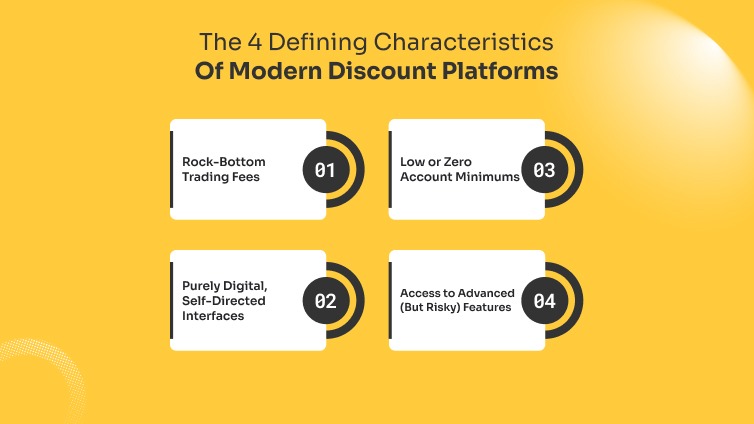
If you are wondering what separates these bare-bones apps from old-school financial institutions, it comes down to four core traits.
- Rock-Bottom Trading Fees: The most obvious trait is the lack of commissions. They do not charge you a fixed fee every time you click “buy” or “sell” on standard assets.
- Purely Digital, Self-Directed Interfaces: You will not get a dedicated account manager calling you with hot stock tips. Everything runs through a clean website or mobile application.
- Low or Zero Account Minimums: You can open an account with $1, $50, or $10,000. They do not lock out smaller accounts.
- Access to Advanced (But Risky) Features: While built simple, they still give users secondary access to complex vehicles like options, cryptocurrency, or margin trading.
Real-Life Scenarios: How Real Beginners Choose
To understand how these platforms work in reality, look at two everyday investors with identical goals but completely different outcomes.
Scenario A: Maya The Automated Indexer
Maya wanted to figure out how to start investing wisely without losing half her paycheck to administrative fees. She opened a free account with a well-known online platform, linked her checking account, and set up an automatic deposit of $ 100 every month. She chose a simple, broad S&P 500 index fund.
Because her platform does not charge commissions, every single cent of her $ 100 went straight into buying shares. Maya logs into her account maybe three times a year. Her portfolio grows steadily because she uses the platform as a simple digital storage vault for long-term compound growth.
Scenario B: Kian The Fast-Lane Trader
Kian joined a flashy, game-like investing app because his coworker told him about a booming tech company. He did not want a traditional financial advisor slowing him down. Kian deposited 1,000 dollars and immediately bought shares.
When the stock jumped 10% in two days, the app sent a celebratory notification. Hooked on the excitement, Kian started treating his account like a video game. He began making speculative investment trades in highly volatile assets, buying in the morning and selling by the afternoon.
Within three months, a market dip wiped out half his money. Kian did not lose money because the platform was bad; he lost money because it made it too easy to treat investing as casual entertainment.
Comparing The Two Paths: Self-Guided VS. Full-Service
Many beginners do not realize that discount platforms are just one side of the coin. Here is how they stack up against traditional full-service firms.
| Feature | Discount Platforms | Full-Service Firms |
|---|---|---|
| Trading Commissions | Usually $0 for standard US stocks/ETFs | Can be $20+ per trade or a percentage of your wealth |
| Human Advice | None; you do your own research | Dedicated professional planners who build custom roadmaps |
| Minimum Balance | Often $0 to $1 | Frequently $10,000 to $250,000+ |
| Best Suited For | Do-it-yourselfers and automated savers | People who want hands-off wealth management |
Pros And Cons: Weighing The Trade-Offs
To understand whether you need a discount broker or not at your stage, you need to take a look at the pros and cons, both:
The Advantages
- Ultimate Affordability: No hidden trade commissions means small balances do not get eaten alive by transaction costs.
- Fractional Shares: Many platforms let you buy 5 dollars worth of a stock that costs 300 dollars per full share.
- Speed and Control: You can react to news instantly from your phone without waiting for a broker to return your calls.
The Disadvantages
- The “U-Turn” Danger: There are no guardrails. If you panic during a market drop and want to sell all your long-term retirement funds at a massive loss, the app will execute that order instantly.
- Customer Support Hurdles: If your account has a glitch, getting a human on a phone call can sometimes take hours, unlike a traditional brick-and-mortar office.
- Hidden Fees: While trading is free, you might incur additional fees for paper statements, wire transfers, or advanced data streams.
The Invisible Price Tag: How Free Trading Actually Works
Nothing on Wall Street is completely free. If an app is not charging you a flat fee to click the “buy” button, it is quietly extracting value somewhere else in the pipeline. It is not a charity. Beginners need to know exactly where the money changes hands so they do not feel cheated down the road.
- The Cash Drag Trick: When you deposit money but leave it uninvested, it feels like it is just sitting idle. It isn’t. The broker moves that cash into interest-bearing accounts, keeps the massive lion’s share of the payout, and drops pennies into your account.
- Order Routing Deals: This is the big one. Many modern apps do not send your stock order straight to the public stock exchange. Instead, they route your request through massive wholesale trading firms. The broker gets a microscopic fraction of a cent per share for directing traffic. When you multiply that by billions of trades, it turns into massive corporate wealth.
- Premium Upgrades: Free features only go so far. The moment you want advanced charts, deeper research data, or extended trading hours, the platform will prompt you to pay a monthly subscription fee.
Safeguarding Your Account: The Strict But Necessary Security Rules

When your entire investment portfolio lives inside a smartphone app, digital safety is your actual financial safety. Relying on basic protection is a massive gamble. It is the easiest way to invite unnecessary panic into your life.
- Mandatory App-Based 2FA: Step away from simple passwords. You need to enable app-based authenticator tools or biometrics, such as fingerprints and face scans. If a platform only sends security codes via standard SMS, use it for now, but upgrade to an authenticator tool as soon as you can.
- Watch Out For Phishing Scams: Legitimate companies will never text or email you out of nowhere demanding your login details. They will never ask for an urgent bank wire transfer to keep your account open. If an alert looks scary, close the app, open a fresh browser tab, and check your status safely from there.
- The Public Wi-Fi Rule: Do not log in to your investment portal while connected to a public Wi-Fi network in a coffee shop. It is too easy to intercept data. Wait until you are back on a secure home internet connection, or use your phone’s cellular data instead.
The Fine Print: Account Types Every Beginner Faces
The second you click “Open Account,” the system will force you to choose a specific bucket for your money. Pick the wrong box, and you will end up facing a surprise bill from the IRS when tax season rolls around.
- Standard Taxable Brokerage Account: This is standard, flexible investing. You put money in, trade whenever you want, and pull cash out whenever you need it. The downside? Every single time you sell a stock for a asset profit or receive a dividend cash payment, you owe taxes on those gains that exact same year.
- Roth IRA (The Retirement Shield): You invest money that has already been taxed from your normal paycheck. Everything inside this bucket grows completely tax-free. When you finally retire decades down the line, you can pull every single dollar out without owing the government a single penny.
- Traditional IRA: This offers a tax break right now. The money you put in reduces your taxable income for the current year, which is great. However, you will owe regular income taxes on the back end when you withdraw the funds later in life.
Day One Logistics: How To Fund Your First Account
Moving from reading financial blogs to actually owning a slice of an index fund is a massive mental hurdle. The actual process is incredibly straightforward, but understanding the timeline prevents you from panicking when your hard-earned money briefly disappears into cyberspace.
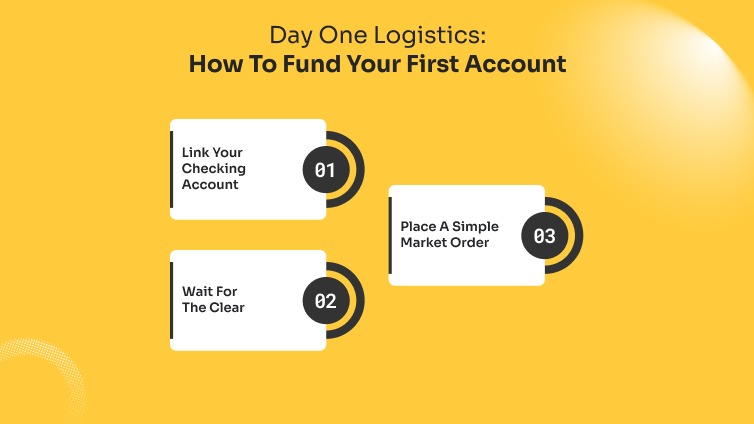
1. Link Your Checking Account
You will use a secure digital bridge to hook up your everyday bank checking account to your new brokerage profile. Try to avoid linking a savings account. Savings accounts often carry strict federal limits on how many times you can pull money out each month, which causes unnecessary transfer glitches.
2. Wait For The Clear
When you trigger your very first deposit, the broker might give you “instant buying power” to play with. Do not get confused by this.
The actual hard cash takes roughly three to five business days to clear between banking systems. It is completely normal for your regular bank statement to show a pending status for a bit.
3. Place A Simple Market Order
Log in during regular stock market hours (9:30 AM to 4:00 PM Eastern Time). Type in the specific ticker symbol for the index fund you want, choose the exact dollar amount you are comfortable spending, and hit “Market Order.”
This tells the computer to grab the shares instantly at whatever the current going price is. No waiting, no fuss.
A 4-Step Decision Framework For Beginners
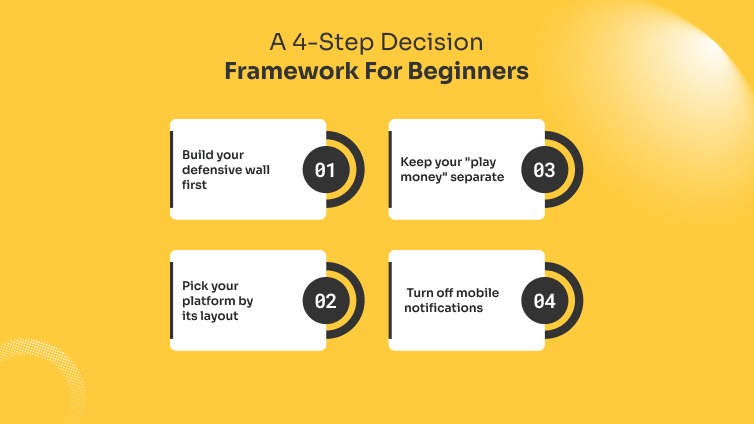
If you are standing on the sidelines trying to figure out how to navigate these digital waters safely, use this step-by-step framework to protect your hard-earned money.
- Step 1: Build your defensive wall first. Never deposit money into an online brokerage account if you have high-interest credit card debt or do not have an emergency cash fund.
- Step 2: Pick your platform by its layout. If you know you are prone to impulsive choices, avoid apps that use flashing lights, confetti animations, or social media feeds. Choose boring, clean, institutional interfaces.
- Step 3: Keep your “play money” separate. If you want to try a speculative investment for fun, cap it at less than 5% of your total net worth. The other 95% should go into boring, diversified index funds.
- Step 4: Turn off mobile notifications. Once your portfolio is set up, delete the app from your home screen or silence its alerts. This stops you from constantly checking daily price swings, which only fuels emotional errors.
Should Beginners Use A Discount Broker?
Yes, absolutely. For 90% of everyday people starting out, these platforms are the absolute best way to build wealth because they eliminate the heavy fees that used to drain small accounts.
However, you must treat the app like a serious utility tool, not a game. If you need someone to hold your hand, coordinate tax strategies, or talk you down during a market scare, paying a certified professional is well worth the cost.
Otherwise, take advantage of the free access and keep your strategy wonderfully simple.
Top Beginner-Friendly Broker Choices
Financial advisors recommend matching your platform choice directly to your primary style. To keep things clear, we have categorized the top choices into groups of three based on specific user needs.
1. Best For Set-And-Forget Investors (Automated Indexing)
- Vanguard: The old-school giant of low-cost investing. Their digital platform is deliberately simple, making it perfect for buying broad-market index funds and leaving them alone for 30 years.
- Fidelity: Offers an excellent balance of zero-dollar stock trades, zero account minimums, and robust customer service options if you ever get stuck.
- Charles Schwab: A massive, trusted institution that provides great research tools alongside completely free equity trades.
2. Best For Mobile-First Micro-Savers (Fractional Shares)
- Robinhood is usually the first app people mention when they start looking into investing. It made trading feel simple and, for many, almost too easy. The design is clean, everything is just a tap away. But that also means you can end up making quick decisions you didn’t really think through.
- Acorns works very differently. It’s built for people who don’t naturally put money aside. Instead of asking you to invest large amounts, it quietly takes the spare change from your everyday spending and puts it to work. You don’t really feel it happening, which is kind of the point.
Stash sits somewhere in between. It doesn’t just let you invest. It tries to explain what you’re doing along the way. You can buy small pieces of well-known companies, but the bigger focus is helping you understand why you’re investing in the first place.
Share this article: