- Quick Summary Box
- Analyzing A Real Life Scenario
- The Core Characteristics of a Real Financial Advisor
- Understanding The Indian Advisory Divide
- Common Types Of Financial Guides In India
- Who Can Help Me Plan My Long-Term Goals?
- 1. Certified Financial Planners (CFPs)
- 2. SEBI Registered Investment Advisors (RIAs)
- 3. Robo-Advisors
- Who Should I Talk To About Specific, Advanced Investments?
- 1. Portfolio Management Services (PMS)
- 2. Wealth Managers
- Pros VS Cons Of Hiring A Financial Advisor
- The Benefits
- The Drawbacks
- Should Beginners Hire A Financial Advisor?
- A Simple Framework To Get Started
- Step 1: Secure Your Foundation
- Step 2: Establish Your Core Savings Rate
- Step 3: Identify High-Risk Distractions
- Step 4: Graduate To Professional Help
- Evaluating Fee Models In India
- Frequently Asked Questions
What Is A Financial Advisor? The Honest Money Guide For Indian First-Taime Earners

A financial advisor is a certified professional who helps you manage, plan, and grow your money based on your specific life goals.
They evaluate your income, expenses, and risk tolerance to design custom investment strategies. Their main benefit is creating an actionable roadmap for your wealth, though their advice carries the risk of fee mismatches if you choose the wrong professional.
Quick Summary Box
- A financial advisor is not a salesman: True advisors sell strategies, not individual mutual fund products.
- Watch the hidden costs: Many people mistake their bank relationship manager or insurance uncle for an advisor.
- Beginners should start simple: If you are just starting out, prioritize building clear habits over paying massive management fees.
- Regulated by SEBI: In India, look specifically for a SEBI-registered investment advisor (RIA) for unbiased guidance.
Analyzing A Real Life Scenario
Picture this scenario. You are 23 years old. Your mobile phone buzzes on the last day of the month with a text message that makes your heart race: “Salary of ₹45,000 credited to your account.”
It is your first real job. After the initial wave of excitement settles, a mild panic sets in. You know you need to save. Everyone on social media is talking about multi-bagger stocks, compound interest, and retiring by thirty.
Then comes the phone call. It is an uncle who sells insurance policies, or perhaps a polite relationship manager from your bank. They tell you about a “guaranteed return plan” that protects your life and grows your money simultaneously. It sounds perfect.
You sign the papers. Two years later, you realize your money is locked up in a low-yield product that barely beats inflation. This is the exact moment most young Indians realize they need real financial guidance, but do not know who to trust.
This brings us to a critical question. Who actually looks after your money without trying to pick your pocket?
The Core Characteristics of a Real Financial Advisor
The financial landscape in India is crowded with people offering tips. However, a legitimate financial professional has very specific traits. You can easily spot a true advisor by looking for these four core characteristics:
- Fiduciary Responsibility: They are legally bound to act in your absolute best interest. They cannot recommend a product simply because it pays them a higher backend commission.
- Holistic Assessment: They do not just shout stock tips at you. They look at your entire financial life. For example, your student loans, your parents’ health insurance, and your dream of buying an apartment.
- Objective Fee Structure: They charge you a transparent fee directly. They do not hide their charges inside complex product documents.
- Strict Regulatory Compliance: In India, they must hold a valid license from the Securities and Exchange Board of India (SEBI) as a Registered Investment Advisor (RIA).
Most investors mistake distributors for advisors. To ensure you do not make the same mistake, look at how the industry splits these roles under SEBI guidelines.
Understanding The Indian Advisory Divide
| Feature | SEBI Registered Investment Advisor (RIA) | Mutual Fund Distributor (MFD) / Bank RM |
|---|---|---|
| Primary Loyalty | To the client (You) | To the financial product house |
| How They Earn | Direct fees paid by you | Trail commissions hidden inside the product |
| Products Offered | Direct Mutual Funds, Stocks, Bonds, NPS | Regular Mutual Funds only |
| Legal Mandate | Fiduciary duty to protect your interests | Suitability standard (it just needs to fit, not be the best) |
Common Types Of Financial Guides In India
To target exactly what you need, we can categorize these professionals based on common search queries that everyday investors use.
Who Can Help Me Plan My Long-Term Goals?
If you have ideas to build a concrete financial health, here are some sources you may seek help from:
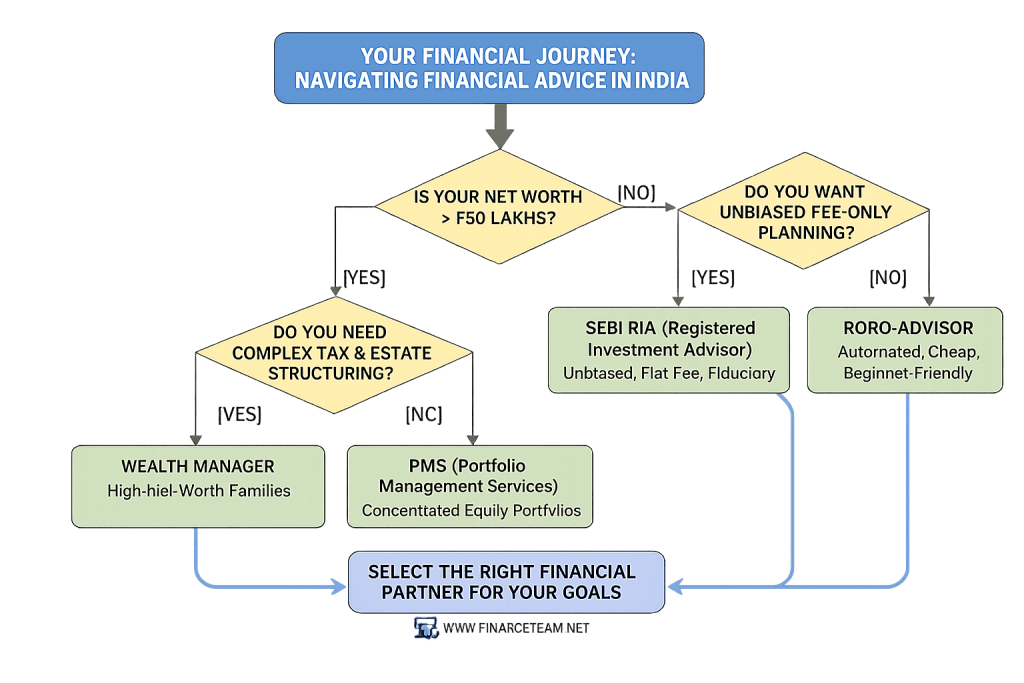
1. Certified Financial Planners (CFPs)
These are professionals who have undergone rigorous training covering insurance, taxation, retirement, and estate planning. They look at your life as an interconnected puzzle. If you want a complete blueprint for your financial journey, a CFP is the right choice.
2. SEBI Registered Investment Advisors (RIAs)
These individuals or firms are the gold standard for unbiased advice in India. They are legally barred from earning commissions from mutual fund houses. They help you build your core asset allocation, ensuring you know How to Diversify Your Investment Portfolio without conflict of interest.
3. Robo-Advisors
These are digital platforms that use automated algorithms to build a portfolio for you based on a quick digital questionnaire. They are incredibly cheap and excellent for absolute beginners who do not have large sums of money but want to know How to start investing wisely.
Who Should I Talk To About Specific, Advanced Investments?
If you know the basic and want to switch to riskier and advanced investments, these sources will help you:
1. Portfolio Management Services (PMS)
These managers handle concentrated stock portfolios for high-net-worth individuals. In India, the minimum ticket size for a PMS is ₹50 Lakhs. They do not consider your monthly household budget; they focus solely on beating the stock market index.
2. Wealth Managers
Wealth managers cater to affluent families who need comprehensive help with complex tax structuring, overseas investments, and niche alternative assets. They handle large pools of capital and rarely work with retail investors just starting their careers.
Pros VS Cons Of Hiring A Financial Advisor
Every financial decision involves trade-offs. Even when someone is helping you save money, there are clear benefits and structural drawbacks to consider.
The Benefits
- Eliminating Emotional Panic: When the Indian stock market drops 3% in a single day, your advisor acts as a behavioral shield, stopping you from panic-selling your long-term equity funds.
- Cutting Out Hidden Middlemen: A fee-only advisor transitions you into direct mutual fund plans. This single move saves you up to 1% annually in expense ratios, which compounds into lakhs of rupees over two decades.
- Custom Goal Tracking: They translate vague desires like “I want to buy a car” into concrete metrics like “You need a recurring allocation of ₹15,000 per month for 36 months in a low-duration debt fund.”
The Drawbacks
- Upfront Cost Friction: High-quality SEBI RIAs charge flat fees that can range from ₹10,000 to ₹50,000 annually. For a beginner saving ₹5,000 a month, this fee can consume their entire initial investment capital.
- No Guarantee of Outperformance: An advisor is a financial architect, not a fortune teller. They cannot force the market to go up, nor can they guarantee your portfolio will beat every trending multibagger stock on social media.
Should Beginners Hire A Financial Advisor?
The short answer is no, not immediately. If you are earning your first salary or investing your first few thousand, you do not need to pay a professional deep fees to tell you to clear your credit card debt and open a Public Provident Fund (PPF) account.
Financial advisors recommend that beginners first build their foundational financial hygiene on their own. Focus your initial energy on setting up a basic emergency fund equal to six months of expenses and buying an independent term insurance policy.
Once your monthly investable surplus crosses ₹20,000, or when your financial life gets complicated due to marriage, a home loan, or windfalls, a SEBI RIA easily pays for itself.
A Simple Framework To Get Started
If you want to transition from a passive saver to a structured investor without losing your peace of mind, follow this actionable four-step framework:
Step 1: Secure Your Foundation
Before looking at equity markets, buy a pure term insurance policy and a family health insurance plan. Do not mix insurance with investment. Keep them completely separate.
Step 2: Establish Your Core Savings Rate
Automate a systematic investment plan (SIP) in a simple, low-cost Nifty 50 Index Fund on the day your salary lands. Treat this money as completely gone.
Step 3: Identify High-Risk Distractions
As you build your core wealth, you will be tempted by high-yield opportunities. Learn to recognize what is a speculative investment is before putting real capital into it. F
or instance, you should recognize that complex institutional structures like learning What are hedge funds or trading volatile crypto tokens are are completely unsuited for your foundational wealth layer.
Step 4: Graduate To Professional Help
When your total portfolio reaches a size where a 10% market drop keeps you awake at night, look up the official SEBI directory. Select an individual fee-only advisor to take over your asset rebalancing.
Evaluating Fee Models In India
When you finally decide to speak with a professional, use this breakdown to evaluate how they expect to get paid:
| Fee Structure | What It Means | Ideal For |
|---|---|---|
| Flat Fee (Fee-Only) | You pay a fixed annual amount (e.g., ₹15,000) regardless of your total portfolio size. | Beginners and mid-level earners with simple goals. |
| Percentage of Assets (AUA) | They charge a fixed percentage (e.g., 0.5% to 1%) of the total money they manage for you. | High-net-worth families with complex portfolios. |
| Commission-Based | You pay nothing upfront, but they take a cut from every product you purchase through them. | Best avoided if you want completely objective advice. |
Frequently Asked Questions
Yes. A CA focuses primarily on your historical data—filing your income tax returns, auditing balances, and maximizing deductions for the previous financial year. A financial advisor looks forward, structuring your investments to meet your upcoming future goals.
Generally, no. Bank relationship managers have intense monthly targets to sell specific corporate insurance products and regular mutual funds. They operate under a sales model, not a fiduciary model, meaning their advice is heavily compromised by institutional incentives.
There is no legal minimum asset requirement to hire a SEBI RIA. However, because they charge flat fees, it makes practical sense only when your total annual investable surplus can absorb their fees without significantly denting your savings rate.
No. Genuine financial advisors never take custody of your money or assets. They give you a written advice report. You then use your own investment accounts to execute those recommendations using direct platforms.
You can verify any professional in under a minute by visiting the official SEBI intermediary portal (sebi.gov.in). Search for their registration number under the “Investment Advisers” tab to confirm their license status is active.
Share this article: