- So, What Is SEC?
- What Does The SEC Actually Regulate?
- How the SEC Actually Works?
- The SEC Writes The Rules.
- The SEC Watches The Markets.
- The Pros And Cons Of Having An Agency Like The SEC
- What The SEC Does Well
- Where The SEC Has Limits
- What The SEC Does NOT Do (This Surprises Most Beginners)
- SEC VS. FINRA: What Is The Difference?
- Should Beginners Really Care About The SEC?
- A Simple Framework: How To Use The SEC As A Beginner Tool?
- Key Takeaways
What Is SEC? The Investing Watchdog Every Beginner Should Know About
Marcus had just turned 28. He had been saving up for three years and finally had $5,000 set aside to invest.
His coworker had been talking about a small company whose stock “was about to explode.” The tip came from a friend of a friend who “knew someone inside.”
Marcus almost wired the money. Then he Googled the company and found an SEC enforcement notice. The company’s CEO had been charged with fraud. The “tip” was part of a pump-and-dump scheme.
So Marcus decided not to invest his $5,000. The SEC had already stepped in.
That is exactly the kind of protection the SEC provides. You may never think about it directly. But if you are going to start investing, understanding what the SEC does is one of the smartest first steps you can take.
So, What Is SEC?
The Securities and Exchange Commission is a federal agency. Congress created it in 1934, right after the stock market crash of 1929 wiped out millions of Americans who had no idea what was really going on inside the companies they had invested in.
The whole idea behind the SEC is simple. Companies that want the public to invest in them must be transparent. They have to share real financial data. They cannot lie. In fact, they cannot tip off certain investors while hiding things from others.
The SEC has five divisions, but for a beginner, the three that matter most are Enforcement, Corporation Finance, and Trading and Markets. What’s most important or you at this stage is to know what is SEC? Each plays a different but connected role in keeping the system honest. You can learn more directly at SEC.gov.
What Does The SEC Actually Regulate?
You know what is SEC? Now it’s time to explore what the agency exactly does. Here is a straightforward breakdown.
This table covers the main areas where the SEC operates and why each one matters to you as a new investor.
| Area | What the SEC Does | Why It Matters to You |
|---|---|---|
| Stock Markets | Oversees trading rules and market fairness | Prevents rigged prices or unfair trades |
| Public Companies | Requires quarterly and annual financial reports | You can read a company’s finances before investing |
| Brokers & Advisors | Licenses and monitors those who handle your money | Helps ensure your broker is accountable |
| Investment Products | Reviews and approves mutual funds, ETFs, and other products | Adds a layer of scrutiny before products reach you |
| Fraud & Insider Trading | Investigates and prosecutes securities fraud | Protects your money from bad actors |
Notice that the SEC covers brokers and advisors, not just companies. If you ever work with a financial advisor, that person is subject to SEC and FINRA rules. That matters a lot, and we will get to it shortly.
How the SEC Actually Works?
Think of the SEC like a combination of a rulebook author, an auditor, and a prosecutor. It writes the rules for securities markets. It watches for violations. And when it finds one, it has real teeth.
The SEC Writes The Rules.
Before a company can sell shares to the public, it must file a registration statement with the SEC.
That document reveals everything: debts, lawsuits, executive salaries, and business risks. You can read those filings yourself on the SEC’s free database, called EDGAR.
The SEC Watches The Markets.
Every trading day, the SEC monitors billions of transactions. It looks for unusual patterns.
A stock jumps 40% the day before a merger is announced? The SEC notices. That is how insider trading cases often begin.
During Fiscal Year 2025, the U.S. Securities and Exchange Commission (SEC) experienced a notable shift, filing 456 total enforcement actions, a 22% drop from FY2024. This total included 303 standalone actions and 69 follow-on administrative proceedings.
Despite an overall drop in case volume due to a deliberate realignment toward complex fraud investigations under Chair Paul Atkins, the SEC secured court orders for $17.9 billion in total monetary relief.
Adjusted downward to exclude non-SEC parallel matters, the baseline recovery was $2.7 billion. Accountability focused heavily on individuals, who were targeted in roughly two-thirds of standalone actions.
Additionally, the Commission received a record 53,753 whistleblower tips and returned $262 million to harmed investors. You can learn more about how federal agencies prosecute high-profile financial internet scams by watching this clip detailing the Eight Financial Influencers Indicted in Massive Pump and Dump Scheme.
This video is relevant because it breaks down how the SEC and DOJ collaborate to investigate and charge online bad actors using social media to manipulate retail investors.
The Pros And Cons Of Having An Agency Like The SEC
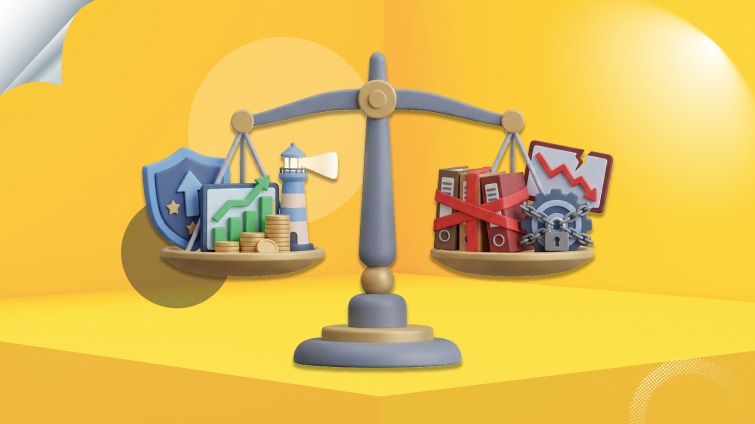
The SEC has implemented several crucial regulatory measures in the last decade. So what went well and what didn’t?
What The SEC Does Well
• Forces companies to publish real financial data before you invest
• Gives you free access to thousands of company filings through EDGAR
• Investigates fraud and often catches it before it wipes out small investors
• Licenses and oversees brokers, which gives you a layer of accountability
• Runs an investor education platform at Investor.gov
Where The SEC Has Limits
• It cannot protect you from bad investment decisions, only from fraud
• Enforcement can be slow. Cases take years to resolve
• Smaller scams sometimes slip through, especially those using social media
• It does not insure your investments. If a stock you own crashes, the SEC cannot get your money back
What The SEC Does NOT Do (This Surprises Most Beginners)
Many first-time investors assume the SEC approves investments. But you must first know clearly what is SEC? People who already know also know that it does not approve.
When the SEC reviews a company’s registration, it checks whether the disclosure is complete. It does not say the investment is safe or that the company is good.
You can still lose every dollar you put in. That is entirely possible, entirely legal, and not something the SEC will fix.
The SEC also does not regulate cryptocurrency the same way it regulates stocks. This is still a contested area in U.S. financial law. If you are thinking about speculative investments like crypto, you have less regulatory protection than you do in traditional markets.
Similarly, areas like venture capital and hedge funds fall under different SEC rules than the public markets most beginners start with. These are generally only open to accredited investors, meaning people with high incomes or net worth.
SEC VS. FINRA: What Is The Difference?
New investors often confuse the SEC with FINRA. Both oversee parts of the financial world, but they are not the same thing.
| Feature | SEC | FINRA |
|---|---|---|
| Type | Federal government agency | Self-regulatory industry organization |
| Created by | U.S. Congress (1934) | Financial industry itself (1939, reorganized 2007) |
| Regulates | All securities markets and public companies | Primarily, brokers and brokerage firms |
| Enforcement | Can bring civil and criminal charges | Can fine and ban industry members |
| Your complaint | SEC.gov complaint portal | FINRA.org investor complaint center |
If you ever have a problem with discount brokers or a robo-advisor, FINRA is often the first place to file a complaint. If the issue involves the company whose stock you own, the SEC is the right body to contact.
Should Beginners Really Care About The SEC?
Yes. Here is the short answer: most beginner mistakes stem from trusting the wrong sources.
That friend who “has a hot stock tip.” That Reddit thread promising 10x returns. That influencer is running a margin trading tutorial. None of those people is accountable to the SEC. But the broker you open your account with? They are.
When you are just starting, the safest path is to work within SEC-regulated systems. That means using registered brokers, reading company filings before you invest, and being deeply skeptical of any investment that is not required to disclose anything. Before anything else, take the time to learn how to start investing wisely.
If you ever hire a professional to help you, check whether they are registered with the SEC or FINRA. You can look up any financial advisor on the SEC’s Investment Adviser Public Disclosure database. It takes about two minutes, and it tells you everything you need to know about their background.
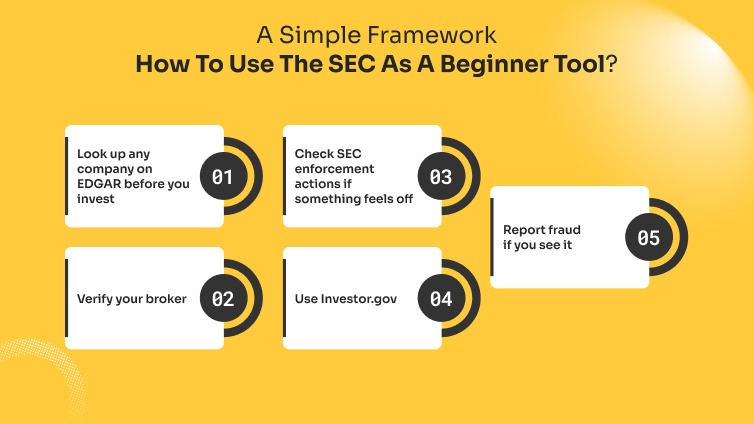
A Simple Framework: How To Use The SEC As A Beginner Tool?
Most people think of the SEC as something that only matters to Wall Street. But there are practical things you can do right now.
- Look up any company on EDGAR before you invest. Go to sec.gov/cgi-bin/browse-edgar and search for the company name. Find their most recent 10-K (annual report). Skim the “Risk Factors” section. This section alone will tell you more than any stock tip.
- Verify your broker. Every legitimate broker in the U.S. must be registered. Go to brokercheck.finra.org and search your broker’s name before you deposit any money.
- Check SEC enforcement actions if something feels off. If someone is pitching you hard on a stock, search the company name plus “SEC enforcement” in Google. If anything comes up, walk away.
- Use Investor.gov. This is the SEC’s free education site. It has compound interest calculators, guides on avoiding fraud, and plain-English explanations of most investment products.
- Report fraud if you see it. The SEC has an online tip system. If you suspect something is wrong, you can report it anonymously. Whistleblowers have helped investors recover billions of dollars over the years.
Key Takeaways
- What is SEC? The SEC is a U.S. government agency created to make financial markets fair and transparent.
- It requires public companies to disclose real financial information before investors hand over money.
- The SEC does not approve investments as “safe.” It only ensures disclosure rules are followed.
- You can use EDGAR for free to read any public company’s filings before you invest.
- The SEC regulates brokers, advisors, and markets, & use SEC and FINRA tools to verify anyone you work with
- Fraud, insider trading, and pump-and-dump schemes are all areas the SEC actively investigates
- Crypto and newer investment types have less clear SEC oversight. So be more cautious in those spaces.
Share this article: