- ITR 1 Vs ITR 2: Understanding the Key Differences
- 1. Understanding ITR 1, And It’s Applicability?
- 2. People Who Can Not File An Income Tax Return Under ITR-1
- 3. What Are The Applicabilities Of ITR 2?
- 4. When Should The Taxpayers File ITR-2?
- 5. ITR 1 Vs ITR 2: What Are The Key Differences Between Them?
- Things To Remember Before Filing Income Tax Return: ITR 1 Vs ITR 2
- Frequently Asked Questions
- 1. Do I Need To File ITR-1 Or ITR-2?
- 2. Who Is Eligible For ITR 2?
- 3. Which Is Better, ITR 1 Or ITR 2?
What Is ITR 1 Vs ITR 2: How To Deal With It On The Internet That Shall Make Some Of The?
Selecting the right ITR form is very important when filing income tax returns. The Department of IT often levies a penalty when a taxpayer files the wrong ITR.
However, taxpayers often remain confused about when to file ITR-1 and when to file ITR-2.
Both the income tax return forms include several similar categories of income. But the difference remains subtle. Hence, this acts as the key differentiator for them.
In this article, we will learn when to file ITR 1 and when to file ITR 2. So, read this article properly if you are planning to file an IT return.
Let’s learn ITR 1 vs ITR 2: Key differences, their applications, and others.
ITR 1 Vs ITR 2: Understanding the Key Differences
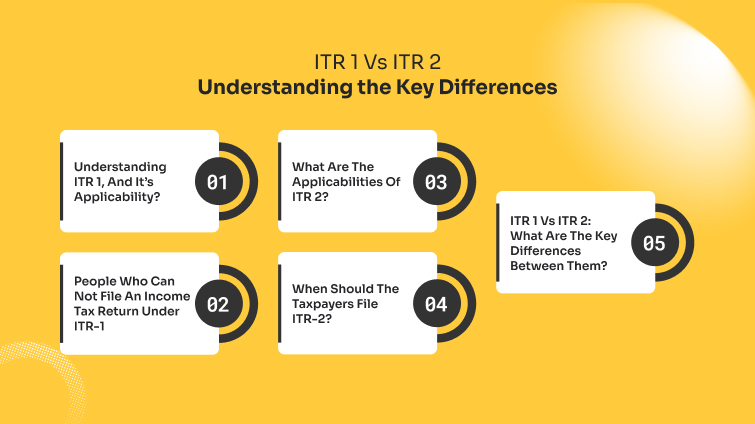
There are several differences between ITR-1 and ITR-2. Here are the key differences between the two platforms.
1. Understanding ITR 1, And It’s Applicability?
People also call Form ITR-1 “ITR-1 (SAHAJ)”. This ITR file works great for the salaried individuals.
This is suitable for the salaried individuals who have salary income, agricultural income, that does not exceed more than ₹me from other sources, more than 2 house properties, and long-term gains in terms of capital u/s 112A that does not exceed ₹ 1.25 Lakhs.
Hence, the taxpayer’s total income should not exceed ₹ 50 Lakhs in a financial year.
There are certain conditions that earning individuals should consider before filing ITR-1.
The source of Income of the individual should be
- Pension or salary,
- Two house properties,
- Income from agriculture that does not exceed ₹ 5000
- LTCG u/s 112A should not surpass Rs. 1.25 lakh with no losses that get carried forward,
- The other sources should not include topics such as horse racing, lotteries, gambling, and similar activities.
Furthermore, the taxpayer should have no foreign income and no properties outside the country.
2. People Who Can Not File An Income Tax Return Under ITR-1
Taxpayers cannot file ITR-1 in certain cases. Hence, here are certain situations in which the Taxpayers cannot file ITR-1.
- A taxpayer cannot file ITR-1 when their total income exceeds ₹50 lakhs.
- The individual should not earn their income from more than just one property.
- In addition, the earning individual should not earn through a profession or a business.
- The taxpayer should not earn income from sources such as the lottery, horse racing, gambling, or other sources.
- When the person incurs losses from income from other sources, he or she should not file an Income Tax Return under ITR-1.
- The earning individual should not earn more than ₹5000 through agricultural income.
- Furthermore, the individual should not serve as a director of a company.
- The earning individual should not be subject to deferred income tax on ESOP contributions from an eligible startup employer.
3. What Are The Applicabilities Of ITR 2?
This form is suitable for individuals without any professional income or businesses. ITR-2 is also great for HUFs (Hindu Undivided Families).
Hence, this is a legal entity under the Indian Tax Law (Income Tax Act, 1961). Families of different income groups, including the sikhs and Jains, manage and maintain all their properties.
This allows them to save tax on the joint properties. Thus, the property becomes a separate taxable entity that has its own PAN card and other exemptions.
Individuals and HUFs with salaried income, multiple properties, and different types of capital gains, foreign earnings can file a tax return under ITR-2.
In addition, taxpayers holding unlisted shares and people with agricultural earnings exceeding ₹5000 can also file ITR-2.
Furthermore, taxpayers with a total annual income exceeding ₹ 50 lakh can also file ITR-2.
Hence, ITR-2 covers a much larger sphere of income sources than ITR-1. Moreover, the form applies to Hindu Undivided Families(HUFs) and NRIs.
4. When Should The Taxpayers File ITR-2?
Individuals or HUFs cannot file ITR-2 under certain circumstances. Moreover, these circumstances are as follows:
Taxpayers, including individuals and HUFs, who earn income from business or other professions cannot file ITR-2.
Furthermore, the companies, firms, and trusts do not have the eligibility to file ITR1 or ITR2.
5. ITR 1 Vs ITR 2: What Are The Key Differences Between Them?
| Categories | ITR-1 | ITR-2 |
| Tot Income | Within ₹ 50 Lakh | Above ₹ 50 Lakh |
| Type Of Application | Individual Resident | Individuals (Resident or Non-Residents) HUFs |
| Capital Income Gains | Under section 112A, which does not exceed Rs 1.25 lakh, and does not have any carry forward or brought forward of losses under the head. | All types of Capital Gains as well as losses. |
| Other sources of income | Excludes various activities, including gambling, racing, lotteries, and others. | Includes all sources of income, including lotteries, horse racing, gambling, card games, and others. |
| Agricultural Income | Within it ₹ 5000 | Above ₹ 5000 |
| Income from other properties | Up to 2 houses | More than 2 houses |
Things To Remember Before Filing Income Tax Return: ITR 1 Vs ITR 2

You should always check that you have the correct file, then submit the Income Tax Returns. In addition, you should also collect all the proof of income.
Hence, you will be able to complete the entire process without facing any challenges.
Frequently Asked Questions
Here are the answers to some of the most commonly asked questions about ITR 1 vs ITR 2.
1. Do I Need To File ITR-1 Or ITR-2?
When the total income of a person exceeds ₹ 50 Lack of total income, then they can not use the ITR 1. Instead, they should use ITR-2.
On the other hand, people with ITR below ₹ 50 lakh can easily use ITR1. Furthermore, there are several other criteria, based on which HUFs and taxpayers can select between ITR forms.
2. Who Is Eligible For ITR 2?
Individuals and HUFs with income from salary, including multiple properties (houses and other residential properties), all types of capital gains, income from foreign sources, and others can easily file ITR-2.
Furthermore, taxpayers with income exceeding ₹ 5000 can also file ITR-2.
3. Which Is Better, ITR 1 Or ITR 2?
Both ITR1 and ITR2 have separate purposes. ITR-1 is also called SAHAJ. Hence, the purpose behind it is simplicity. Thus, it covers most types of normal income.
On the other hand, ITR 2 covers much more complex types of income, such as capital gains and income from multiple properties.
Additional Reading:
Share this article: