- Intro
- Mutual Consent Path
- Pre-Filing Requirements
- Drafting And Filing The Petition (First Motion)
- The “Cooling Off” Period
- Final Hearing And Decree (Second Motion)
- Contested Part
- Disagreement On The Divorce
- Disputed Terms And Settlements
- Procedural Stages
- Protection Of Financial Assets
- Securing And Organizing Documents
- Separating Finances
- Manage Debit And Spending
- Control Legal And Financial Experts
- Get Things Sorted During The Divorce Procedure!
How To Protect Financial Assets During a Divorce Procedure In India? [Complete Guide]

Intro
Divorce is a legal process of terminating a marriage. A divorce terminates all legal duties and responsibilities of a marriage and allows both of the partners to remarry.
Furthermore, in a divorce procedure, many disputes and disagreements can arise between the partners.
In this article, we will look at two types of divorce procedures, and we will see how a person can protect their financial assets during a divorce procedure.
In a divorce procedure, we get two paths. Keep reading to know about them and more.
Mutual Consent Path
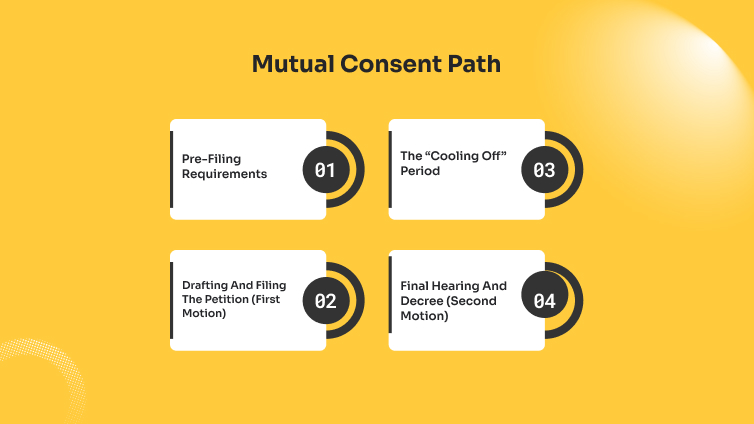
The mutual consent part of the divorce procedure is a no-fault legal process. Moreover, in the mutual consent part, both partners agree to separate peacefully.
Additionally, this process requires joint filing for at least one year before separation. The filing is generally about:
- Agreement on alimony
- Child custody
Furthermore, the divorce procedure involves a mandatory six-month waiting period before the final decree.
Pre-Filing Requirements
Both of the partners need to meet specific legal requisites before filing for a divorce. The legal requisites the partners need to meet are:
- Separation period: Firstly, in the separation period, both of the partners need to live separately for at least one year.
- Mutual agreement: Secondly, under the mutual agreement, both of the partners need to agree voluntarily to dissolve the marriage.
- Settlement terms: Finally, during a divorce filing, both of the partners need to agree on critical issues like child custody, alimony, and division of property.
Drafting And Filing The Petition (First Motion)
- Joint petition: Attorneys of both partners have to represent them and have to file a joint petition in the Family Court.
- Court appearances: Both of the partners have to appear before the judge to record their statements regarding their voluntary consent.
- Document verification: For document verification, both of the partners need to present certain documents. The required documents are marriage certificates, address proofs, joint photographs, income tax statements, and details of professions and income.
The “Cooling Off” Period
- Firstly, according to the law, a six-month period is required after the first motion statements are recorded.
- Secondly, the law gives the partners a final opportunity to reconsider and reconcile.
- Finally, in some cases, the court sometimes waives the waiting period when the separation becomes lengthy or reconciliation is not possible.
Final Hearing And Decree (Second Motion)
- Second motion: After the cooling-off period, both of the partners have to return to the court to reaffirm thier decision to divorce.
- Final judgment: If the consent satisfies the court and all types of settlement are fulfilled, the judge will grant the final divorce. With the final divorce, the marriage will be legally dissolved.
Contested Part
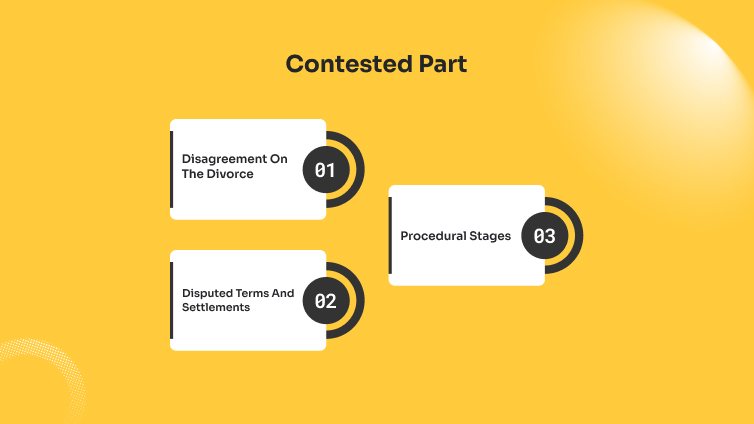
In the contested part of a divorce, one partner files for divorce, and the other partner disagrees with the divorce.
Moreover, in the contested part of divorce, one partner is often seen to disagree with the settlement terms.
In such cases, the court generally steps in to decide the unresolved issues.
The categories under which the contested aspects fall are:
Disagreement On The Divorce
When it comes to the concept of disagreement during divorce, there are two key things that can happen:
- Refusal to separate
- Proving fault
On the first part, this is how it generally occurs – one partner wants to end the marriage, and the other partner doesn’t.
During such cases, the petitioner (with the help of a lawyer) will have to provide the necessary reasons or grounds for filing the divorce. These can include:
- Adultery.
- Cruelty.
- Desertion.
- Unsoundness of mind.
Also, just in case you were wondering – it does not end there. Apart from providing reasons, the petitioner also needs to provide evidence supporting the allegations.
Disputed Terms And Settlements
If both of the partners agree on the divorce but cannot agree on settlements, then the divorce also becomes contested. The issues on which the partners might not agree can be:
- Child custody: In many cases, child custody becomes a major point of disagreement. In these the partners find it difficult to determine who will have the physical and legal custody of the child.
- Alimony: Secondly, in many divorce cases, the partners cannot agree on the amount of financial support one is going to receive from the other after separation.
- Property and asset division: Furthermore, the issue of dividing matrimonial properties, bank accounts, investments, and liabilities becomes a major issue of disagreement in many cases.
Procedural Stages
When a divorce case cannot be solved through mediation, the court guides the case through a formal process.
Furthermore, this process is sometimes lengthy, which can take 3 years to 5 years.
- Petition and notice: Firstly, one partner has to file a divorce petition, and then the court will send a notice to the other partner.
- Written statement: Secondly, the responding partner has to file a reply to defend themselves. Moreover, they can also counter the allegation with valid proof.
- Evidence and cross-examination: Thirdly, both sides have to present evidence. It can be witnesses or documents, and they will cross-examine each other.
- Final order: Finally, the judge will issue the final order. This final order can grant or deny the divorce.
Protection Of Financial Assets
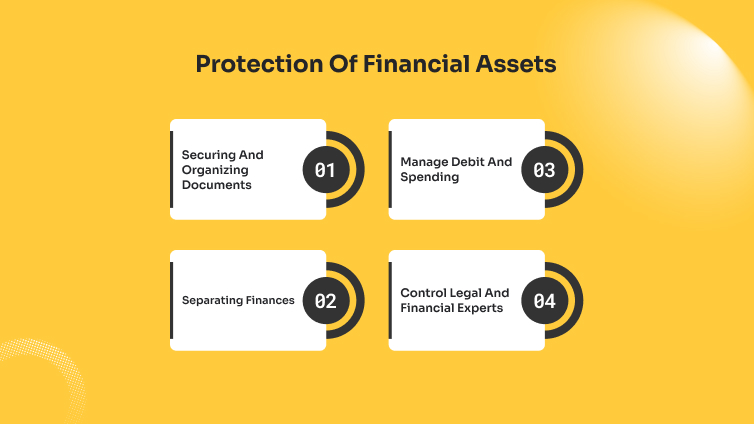
Protection of financial assets during a divorce procedure requires immediate organization and legal strategy.
You will need to gather all financial documents and follow some necessary steps:
- Tax returns
- Bank statements
- Asset deeds
- Separate joint accounts
Furthermore, you will need to:
- Establish independent funds
- Track household expenses
- Consult an experienced family law attorney
Moreover, proper navigation of the financial complexities of divorce requires proactive, localized planning to safeguard your wealth and interests.
Securing And Organizing Documents
- Gather evidence: Firstly, you have to gather bank statements, tax returns, pay stubs, loan balances, and investment portfolios which covers last 3 years to 5 years.
- Digitize and print: Secondly, you should keep physical and digital copies in a secure private location so that no one can hide or destroy them.
- Document assets: Finally, and most importantly, you should clearly distinguish between self-acquired properties that were owned before marriage or inherited. Furthermore, you should also distinguish marital or jointly acquired properties.
Separating Finances
- Establish independent accounts: You should open a personal savings account in your name only. Additionally, you should route all of your personal income into that account.
- Assess joint accounts: Furthermore, you need to close or freeze joint bank accounts and credit cards, which will prevent any unauthorized spending or draining of funds. Moreover, you should keep in mind to do this in consultation with your legal counsel.
- Update beneficiary and wills: Moreover, you should change the nominee on life insurance policies, mutual funds, provident fund, and demat accounts as soon as possible. Additionally, you have to revise your will to remove your partner as a beneficiary.
Manage Debit And Spending
- Pause large purchases: You should avoid making major financial investments like buying a car or home before the divorce is finalized. This can violate legal constrains or trigger asset division disputes.
- Control expenses: Moreover, you have to track and document all living and personal expenses so that you can present a clear record to the court. Additionally, you should try to pay off shared debts where it is possible so that you can avoid joint credit score damage.
Control Legal And Financial Experts
- Hire a family law attorney: You should hire a local, experienced lawyer to handle court proceedings, temporary restraining orders to freeze marital assets, and the formal drafting of settlements.
- Consult a financial advisor: Furthermore, you should work with a certified financial planner or chartered accountant to understand tax implications and long-term settlement impacts.
Get Things Sorted During The Divorce Procedure!
In conclusion, the very task of protecting financial assets during divorce procedures is very challenging. And that is the reason why you should try to move strategically.
For instance, experts often suggest that getting the help of an experienced lawyer specializing in family law is important. They have experience in such matters. As a result, they will be able to help you protect your financial assets.
Additionally, you can follow the steps that I have mentioned above in this blog. And hopefully, you get the closure you need!
Share this article: